

Being a back end developer is definitely a trendy occupation nowadays. Whether you’re looking to hire a back end developer, considering a partnership with a bespoke software development company, or wondering if you’re being compensated fairly, this article aims to help you understand the average salary ranges for the position internationally.
From entry-level positions to seasoned veterans, we’ll have a look at trends, disparities, and emerging patterns in remuneration. By examining salary data from various regions, we aim to provide valuable insights for both aspiring back end developers and hiring managers seeking to understand the market dynamics driving compensation in the rapidly evolving tech industry.
Back end developers – a profession in increasing demand
Let’s begin by addressing the elephant in the room: AI. With all the uproar about AI, you might be wondering if going into a career as a back end developer is still worth it, but rest assured - the demand for skilled developers has only increased. In fact, all generative AI has done is enhance the experience of programming by speeding up the completion of menial and administrative tasks, allowing programmers to focus on the more important and interesting parts of coding.
As more and more industries rely on digital infrastructure, back end developers are becoming even more sought after. Of course, you’ve probably heard a lot about how well-paid developers are, but what are the actual numbers?
Let’s have a look at the average salary ranges for the US, UK, Germany, Switzerland, Eastern Europe, and India, so you know what to expect when you’re ready to look for work or if you’re looking to relocate.
Do back end developers make good money?
Back end developers often command lucrative salaries due to their specialized skill set and high demand in the job market. Their expertise in designing, implementing, and maintaining server-side logic and databases is essential for the functioning of web applications and digital platforms. Salaries for back end developers vary based on factors such as experience, location, industry, and company size.
All that said, in many cases, back end developers enjoy above-average compensation compared to other IT professionals due to the critical role they play in powering digital infrastructures. According to various industry reports and salary surveys, back end developers can earn salaries ranging from mid-five figures to six figures annually, depending on their level of experience and the region in which they work.
Additionally, with the increasing reliance on digital technologies across sectors like e-commerce, finance, healthcare, and more, the demand for skilled back end developers is expected to continue rising, further driving their earning potential.
As with most careers, skill and luck are two major factors. It can be difficult to land your first gig as a junior developer due to intense competition, so luck can be a major influence in getting a “good” offer early on. However, as you advance in your career, your skills and experience quickly become the defining factor of your success. This is why it’s crucial to focus on learning and improving.
Is a back end developer a high paying job?
In the rapidly evolving tech landscape, backend developers are instrumental in building and sustaining the functionality of websites and applications, leading to competitive backend developer salaries.
Several key skills significantly impact the salaries of backend web developers, shaping their earning potential within the industry. Proficiency in specific programming languages like Python often correlates with higher salaries. Additionally, job roles may differentiate between frontend and backend developers, with full-stack developers (developers who work both on the front and back end) typically commanding higher averages.
Roles emphasizing data-driven skills, like those combining elements of back end developers and data scientists, also tend to offer higher salaries due to their advanced ability to utilize information. Lastly, experience levels also significantly influence earning potential.
Back end developers – outsource or direct hire?
As the remote work job market continues to grow, location is becoming less of a factor when it comes to how much back end developers earn. This means that developers are often competing not just with local candidates, but also those living in different countries.
When considering whether to outsource back end developers or hire them directly, several factors come into play. Outsourcing can offer cost savings, as you're not responsible for employee benefits, office space, or equipment. It also gives you access to a global talent pool, allowing you to find specialized skills that may be scarce locally. Outsourcing also makes practical sense for short-term projects or when specific expertise is needed only temporarily.
However, direct hiring has its own benefits, such as better control over the development process, easier communication, and long-term commitment from the team. Every back end developer will take time to familiarize themselves with a client and reach their full potential, and direct hiring enables this. Having an in-house team also facilitates collaboration and ensures alignment with the company's goals and values.
Ultimately, the decision between outsourcing and direct hiring comes down to the project scope, budget, timeline, and desired level of control. Companies should carefully evaluate their specific needs and consider the pros and cons of each approach before making a decision.
Average back end developer salary range in the United Kingdom

In the UK, as it is everywhere else, back end developer salaries vary based on experience and seniority levels. Your location and industry also play a significant role. But there are some general ranges you can use to get a baseline idea of what to expect.
Junior back end developers typically earn between £35,000 to £55,000 annually, while mid-level developers command salaries ranging from £55,000 to £75,000. Senior back end developers with extensive experience may earn between £75,000 to £100,000 per year.
Moving up the hierarchy, lead, staff, principal, or group managers can expect salaries between £100,000 to £120,000 annually. Principal, distinguished, or director-level positions offer higher compensation, ranging from £100,000 to £150,000. The highest earners in the field, including fellows or VPs, may receive salaries between £150,000 to £175,000.
If you’re earning below these numbers for your respective level of expertise, you might be getting underpaid. That said, with luck and good negotiation skills you could secure an above market salary as well. Your chances of securing stock or better bonuses are better at more prestigious companies, such as Google, Stripe, Meta, and the like. Salaries in cities like London are also naturally higher.
Average back end developer salary range in the USA
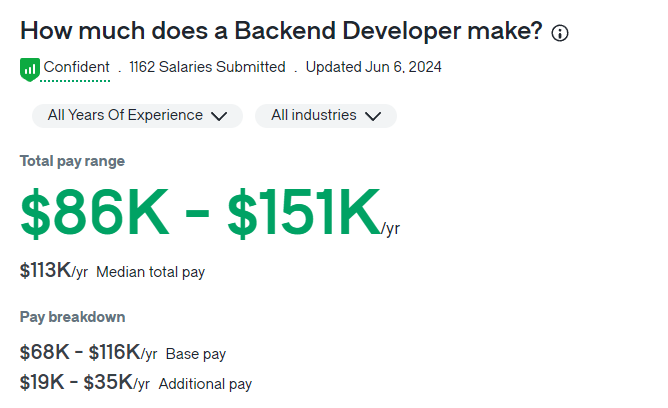
In the United States, back end developer salaries vary depending on experience levels. According to SalaryExpert data, junior back end engineer positions typically start at around $71,000 annually. The mean average salary for back end engineer roles in the USA is $101,500, with cash bonuses averaging around $4,500. Senior back end engineers can earn up to approximately $126,000 annually, although individual specialist roles may offer higher pay.
Translating these figures into monthly salaries, junior back end engineers can expect to earn around $5,900, while the average monthly salary for back end engineers is approximately $8,460. Senior positions can yield monthly earnings exceeding $10,500.
Specialization is key to getting paid more, but that comes with its own caveats, such as potentially having to move for job offers. You might have fewer options in terms of employers if you’re highly specialized, but they’ll be willing to pay you quite a bit more for your skills.
Average back end developer salary range in Germany
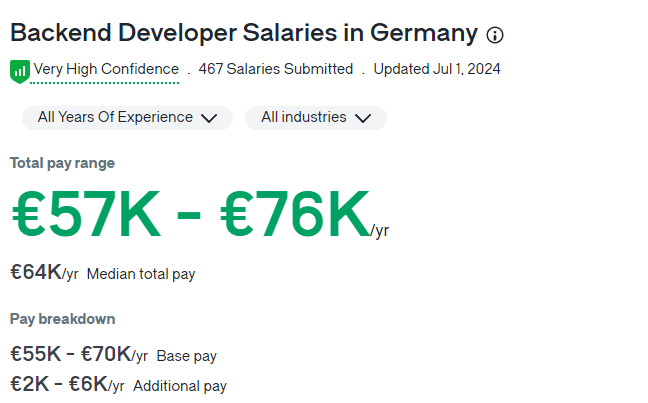
On average, a back end developer can expect to earn around €6300 per month in Germany. Junior positions typically start around the €4450 monthly salary mark, with seniors earning up to €7875 per month, according to SalaryExpert data.
Glassdoor gives us a slightly different picture based on 174 survey entries. The website quotes junior back end devs’ earnings as hovering around €43k per year (approximately €3500 a month) and mid-level back end developers getting an average yearly salary of €56k (close to €4600 per month). Senior back end developers can earn up to around €72,000 on average, or €6k monthly, with some specialist roles potentially paying more.
However, Glassdoor has a separate page for the title of back end engineer that quotes slightly higher ranges. Junior back end engineer positions typically start at around €46,000. Mid-level back end engineers earn an average salary of €60,000 and senior roles can earn up to approximately €75,000 on average.
Average back end developer salary range in Switzerland
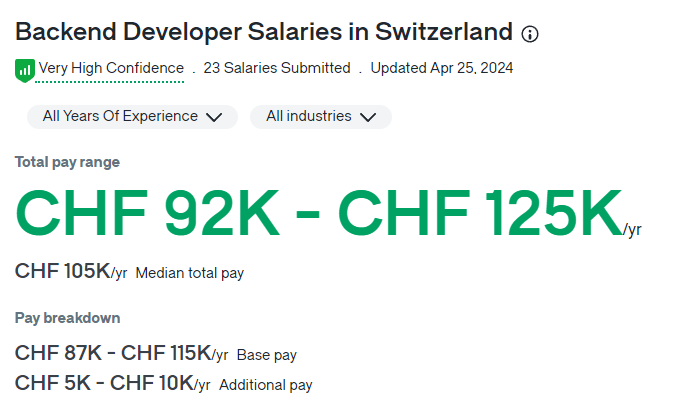
Backend Developers in Switzerland typically earn around 105,000 CHF per year, with most salaries ranging between 82,500 CHF and 125,000 CHF. If your salary is below 82,500 CHF, it may be time to discuss a raise with your employer or consider looking for an offer at a different company.
The salary back end developers are able to negotiate will depend greatly on their location and the specific industry. Naturally, cities such as Zurich offer higher salaries but are also more expensive to live in. Some of the best paid industries include banking, insurance, and specialized manufacturing, and a developer with specific experience in those will be sought-after.
Keep in mind that Switzerland is quite the cultural melting spot and very attractive to expats, making the job market extremely competitive. Non-EU residents will have a harder time getting hired as employers will have to prove none of the other EU applicants could do the job as well, which can be a cumbersome process.
Average back end developer salary range in Eastern Europe
Eastern Europe has become a popular IT outsourcing destination for high-salary economies like Germany and the UK. Lower average salaries, taxes, and overhead costs such as office space contribute to significant savings compared to the West.
Remote work becoming normalized, combined with the compatible time zones, easy travel logistics, and the high quality of IT specialists with reasonable-to-good English proficiency, make Eastern Europe extremely attractive to companies looking to outsource some of their work. As an added perk, some Eastern European countries, including Poland, Romania, and Bulgaria, are EU members, which is advantageous for projects requiring GDPR compliance.
However, Eastern Europe is not a homogenous region. Each country has its own market dynamics and economies. A common factor is the relatively high number of software developers per capita, often attributed to the region's strong tradition in mathematics.
Eastern European developers are in high demand, leading to significant salary inflation, but the high rates of inflation experienced globally have affected this sector as well. Hiring back end developers in Eastern Europe still generally offers significant savings compared to hiring similar profiles in Western Europe.
Let's examine the salary data specifically for back end developers in Bulgaria and Ukraine.
Average back end developer salary in Bulgaria
While not as well known for IT outsourcing as many other countries on this list, Bulgaria has been building a powerful local tech ecosystem for decades. As a result, it has a surprisingly robust ecosystem of IT outsourcing firms and talented freelancers alike.
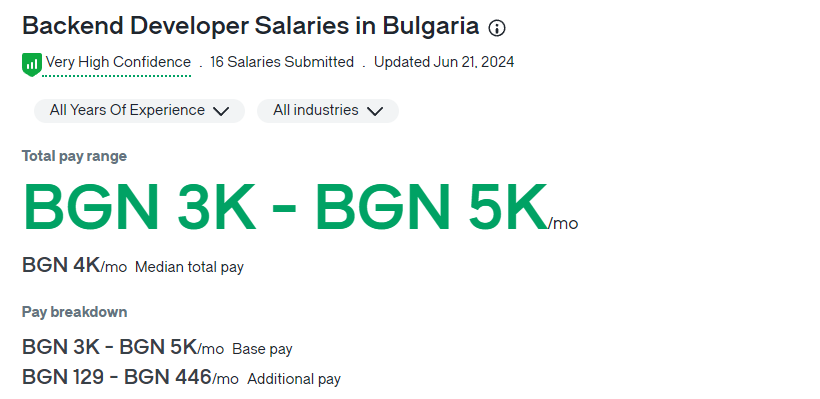
According to Glassdoor data, the average annual salary for a back end developer in Bulgaria ranges from $66k to $85k. The median salary is estimated to be around $75k a year or BGN136k in the local currency. There is a lot of variation in compensation depending on the level of experience, however. Devs in the very beginning of their career can make less than $13k a year, while the top 10% of earners earn upwards of $50k.
Most salaries in Bulgaria are quoted in terms of monthly post-tax take home pay in the local currency. So, junior back end devs can start at a monthly salary of BGN2570 for C/C++/embedded developers or negotiate as much as BGN3480 monthly as a Go developer.
Mid-level positions typically earn about BGN 4670 per month for those working with Python, while Go developers once again can expect significantly more with a salary of BGN5440 a month. Java is the best paid language for senior developers, earning them an average monthly salary of BGN8610. C/C++/embedded developers at senior positions typically earn about BGN6700 per month. This information is based on the data provided by 7 HR agencies operating in the country.
Average back end developer salary range in Ukraine
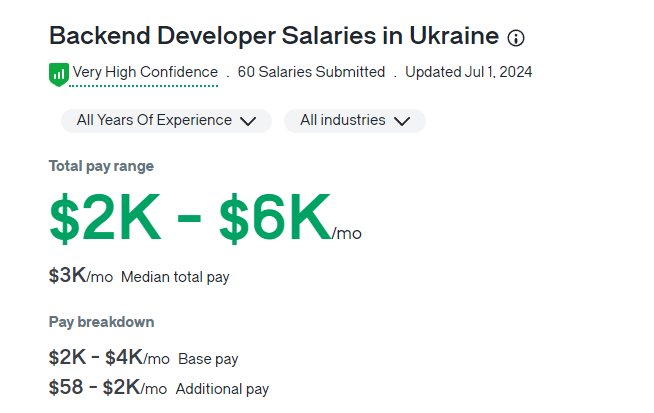
Like everything else in Ukraine, the IT job market has been significantly impacted by the ongoing war. Many IT specialists have had to relocate to other countries for their safety, reducing the pool of available talent. Some companies have also paused hiring in Ukraine for the moment, due to the instability of the region. The decrease in job openings has therefore made a lot of IT specialists more flexible in their salary expectations.
All of these factors mean there’s a great potential for cost savings for Western companies looking to outsource back end developer positions to Ukraine. Foreign companies would also be well-positioned to offer competitive salaries and therefore attract some of the top talent available.
Back-end development has always been in high demand, especially with the rise of mobile apps, which has increased the need for robust back-end infrastructure. There’s a lot of variation in the skillset of what would be considered a back end developer or engineer, and salaries reflect these. Average salaries for backend developers in Ukraine by programming language are as follows:
- C#: Junior $800-1500, Middle $1500-3500, Senior $4000-6000
- Java: Junior $800-1500, Middle $1500-3500, Senior $5000-7000
- Python: Junior $800-1500, Middle $1500-3500, Senior $4000-6000
- PHP: Junior $800-1500, Middle $1500-3500, Senior $3500-5500
- Golang: Junior $800-1500, Middle $1500-3500, Senior $5000-8000
Of course, salaries vary as per the location as with every other country. The five most popular cities for outsourcing right now are Kyiv, Kharkiv, Lviv, Dnipro, and Odessa.
Average back end developer salary range in India
With its large population and corresponding large talent pool, as well as the low labor costs, India is an extremely attractive destination for outsourcing IT needs. In fact, the country has been cultivating itself as a location for IT outsourcing for decades.
However, foreign employers still face challenges here, mainly the timezone and the differences in communication styles. That said, India produces some very strong developers that have a lot to offer.
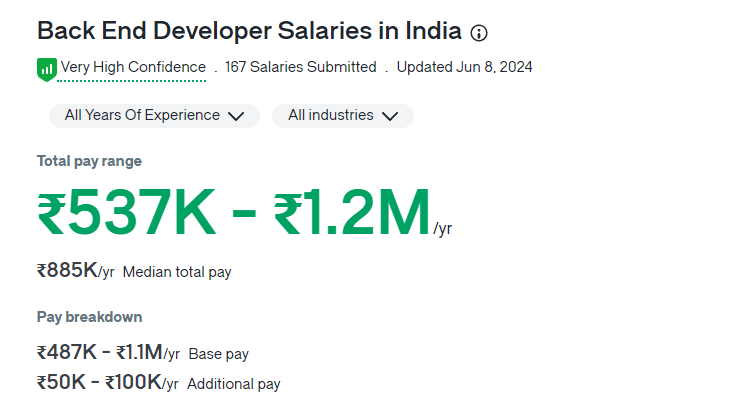
Back end developers in India make an average of $8,434 per year with additional cash compensation circa $602, ranging from $241 to $1,205. These salary estimates are based on 2083 salaries submitted anonymously to Glassdoor by back end developer employees based in India.
But how do experience and expertise factor in these numbers? Back end devs who specialize in Java seem to fetch some of the highest salaries in IT. There also seems to be less of a divide between front end and back end work, as most companies expect you to be fullstack.
The sheer size of the country can’t be ignored when it comes to discussing salaries, as there are big variations based on the city and region. Bigger cities offer developers higher salaries.
How to hire back end engineers
A back-end developer is a critical member of any development team, responsible for creating and maintaining the server, application, and database of a website using technologies such as Java, Python, and Go.
To better understand their role, it's useful to explore the different levels of back-end developers and their respective skills and responsibilities. Much like other developer roles, back end engineers are typically separated into junior, middle, and senior levels.
Levels of Back-End Developers
A junior back-end developer has 0-2 years of experience. They often serve as assistants but possess the fundamental knowledge to tackle common server and database issues. They are cost-effective for simpler projects but may require more time to complete tasks due to their learning curve.
With several years of experience, middle back-end developers are more adept at analyzing business requirements and proposing effective solutions. They have a solid track record of creating and maintaining servers, applications, and databases, making them a reliable choice for more complex projects.
A senior back-end developer brings over five years of experience and extensive expertise. They can independently manage development workflows and provide leadership within the team. Their proficiency makes them highly sought after, especially by startups needing robust and scalable solutions.
Essential Skills for Back End Developers
Back-end developers must be proficient in at least one server-side language, such as Java, Python, Go, Ruby, PHP, R, or Node.js. These languages are crucial for building the server, application, and database components of a website and ensuring seamless communication between them.
Because of how varied the work they do can be, what makes a back end developer ideal for your project will depend on what you need them to do. That said, a proficient back end developer would be well-versed in database technologies, server administration, and APIs.
Responsibilities of a Back End Developer
A back-end developer's primary responsibility is to write clean, well-documented code for the server-side of web applications. They ensure the code is optimized, secure, and thoroughly tested. Collaboration is key, as back end developers often work closely with front end developers and project managers to align on project goals and progress.
Few back end developers will work alone, so it’s important they are able to work effectively with their teammates within the team’s chosen framework. That’s why it’s important to consider such factors alongside basic technical skill sets.
Outsourcing Your Software Development
Hiring in-house back end developer teams might not be the right fit for everyone. Outsourcing software development has many benefits, such as cost savings, access to a broader talent pool, and flexibility. Outsourcing allows companies to tap into specialized expertise that might not be available locally or that they might need only for one specific project. This approach also provides scalability, enabling businesses to adjust team size based on project demands. The right software development partner will free up time, focus, and resources to other parts of your business, allowing you to reach your highest potential.