By now, agile software development has become the new normal and around 97% of organisations report using agile development methods at least to some extent, Star Agile reports. But it’s when agile unites with nearshore software development to become agile nearshoring that your company can fully benefit from this methodology. If you're currently evaluating how to overcome delivery delays, budget overruns, or quality issues with your existing software development process, this powerful approach combines proximity advantages with iterative methodologies to deliver real business results.
Agile nearshoring integrates the best practices of agile software development with the geographical benefits of nearshore software development to create an optimised delivery model that drives results. In this article, we will walk you through the specifics of implementing agile nearshoring for your next software development project or as part of your broader IT strategy.
What is agile nearshoring?
Agile nearshoring combines two powerful approaches - agile software development methodologies and strategic geographic proximity through nearshore software development - to create an optimised software delivery model. This hybrid approach involves partnering with development teams in neighboring countries while implementing iterative development practices, regular feedback cycles, and cross-functional collaboration.
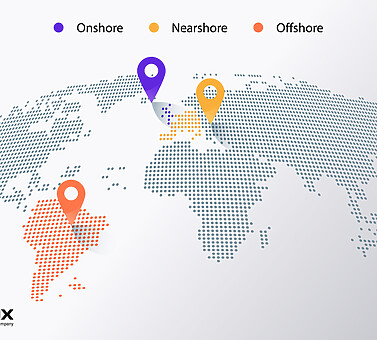
Unlike traditional outsourcing models that often struggle with communication barriers and delivery alignment, agile nearshoring creates a synchronized working relationship through overlapping time zones (typically 80-100% business hour overlap), cultural compatibility, and geographical accessibility. For example, U.S. companies implementing agile nearshoring typically work with partners in Mexico, Colombia, or Argentina, while Europe-based companies often partner with nearshore software development teams in Bulgaria, Romania, or Ukraine.
When evaluating agile nearshoring providers, look for teams with verifiable agile software development credentials (such as Certified Scrum Masters or SAFe practitioners), demonstrated expertise in your technology stack, and established processes for maintaining transparency throughout the development lifecycle. The most effective partnerships feature dedicated teams rather than fractional resources, direct access to developers rather than multiple management layers, and flexible engagement models that can adapt as your project evolves.
Measurable benefits of implementing agile nearshoring
Companies that have successfully implemented agile nearshoring report several quantifiable advantages that directly impact business outcomes:
Accelerated Time-to-Value: Organisations implementing agile nearshoring typically experience 25-35% faster delivery cycles compared to traditional development approaches. This acceleration comes from combining daily synchronous collaboration during overlapping business hours with agile's iterative approach, allowing teams to identify and resolve issues without the delays inherent in asynchronous communication.
Optimised development costs: Compared to domestic development resources, agile nearshoring generally delivers 15-30% cost savings while still maintaining high quality standards. These savings come from lower labor costs in nearshore locations combined with reduced overhead expenses. Unlike offshore arrangements that often require additional management layers and extended timelines, agile nearshoring's efficiency helps contain total project costs.
Enhanced business agility: Organisations using agile nearshoring can respond to market changes or customer feedback 2-3 times faster than traditional development approaches. This responsiveness comes from combining agile's built-in flexibility with the ability to quickly realign priorities during daily synchronous communications.
Higher team сatisfaction and retention: Both client and nearshore team members report higher satisfaction and engagement when working in agile nearshoring arrangements. Clear visibility into project progress, regular feedback cycles, and collaborative problem-solving create a more rewarding work environment that reduces turnover and preserves institutional knowledge.
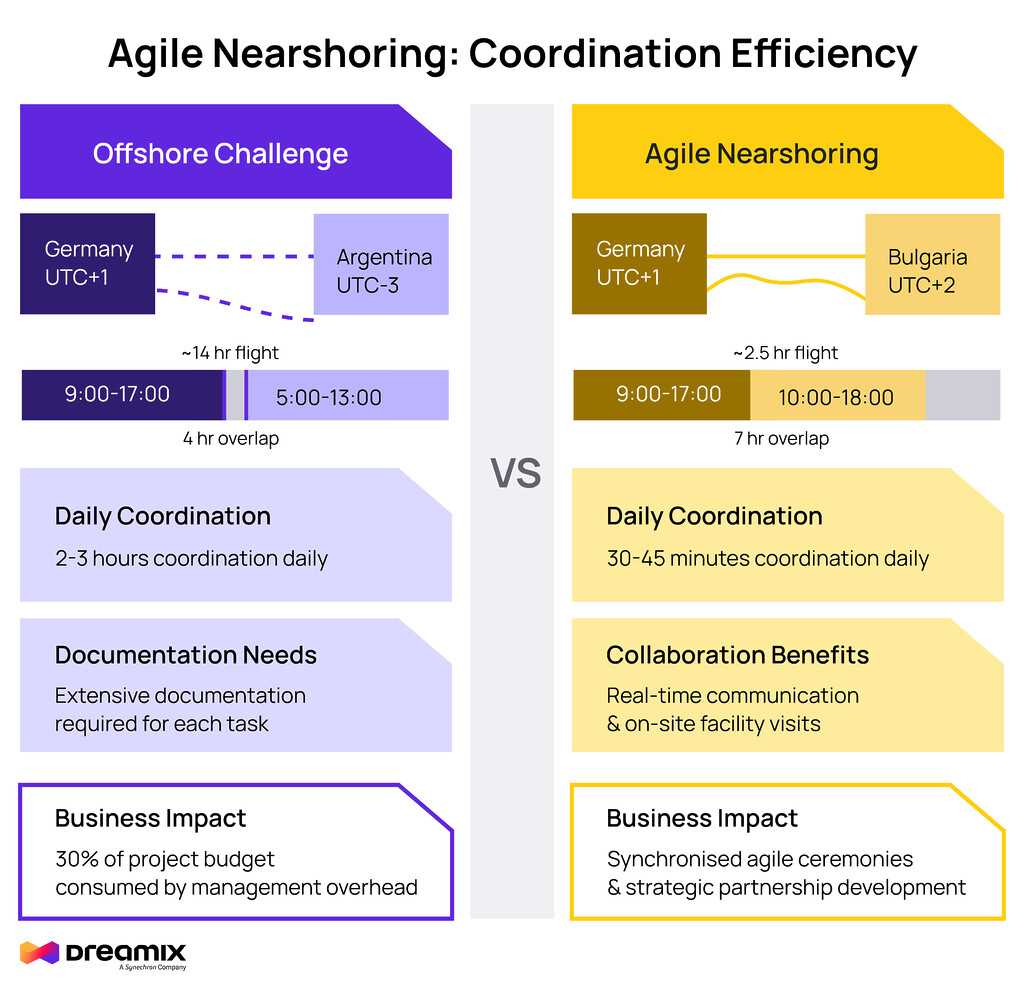
Reduced management overhead: Managers typically spend 20-40% less time on coordination activities with agile nearshoring compared to traditional offshore relationships. Time zone alignment eliminates the need for early morning or late evening calls, while cultural compatibility reduces miscommunication issues that require remediation.
The infographic below illustrates an example scenario of coordination comparison between offshore teams and agile nearshoring:
These benefits make agile nearshoring particularly attractive for organisations looking to optimise their development approach without compromising on speed, quality, or cost-effectiveness.
Key elements of agile software development in a nearshore context
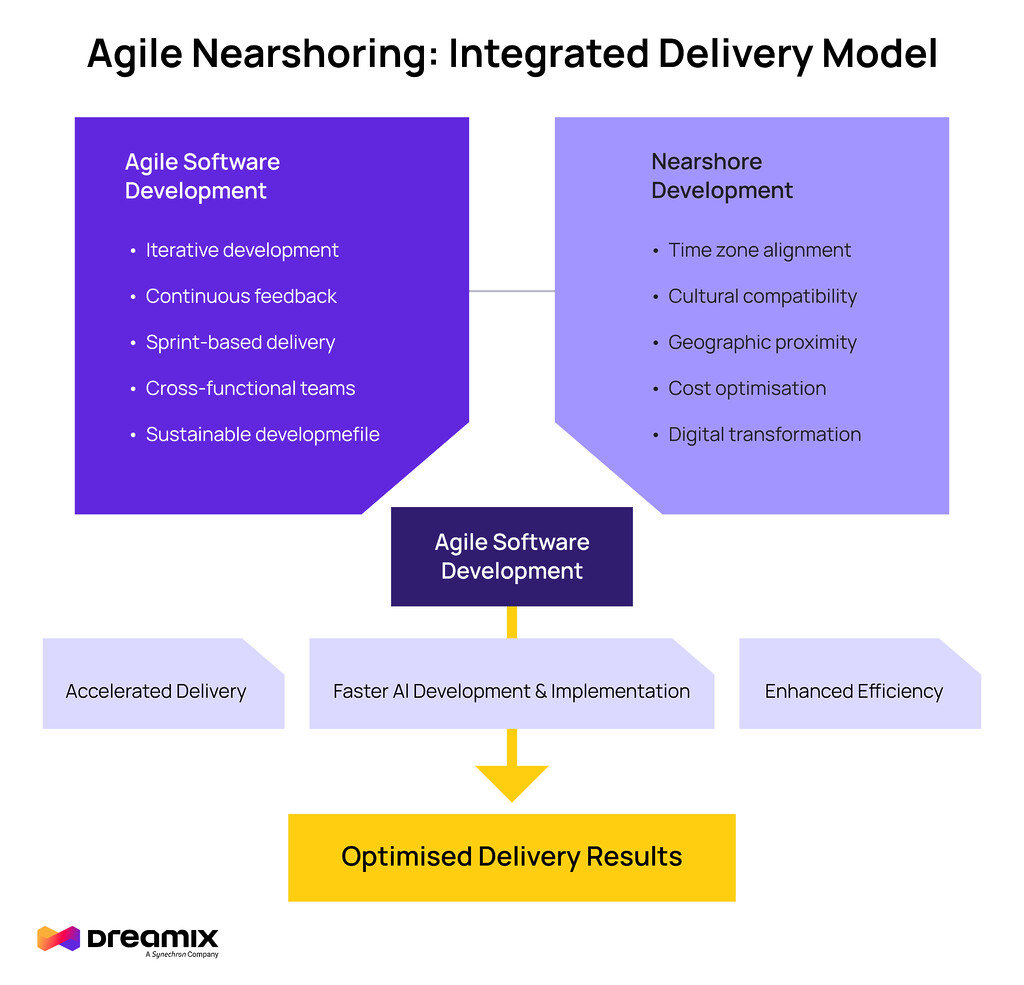
The agile nearshoring integrated delivery model illustrates how traditional agile software development principles effectively merge with nearshore capabilities to create a powerful software delivery strategy. On one side, core agile practices - including iterative development, continuous feedback, sprint-based delivery, cross-functional teams, and sustainable development - establish the methodological foundation.
These elements combine seamlessly with nearshore advantages of time zone alignment, cultural compatibility, geographic proximity, cost optimisation, and digital transformation expertise. This integration produces a comprehensive framework that delivers three key outcomes: accelerated delivery timelines, faster custom AI development, and enhanced overall efficiency. The visual representation clearly demonstrates how this synergistic approach ultimately leads to optimised delivery results, making it an appealing model for organisations seeking to leverage global talent while maintaining agile principles.
Agile team collaboration practices
Synchronised sprint cycles: Effective agile nearshoring relies on aligning sprint cycles across locations. With typical time zone overlaps of 6-8 hours, teams can conduct sprint planning, daily standups, reviews, and retrospectives during shared working hours, maintaining the rhythm critical to agile software development success.
Collaborative backlog refinement: Nearshore software development teams should actively participate in backlog refinement sessions, contributing technical insights while gaining deeper understanding of business context. This collaborative approach ensures that user stories are appropriately sized and technically feasible before entering sprints.
Cross-location pair programming: Regular pair programming sessions between onshore and nearshore developers strengthen technical alignment and knowledge sharing. Modern collaboration tools make this practice feasible across locations, accelerating team formation and reducing knowledge silos.
Transparent visual management: Shared digital Kanban boards, sprint backlogs, and burndown charts create visibility across locations. These visual management tools help maintain alignment on priorities and progress, supporting agile software development's emphasis on transparency.
Regular retrospectives: Continuous improvement lies at the heart of both agile software development and successful nearshore partnerships. Regular retrospectives help teams identify and address challenges specific to distributed collaboration, steadily improving their working practices.
Technical and organisational framework
Continuous Integration/Continuous Deployment: Implementing robust CI/CD pipelines becomes even more critical in agile nearshoring scenarios. Automated build, test, and deployment processes provide immediate feedback on code quality and integration issues, maintaining technical cohesion across distributed teams.
Dedicated scrum master role: Successful agile nearshoring often includes a dedicated Scrum Master who focuses on removing impediments, facilitating ceremonies, and ensuring smooth communication between onshore and nearshore team members. This role becomes particularly important when bridging different locations.
Blended team structure: Rather than creating separate onshore and nearshore teams, effective agile nearshoring often implements cross-location teams organized around product features or components. This structure promotes shared ownership and reduces "us vs. them" dynamics.
Pro tip from Dreamix: When choosing to go for nearshore agile software development, look for potential partners who have mastered operational excellence and lean software methodologies as these are proven success strategies.
By thoughtfully implementing these practices, organisations can effectively translate the benefits of agile software development to a nearshore context, creating high-performing distributed teams that deliver exceptional results.
Let's also go through the essential skills necessary for the successful agile implementation in a nearshoring context.
Essential skills for successful agile implementation
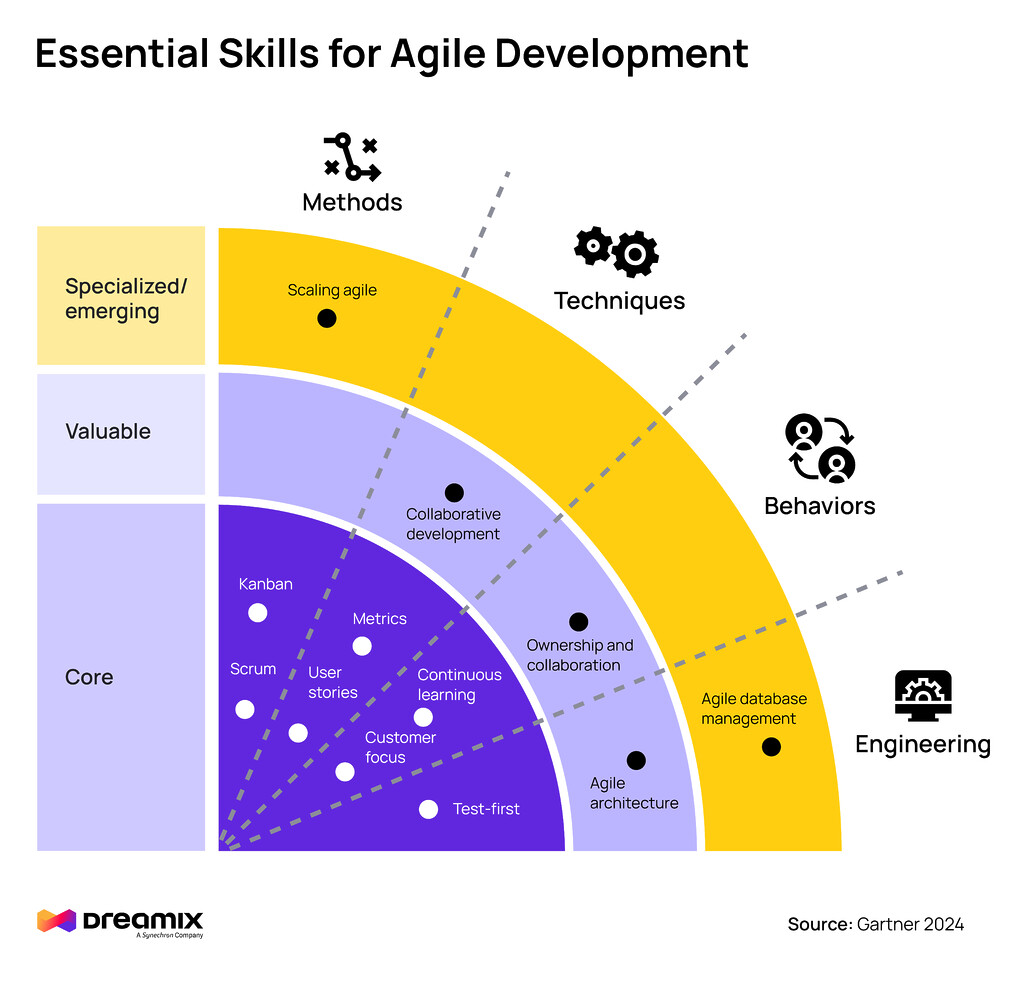
Mastering the agile development landscape requires a strategic approach to skills acquisition and implementation. As illustrated in the Gartner 2024 infographic below, successful agile methodologies are built on Scrum, Kanban, user stories and utilise customer focus, and test-first approaches. But beyond these fundamentals, valuable skills include collaborative development, ownership and collaboration, and agile architecture—all essential elements for teams to function cohesively.
For organisations looking to implement agile nearshoring, it's critical to ensure offshore partners possess not just these core competencies, but also specialised capabilities in scaling agile and agile database management. The multi-dimensional nature of agile expertise spans methods, techniques, behaviors, and engineering practices, creating a comprehensive framework that enables teams to adapt quickly to changing requirements while maintaining productivity. When selecting nearshore partners, evaluating their proficiency across this skills spectrum will significantly impact project success and ensure alignment with your development goals.
Agile nearshoring vs. traditional offshore software development
When evaluating development strategies, it's crucial to understand how agile nearshoring differs from traditional offshore models in several key dimensions:
Time zone alignment: Agile nearshoring typically provides 6-8 hours of overlapping business hours, enabling real-time collaboration during core working hours. Traditional offshore development often offers only 2-3 hours of overlap or requires one team to work outside standard hours, creating communication delays and team burnout.
Agile software development implementation: Nearshore teams can fully participate in agile ceremonies like daily standups, sprint plannings or retrospectives during normal business hours, unlike offshore teams. Offshore arrangements often struggle to implement true agile practices due to asynchronous communication patterns due to extensive time zone differences.
Cultural compatibility: Nearshore software development partners generally share more cultural alignment with client organisations. In the long run, this facilitates mutual understanding of business contexts and software project requirements. Traditional offshore partnerships often struggle with cultural barriers that require additional management oversight and explanation.
Travel requirements: Meeting face-to-face with a nearshore software development team typically involves flights of 2-5 hours and minimal jet lag, making quarterly in-person team visits practical and affordable. In the opposite scenario, offshore visits often require 12+ hour flights, significant jet lag recovery time, and higher travel expenses.
Total cost considerations: While offshore hourly rates may be 10-15% lower than nearshore rates, agile nearshoring often yields a more favorable total cost of ownership. The efficiency gains from synchronous collaboration, reduced rework, and accelerated time-to-market. Typically, this translates into better overall ROI.
Agile team integration: Nearshore teams can function as true extensions of internal teams, participating fully in product visioning, sprint planning, and day-to-day collaboration. On the other side, offshore teams often function as separate execution units.
These are some of the key comparison factors to take into account when choosing between offshoring vs nearshoring. But let’s also review what the true value proposition of agile software development can bring into the bigger picture to make agile nearshoring such an attractive option for B2B partnerships.
Key principles of agile software development
Agile software development represents a fundamental shift from traditional sequential development approaches. The Agile Manifesto emerged in 2001 when a gathering of 17 software developers collaborated to document a set of Agile values and principles. The Agile manifesto prioritises human factors over formal procedures and advocates for close working relationships between software development teams and their customers.
These foundational Agile tenets emphasise the importance of adaptability when project circumstances evolve and value functional software delivery above exhaustive documentation. Whether implemented in nearshore contexts or elsewhere, these core principles drive Agile's effectiveness:
Iterative development: Rather than attempting to deliver a complete product at the end of a long development cycle, agile breaks work into small increments called sprints (typically 1-4 weeks). Each sprint produces a potentially shippable product increment, allowing for early feedback and course correction.
Customer collaboration: Agile methodologies prioritise close collaboration with customers or their representatives throughout the development process. This ongoing engagement ensures that the evolving product meets actual user needs rather than just satisfying initial specifications.
Change response: Instead of resisting change as a disruption to plans, agile embraces change as an opportunity to improve the software product. Agile teams maintain flexibility to produce new insights, even late in the development process.
Working software as progress measure: Agile values working software over comprehensive documentation as the primary measure of progress. While documentation is still valued, the ability to demonstrate functioning software features provides clear evidence of project advancement.
Self-organised teams: Agile empowers development teams to make autonomous decisions about the way they'll accomplish their work rather than following rigid, top-down directives. This autonomy increases motivation and leverages the collective intelligence of the team.
Continuous improvement: Through regular retrospectives, Agile teams reflect on their processes and outcomes, identifying opportunities to improve their effectiveness. This commitment to ongoing refinement helps teams evolve their practices to match their specific context.
Face-to-face communication: According to Notta, in 2025 16% of companies are working fully remote, and we know that remote team engagement strategies are important. But even though digital tools play an important role, Agile prioritises direct communication whenever possible as the most efficient and effective method of conveying information within development teams.
In nearshore implementations, these principles remain foundational, though they may require adaptation to account for physical distance. For example, video conferencing might substitute for in-person meetings, when these are not possible.
Pro tip from Dreamix: Lots of companies overlook the importance of turning on the camera during business meetings. We’ve implemented a rule that every company employee should have their camera on during meetings, which boosts team spirit, engagement and collaboration.
This is how our Dreamix agile software development process looks like:
Our iterative agile process
1
Define your product
2
Build the team & architecture
3
Develop the code
4
Test and QA
5
Release
6
DevOps and Live Support
How to select the right agile nearshoring partner?
Both agile methodologies and nearshore software development are strategic business decisions but even more crucial is choosing the right agile nearshoring partner for your enterprise. Based on Dreamix’s 18+ years of business experience, here’s our list of evaluation criteria and practical selection steps:
1. Verify vendor’s agile maturity level
- Request evidence of formal agile certifications (Scrum, SAFe, etc.)
- Review examples of their sprint planning, retrospective, and demo processes
- Assess their experience with agile tools (JIRA, Azure DevOps, etc.)
- Interview potential Scrum Masters to evaluate their facilitation approach
2. Evaluate Technical Competence
- Review their portfolio of completed projects in your technology stack
- Conduct technical interviews with potential team members
- Request code samples and architecture documentation from previous projects
- Assess their approach to quality assurance and test automation
3. Assess Communication Capabilities
- Evaluate the English proficiency of all team members, not just team leads or managers
- Test communication tools and processes during the evaluation phase
- Confirm availability during your company’s main business hours
- Determine official protocols for escalation and problem resolution
4. Review references and case studies
- Speak directly with current clients in situations similar to yours
- Request metrics from comparable projects (e.g. velocity, defect rates, etc.)
- Evaluate how they handled challenges and scope changes
- Assess client retention rates and average engagement duration
5. Understand team composition and continuity
- Confirm you'll have dedicated resources rather than shared team members
- Review their retention strategies and historical turnover rates
- Understand their backup and knowledge transfer processes
- Verify team scalability if your needs grow
6. Examine contract terms and flexibility
- Avoid long-term commitments before proving compatibility
- Ensure contracts include clear performance metrics and SLAs
- Verify intellectual property protection provisions
- Confirm flexibility to adjust team size based on changing needs
7. Conduct a pilot project
- Start with a defined, contained scope to test the relationship
- Evaluate not just the final deliverable but the entire process
- Assess how they handle feedback and course corrections
- Measure actual performance against initial estimates
By thoroughly evaluating potential partners using these criteria, you can significantly increase the likelihood of a successful agile nearshoring implementation that delivers the expected benefits to your organisation.
We’d love to hear about your software project and help you meet your business goals as soon as possible.
FAQ:
What is the difference between agile nearshoring and traditional offshore outsourcing?
Agile nearshoring differs from traditional offshore outsourcing in several critical ways. Whilst offshore outsourcing typically involves partners in distant time zones (often 8+ hours difference), agile nearshoring prioritises geographical proximity with partners in similar or adjacent time zones. This proximity enables synchronous collaboration during standard business hours, which is essential for implementing proper agile software development practices. Additionally, nearshore partners often share greater cultural alignment and communication patterns, reducing misunderstandings and facilitating more effective collaboration than traditional offshore arrangements.
How much can my organisation save through agile nearshoring compared to in-house development?
Most organisations implementing agile nearshoring report cost savings of 15-30% compared to maintaining fully in-house development teams. However, the actual savings depend on several factors, including your current domestic costs, the specific nearshore location selected, the complexity of your projects, and the efficiency of your implementation. It's important to note that agile nearshoring aims to optimise the balance between cost, quality, and speed—not simply to minimise hourly rates. The greatest financial benefits often come from accelerated time-to-market and improved product quality rather than from reduced hourly rates alone.
Which countries are best for nearshore software development partnerships with UK companies?
For UK-based organisations, several European regions offer excellent nearshore software development options. Central and Eastern European countries - Bulgaria, Romania, Poland, and the Czech Republic in particular - provide strong technical talent pools with significant cost advantages compared to UK rates. These countries typically share compatible business hours with the UK (0-2 hour time difference), strong English proficiency, and EU or close-to-EU regulatory frameworks.
Which countries are best for nearshoring partnerships with companies from the DACH region?
The same goes if your company is based in the DACH region - most Central and Eastern European countries will have overlapping work hours with you as they’re in the same time zone or +1.
How do we manage data protection and intellectual property in agile nearshoring arrangements?
For UK and EU companies, prioritise partners in countries with GDPR compliance or comparable data protection regulations. Your agreements should include detailed IP assignment clauses ensuring all created intellectual property transfers to your organisation. Implement technical measures such as secure development environments, restricted access controls, and encryption of sensitive data. For highly regulated industries, consider implementing a hybrid model where particularly sensitive components remain with your in-house team while leveraging agile nearshoring for other aspects of development.
How long does it typically take to establish a productive agile nearshoring relationship?
Establishing a fully productive agile nearshoring relationship typically requires 3-6 months, though basic operations can begin much sooner. The first 4-8 weeks generally focus on team formation, alignment on processes, and knowledge transfer. Productivity usually reaches about 60-70% of optimal levels during months 2-3 as teams establish working patterns and build relationships. By months 4-6, most partnerships achieve 85-90% of their potential productivity, with full optimisation continuing to develop over the first year. Factors influencing this timeline include the complexity of your technical environment, clarity of your existing processes, and experience of both parties with distributed agile software development methodologies.
What agile ceremonies need adaptation for nearshore software development teams?
Several agile ceremonies require thoughtful adaptation for nearshore contexts. Daily standups should be scheduled during overlapping business hours, typically focusing on critical blockers and coordination points rather than comprehensive status updates. Sprint planning may need extension to accommodate deeper discussion across locations, often benefiting from pre-planning sessions to identify areas requiring clarification. Retrospectives should explicitly address cross-location collaboration challenges, with special attention to communication patterns and knowledge sharing. Sprint reviews benefit from structured demonstration formats ensuring remote participants can fully engage. Some organisations also implement additional ceremonies such as weekly technical alignment sessions to maintain architectural coherence across locations.
Can agile nearshoring work for highly regulated industries like aviation or healthcare?
Yes, agile nearshoring can work effectively for highly regulated industries with appropriate adaptations. The key is implementing a compliance-aware approach that addresses regulatory requirements from the outset. This often includes developing detailed data handling protocols; implementing role-based access controls; establishing enhanced security measures for sensitive information; conducting regular compliance training for all team members; and creating comprehensive audit trails of development activities. Many organisations in regulated sectors implement a hybrid model where certain components with the highest regulatory sensitivity remain with the in-house team while leveraging nearshore resources for other aspects of development. Select nearshore partners with demonstrated experience in your regulatory environment and appropriate certifications (ISO 27001, SOC 2, etc.).