The software development life cycle (SDLC) is changing faster than at any point since the Agile era. In early 2023, fewer than 10% of enterprise software engineers used AI code assistants, and successful delivery relied on engineers doing nearly all the work by hand.
In 2026, just over three years later, AI coding agents work across the whole lifecycle, from planning to writing and reviewing code: a shift from SDLC to ADLC, or an AI-led software development lifecycle. In fact, Gartner predicts that by 2027, more than 65% of engineering teams using agentic coding will treat the IDE as optional, moving control and validation to automated platforms. And as far as business value is concerned, McKinsey found that the top fifth of software organisations already see 16 to 30% gains in productivity and time to market, plus 31 to 45% better software quality. Companies that adapt early turn that speed into a competitive edge.
At Dreamix, we’ve also embraced the new way of building software products: AI-native software development. In those projects that we can put AI tools into practice, we discover that the newly forming ADLC does in fact speed up many aspects of software delivery. But agentic AI tools, however capable, fast and innovative still make mistakes, hallucinate and carry biases. Senior engineers who can spot a flawed output, question an assumption and actually own the final decision keep that speed safe for the business.
In this article, we’ll focus on what is the new paradigm of AI-driven software development and how it fundamentally reshaped the entire industry in just a few years. We’ll compare it to the traditional software development life cycle and discuss the benefits, potential pitfalls of the ADLC.
The Evolution From Traditional SDLC to ADLC
The traditional software development lifecycle moves work through fixed stages: requirements, design, build, test, deploy and maintain (we cover each one in our guide to the 7 stages of the custom software development lifecycle). Waterfall ran those stages in sequence. Agile split them into short sprints. DevOps automated the path to production. In every model, people carried out most of the work, so delivery speed depended largely on team size.
The Agentic Development Lifecycle (ADLC) keeps the business goals of the SDLC but hands much of the execution to AI agents working within clear guardrails. Engineers define intent, review outputs and approve what reaches production.
| Aspect | Traditional SDLC | ADLC |
| Who executes the work | Developers, testers and analysts complete each task by hand | AI agents draft specs, code, tests and documentation, while engineers direct and approve |
| How work flows | Sequential phases or sprints with handoffs between teams | Continuous loops where planning, building and testing overlap |
| Main bottleneck | Engineering capacity and review queues | Clarity of requirements and quality of review |
| Role of senior engineers | Write and review code | Set intent, design guardrails, verify agent output and own final decisions |
| Quality control | A dedicated testing phase before release | Automated checks at every step, plus human review gates |
| Governance | Code reviews and release approvals | Policies built into the workflow, audit trails and human sign-off on high-risk changes |
| How capacity scales | Mostly by hiring more people | By adding agent capacity to the same team |
| Metrics that matter | Velocity, story points, release frequency | End-to-end cycle time, time to value, defect rates, human intervention rate |
See our AI-driven software development workflow in action: Our Agentic Engineering Workflow took a feature estimated at 12.5 developer-days to production in about 3 days, a 76% reduction in development time, with no manual code written.
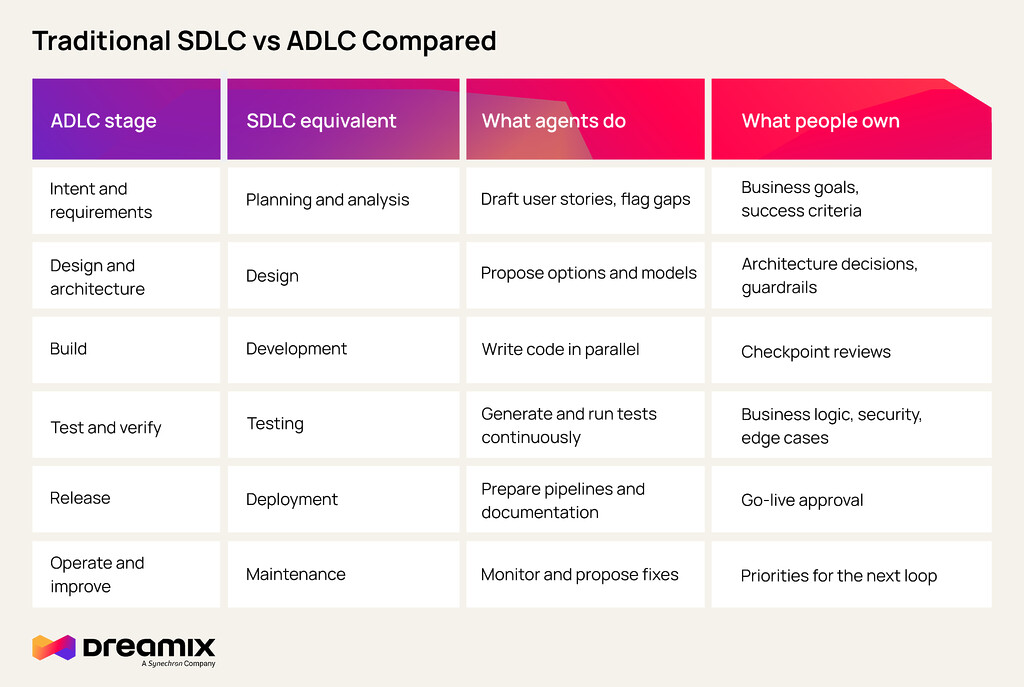
The 6 stages of ADLC
ADLC keeps the familiar stages from traditional software delivery. What’s fundamentally changed is who carries out the work and how the stages connect.
AI agents now handle most of the execution, while human engineers set direction, double check and approve outcomes at defined checkpoints. The stages also run as a continuous loop instead of a straight line, so feedback from live software flows directly into the next round of work.
1. Intent and requirements. Business leaders and product owners define the goal, the constraints and what success looks like. Agents analyse existing documentation, draft user stories and flag gaps or conflicting requirements early. Clear intent at this stage decides the quality of everything that follows.
2. Design and architecture. Agents propose architecture options, data models and integration approaches. Senior architects choose the direction and set the guardrails agents must follow, including security, compliance and coding standards.
3. Build. Specialist agents write code in parallel, each within a clearly assigned role. Engineers review the work at defined checkpoints instead of writing every line themselves.
4. Test and verify. Agents generate and run tests continuously during the build, so testing is no longer a separate phase at the end. Engineers focus on what automation can miss: business logic, edge cases, security risks and bias in agent output.
5. Release. Agents prepare deployment pipelines, documentation and release notes. People approve the go-live decision, especially for high-risk changes, and every step leaves an audit trail.
6. Operate and improve. Agents monitor performance, sort incoming issues and propose fixes. Insights from real users feed straight back into stage 1, which shortens the time between learning something and acting on it.
Here's a visual breakdown of the work divided between agents and human engineers.

From sprints to agents: How ADLC speeds up software delivery
According to Bain, an AI-native approach rethinks the end-to-end development process and replaces fixed steps with continuous agent loops focused on outcomes. Bain describes AI-enabled product and engineering teams that define, build, test and refine together in one continuous flow, rather than passing work through sequential stages.
In a sprint-based model, a feature spends much of its life waiting. It waits for backlog refinement, then for a developer, then for code review, QA and release approval. Each handoff adds days, and at times, context gets lost along the way.
Now, ADLC shortens those queues in three ways that matter to executives:
- Less waiting between steps: Agents work continuously and pass full context from one stage to the next, so work moves forward without sitting in someone's queue.
- More work in parallel: Separate agents can draft tests, documentation and code at the same time, while engineers review each output at defined checkpoints.
- Earlier feedback: Working versions reach business stakeholders sooner, so teams can validate direction before investing weeks of effort.
What makes the difference is structure. Our own workflow assigns each agent a specific role at each phase, adds human review gates, and stays tool-agnostic, so it works with Claude Code, Cursor, Copilot or open-source options for clients with strict data governance needs. Buying licences alone rarely moves the numbers. McKinsey's research shows that handing developers AI tools has little effect by itself, and the real gains come from companies that redesign how they build software across the full SDLC.
As execution gets faster, the bottleneck moves upstream. Clear requirements, precise acceptance criteria and experienced reviewers now set the pace of delivery.
Read next: AI in Software Development: Conventional vs AI solutions
The business case for AI-driven software development life cycle
For the C-suite, ADLC matters because of what it does to the P&L and the business roadmap.
Shorter time to value: Using AI-led development allows engineers to build features reach customers in days instead of weeks, so revenue, cost savings or compliance benefits start sooner.
Higher throughput without matching headcount growth: With more than 300 AI-enabled engineers, Dreamix consistently delivers 75% faster than traditional delivery benchmarks when developing with AI assistants. The same team can take on a larger portfolio of work.
Better quality: Among McKinsey's top performers, software quality improved by 31 to 45%, which means fewer production incidents and less rework.
Clear measurement: McKinsey advises tracking outcomes such as cycle time, release quality and customer satisfaction, and warns against weak proxies like the share of code written by AI. Boards want those numbers, and ADLC makes them easier to report.
How to choose a partner for AI-led software development
The right partner for agentic software development combines senior engineering expertise, a proven agentic workflow with measurable results, and deep knowledge of your industry. AI agents speed up delivery, so the quality of the people directing and reviewing them decides whether that speed creates value or risk.
The following six criteria help executives separate real capability from pure marketing claims:
1. Senior engineers who verify every output. Agents still make mistakes and carry biases. Look for a delivery partner whose experienced engineers set intent, review agent work and take ownership of what reaches production.
2. A proven agentic workflow with measurable results. Ask for case studies with concrete numbers, such as reduced cycle time, faster time to market or lower defect rates. Pilots and demos are a starting point, but production results show real capability.
3. Domain expertise in your industry. Agents follow the context they are given. A partner who understands your regulations, processes and customers writes better requirements, which leads to better agent output.
4. Capability on both sides of ADLC. The strongest partners build software with agents and also build agentic systems for your business. That combination covers faster delivery today and new AI-powered products tomorrow.
5. An end-to-end approach. Many agentic initiatives stall between proof of concept and production. Choose a partner that can take you from the first use case to a scaled solution without handing work between vendors.
6. Long-term stability. Team continuity protects the business knowledge your agents and engineers depend on. High employee retention and client satisfaction rates are reliable signals of a partner you can grow with.
How Dreamix meets these criteria
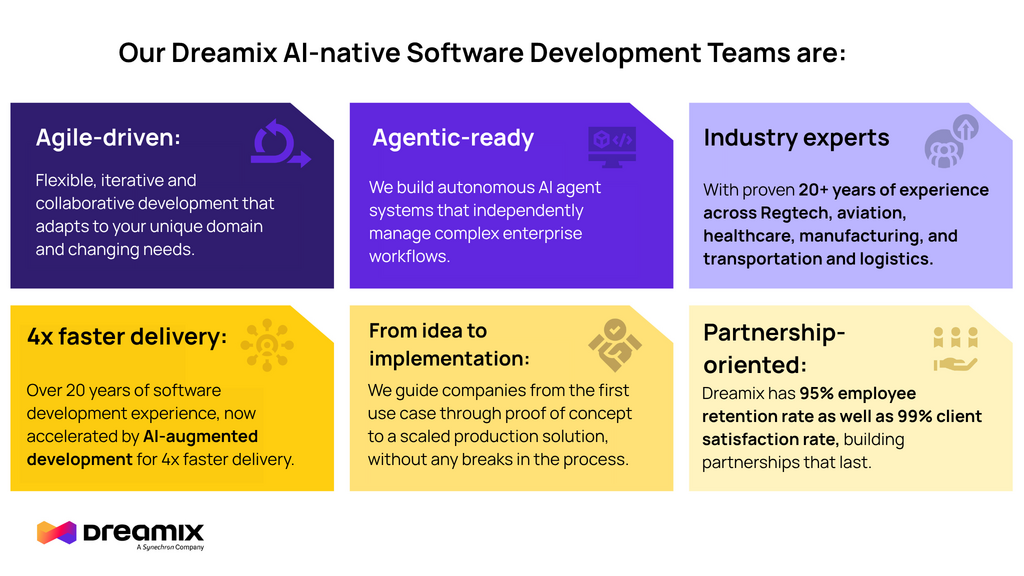
Dreamix has worked as a software development partner for over 20 years and is now part of Synechron. Our AI-native teams bring each of these criteria to every engagement:
- Agentic-ready: We build autonomous AI agent systems that manage complex enterprise workflows, and we use agentic engineering in our own delivery.
- 4x faster delivery: Two decades of engineering experience, now accelerated by AI-augmented development.
- Industry experts: Proven experience across our core focus domains regtech, aviation, healthcare, manufacturing, and transportation and logistics.
- From idea to implementation: We guide companies from the first use case through proof of concept to a scaled production solution in one continuous process.
- Agile-driven: Flexible, iterative collaboration that adapts to your domain and changing priorities.
- Partnership-oriented: A 95% employee retention rate and a 99% client satisfaction rate mean the team that learns your business stays with it.
From fixed phases to outcome-driven agent loops
It's clear that the IT industry is headed towards implementing Agentic-driven approach to the classic software development process we used for decades.
For executives, the takeaway is practical. The companies that gain the most from ADLC redesign their workflows, yet keep experienced engineers accountable for every output, and measure results in business terms. Those that only add AI tools to an old process will see modest gains at best.
If you're planning your move from SDLC to ADLC, talk to our team about agentic AI development and how our Agentic Engineering Workflow can shorten your time to value.