

Today’s digital-first economy has turned the cloud from competitive advantage into a business necessity. Yet as organisations expand across platforms like AWS, Microsoft Azure, and Google Cloud, the challenges related to interoperability continue to grow. The multi-cloud era gave rise to an increasingly crucial strategy: cloud agnostic development.
Cloud agnostic development is gaining attention among innovative enterprises as a way to avoid vendor lock-in, enable cross-cloud flexibility, and saving on hiring highly skilled cloud professionals in-house. In a landscape where cloud development services are quickly becoming the norm, developing applications that can operate across diverse cloud platforms isn’t just a technical preference but a business imperative.
In this article, we’ll provide a balanced view of cloud agnostic development: what it means, why it matters, and how forward-thinking organisations can approach it with clarity and confidence.
What exactly is cloud agnostic?
Cloud agnostic development is the practice of building software that runs consistently across multiple cloud environments without being tied to a specific cloud provider’s proprietary services or tools. The approach actually gives you the opportunity to interconnect demanded services and leverage one provider against another.
Unlike cloud native development, which optimises applications for one provider, and multicloud strategies that use multiple providers independently, cloud agnostic approaches aim for true interoperability. This means applications can be deployed, scaled, and managed across clouds with minimal reconfiguration, making your cloud infrastructure universally accessible (AWS re:Invent event).
The concept evolved alongside the rise of containers, Kubernetes, and Infrastructure as Code (IaC), which enabled abstraction from specific environments and greater platform independence. Today, cloud agnostic development is a growing focus area for CIOs, architects, and enterprise IT leaders looking to minimise risk while maximising flexibility.
Cloud-agnostic vs cloud-native development
While both cloud agnostic and cloud native development approaches aim to leverage the power of the cloud, they serve fundamentally different strategic goals. Cloud native development embraces the full capabilities of a specific cloud provider—often using proprietary tools, managed services, and deep integration with platform-native features. This results in optimised performance and faster time-to-market but at the cost of vendor lock-in.
The cloud agnostic approach, on the other hand, deliberately avoids tight coupling with any single cloud provider. Instead, it uses portable technologies like containers, Kubernetes, and open-source tools to enable deployment across multiple clouds or even on-prem infrastructure. For companies, the key to successful cloud agnostic development lies in planning for abstraction early, standardising their deployment and automation practices, and accepting some trade-offs in service richness in exchange for long-term strategic flexibility and resilience.

The multicloud reality: Why cloud agnostic development matters
New data reveals that 89% of enterprises now operate in a multi-cloud environment (Flexera 2024 State of the Cloud Report). The multicloud strategy is a preferred choice for various reasons including service reliability, optimise costs across providers, and leverage unique specialised services from different cloud platforms.
Still, most companies using multicloud struggle with critical challenges:
The multicloud struggle is real
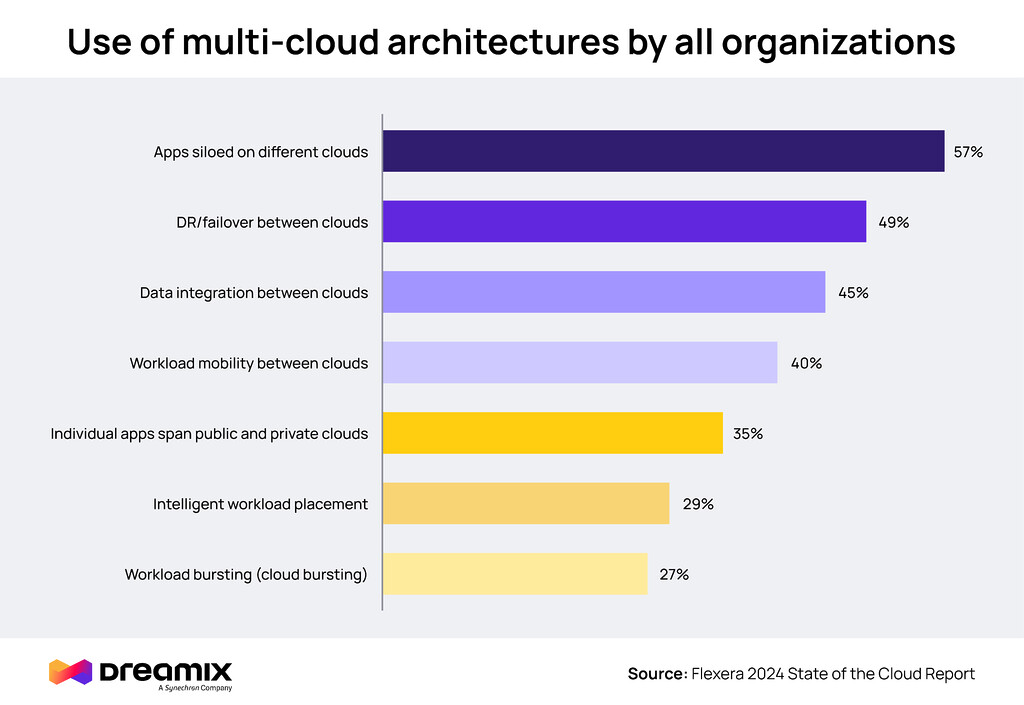
- 57% have applications siloed across different clouds, creating management headaches
- 49% use multicloud for disaster recovery, but face interoperability gaps
- 45% report data integration as their top challenge (IDC 2023 Cloud Computing Survey)
- 40% cite workload mobility limitations between providers
These findings from leading industry analysts expose a harsh truth: simply using multiple clouds doesn't guarantee flexibility or resilience.
Related: Build or Buy: When Do Cloud Application Development Services Make Business Sense?
Pros of cloud agnostic development
Freedom from vendor lock-in
Let’s get that one straight - vendor lock-in limits business flexibility and increases dependency on a single provider’s pricing, future roadmap, and inevitably, service availability. On the other hand, cloud agnostic architecture gives enterprises:
- Leverage: Freedom to switch providers improves pricing and contract terms.
- Long-term flexibility: Cloud-agnostic architectures let businesses adapt to new technologies, regulations, or partnerships without massive re-engineering.
- Risk mitigation: It’s normal for cloud providers to discontinue services, change SLAs, or alter pricing. Cloud agnosticism shields businesses from disruptions by reducing the impact of policy or service changes by any one vendor.
Performance and cost optimisations
By avoiding single-vendor constraints, businesses can:
- Choose best-priced services: Being cloud agnostic allows businesses to shift workloads based on pricing dynamics and achieve more cost optimisations.
- Geographic optimisation: Deploying closer to business clients allows for better latency. In general, high latency occurs when it takes too much time for data to reach its destination, preventing applications from working as fast and smoothly as intended.
- Workload-specific selection: Use provider strengths for specific workloads. For instance, GCP excels in AI/ML workloads due to its Vertex AI platform - enterprise ready, fully managed platform for AI development with TensorFlow integration (developed by Google), and TPUs (custom AI accelerators for high-performance training).
Simplified M&As
When companies merge, they often bring different cloud infrastructures. Cloud agnostic systems allow for:
- Easier integration: A cloud-agnostic approach standardiсes on open-source or multi-cloud-compatible tools, reducing integration headaches when connecting different services across environments.
- Reduced migration complexity: Cloud-agnostic apps need less refactoring and avoid deep dependencies on a single provider’s services, making migrations faster and cheaper.
- Consistent management: Unified monitoring and deployment practices.
Related: Software solutions for your cloud-first strategy
The cons and challenges of being cloud agnostic
Increased complexity
One of the most obvious challenges when it comes to becoming cloud agnostic is that abstraction comes at a cost:
- Management overhead: Maintaining consistency in multi-cloud environments requires abstracting away provider-specific services, leading to the need of cross-platform tools (e.g., Terraform, Kubernetes) instead of native services (AWS CloudFormation, Azure ARM).
- Skills requirements: Teams need broader expertise and cloud-agnosticism demands knowledge beyond just a single provider.
- Troubleshooting challenges: Debugging cross-cloud failures can be harder and distributed systems across multiple clouds can introduce unique issues such as observability gaps.
Higher initial investment
Building agnostic systems often means:
- Upfront investment: More development and planning needed. For instance, instead of using AWS Lambda (serverless), your development team will build on Knative or OpenFaaS for multi-cloud compatibility - adding initial setup time.
- Steeper learning curve: Training and hiring for new skills is a norm when building cloud agnostic architecture as teams must master cross-platform tools and concepts. For example, software engineers will need to be experienced in both Terraform and Kubernetes instead of just AWS CloudFormation/EKS.
- Infrastructure duplication: Avoiding cloud vendor lock-in can mean running parallel systems. Also, a potential synchronisation issue could be keeping data consistent across clouds during failovers.
Abstraction layer maintenance
Keeping abstraction layers relevant requires skilled work:
- Cloud provider updates: APIs and services evolve quickly and cloud providers frequently deprecate, update, or introduce new services, forcing abstraction layers to adapt. Lagging updates can lead to silent failures, e.g., Azure’s API version drift breaking Helm charts.
- Cross-environment testing: Cloud agnosticism translates in more scenarios to validate. And every cloud provider has unique specifics, requiring exhaustive testing. A potential challenge might be that untested edge cases cause production outages.
- Technical debt: Keep in mind that both over-engineering or under-maintaining abstractions creates fragile systems. And poor abstractions can accumulate complexity over time increasing technical debt.
Related: 25 Top Azure Cost Optimization Tips & Tricks For 2024
Best practices for implementing cloud agnostic strategy
Ultimately, there is no right or wrong way to implement cloud agnostic strategy and avoid vendor-dependency as each business case is unique. Nevertheless, if you aim to become cloud agnostic, here are some proven best practices:
Containerisation strategy
Containerising your application is a foundational best practice for achieving true cloud-agnostic architecture. By packaging applications and their dependencies into lightweight, portable containers, you create a consistent execution environment that transcends underlying infrastructure differences. This approach effectively decouples your software from the specificities of any single cloud provider's platform.
The real power of containerisation lies in its standardised runtime environment. Whether deployed on AWS EKS, Azure AKS, or Google GKE, containerised applications behave predictably because they carry their own isolated filesystems, libraries, and configurations.
Also, containerisation enables a true hybrid cloud strategy. Apps can be developed locally in containers, tested in one cloud environment, and deployed to production in another without modification. This flexibility becomes particularly valuable when responding to changing business requirements, cost optimisations, or compliance needs that might necessitate shifting workloads between providers.
However, while containers solve the portability challenge, they won't automatically make your entire stack cloud-agnostic. Persistent storage, networking configurations, and managed services still require careful abstraction to maintain full portability. The combination of containers with infrastructure-as-code and thoughtful architecture decisions creates the most robust cloud-agnostic foundation.
Infrastructure as Code (IaC) approach
Building on the portability achieved through containerisation, Infrastructure as Code (IaC) serves as the next critical pillar in developing cloud-agnostic systems. IaC is undeniably a best practice for cloud-agnostic architectures, as it codifies infrastructure provisioning and management in a way that abstracts away provider-specific implementations.
By defining infrastructure through declarative or imperative code, organisations can create repeatable, version-controlled environments that deploy consistently across any cloud platform. IaC enforces discipline by storing infrastructure state and parameters in version control systems like Git. This means every environment - development, staging, production - can be traced back to a single source of truth. If a configuration works in one cloud, the same code can deploy it to another with minimal adjustments.
Abstraction layer design
Abstraction layer design is the next best practice for building cloud-agnostic systems, acting as a bridge between your software applications and the underlying cloud services. By introducing well-defined interfaces that hide provider-specific implementations, abstraction layers enable applications to run seamlessly across multiple clouds without requiring extensive rewrites. This approach is particularly valuable for businesses seeking long-term flexibility, cost efficiency, and reduced vendor dependence.
You might wonder why abstraction layer design matters for cloud agnosticism? Well, all cloud providers offer similar services - compute, storage, databases, networking - but with different APIs, configurations, and operational quirks. An abstraction layer standardises these interactions, allowing developers to work with a unified interface while the underlying implementation adapts to AWS, Azure, GCP, or even on-premises environments.
From a QA perspective focusing on cloud-agnostic testing to protect your business investments. When we test across providers, we're essentially future-proofing your applications. Our team implements standardised validation checks that work the same way whether we're using AWS, Azure, or Google Cloud. This means your applications perform consistently for customers regardless of where they're hosted.
By comparing metrics across environments, QA experts can identify cost-saving opportunities without sacrificing performance. This approach gives your business the flexibility to negotiate better terms with providers or quickly pivot if market conditions change - all without causing customer experience disruptions or requiring extensive re-development.
Related: Migrating Applications to the Cloud in 2025: Best Practices
Being cloud agnostic: When it makes strategic sense
Cloud agnosticism represents a strategic decision that must be carefully weighed against business needs and capabilities. As seen on the table below, organisations should choose cloud agnostic approaches when they must meet diverse regional compliance requirements (like GDPR or data residency laws), need high availability with disaster recovery protections, want leverage in contract negotiations, aim to optimise cloud spend by shifting workloads between regions, have experienced teams capable of managing multi-cloud environments, prioritise long-term flexibility over speed, are integrating diverse IT stacks post-acquisition, want access to best-in-class tools from different providers, or run critical workloads that must adapt to strategic shifts.
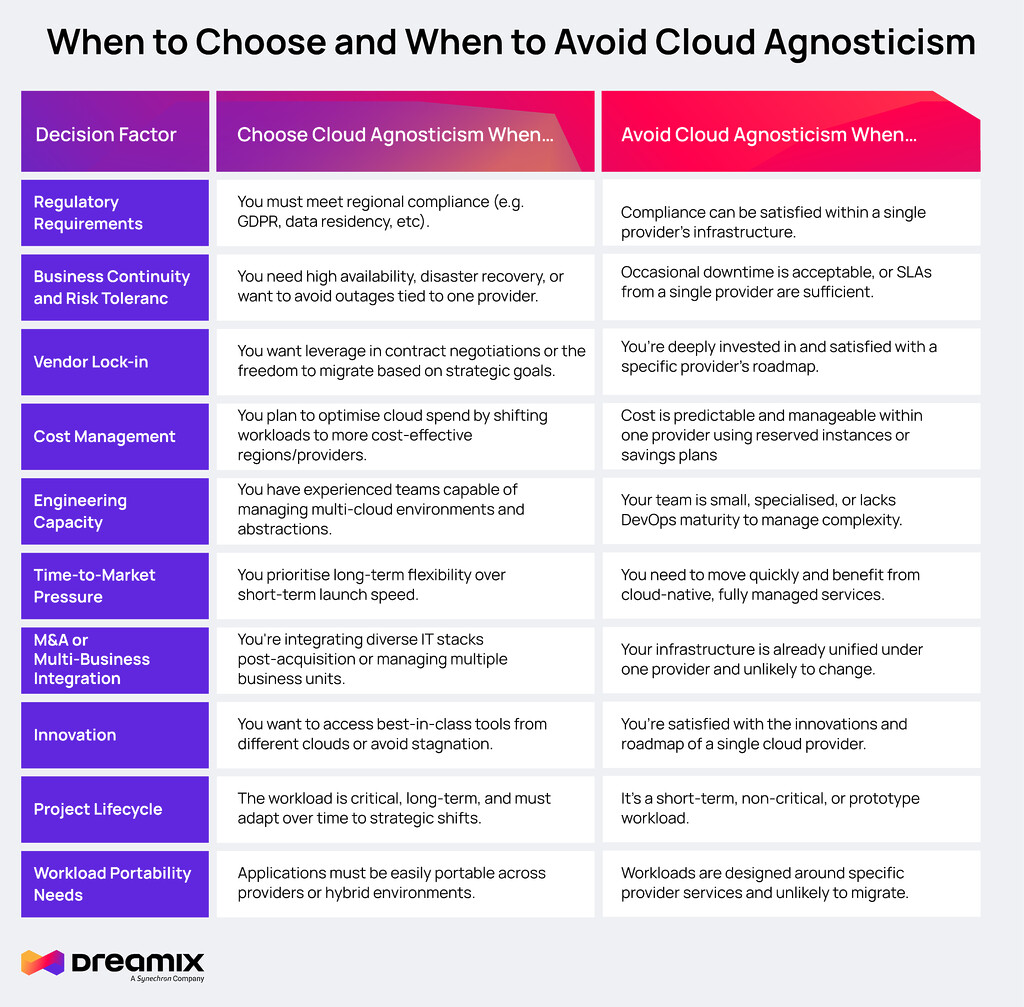
Conversely, cloud agnosticism should be avoided when compliance needs can be satisfied within a single provider, occasional downtime is acceptable, you're deeply invested in a specific provider's roadmap, costs are predictable with reserved instances, your team lacks DevOps maturity for complex environments, you need to move quickly with fully managed services, your infrastructure is already unified under one provider, you're satisfied with a single provider's innovation trajectory, or for short-term, non-critical workloads. The decision ultimately depends on weighing the strategic flexibility of cloud agnosticism against the simplicity and optimisation benefits of cloud-native approaches.
Wrap up
The journey towards cloud agnostic architecture is neither simple nor without tradeoffs. Yet, as we've explored throughout this article, the strategic advantages, namely vendor independence, enhanced business continuity, cost optimisation, and simplified M&A integration - make it an increasingly compelling approach for forward-thinking organisations.
By implementing containerisation strategies, adopting IaC, designing thoughtful abstraction layers, and establishing cross-environment testing protocols, businesses can successfully navigate the complexities of cloud agnostic development while positioning themselves for greater flexibility and resilience in an ever-evolving digital landscape.
Our Dreamix team of cloud architecture experts can guide your organisation through the complexities of cloud agnostic development, delivering custom solutions that align with your unique business objectives while ensuring maximum flexibility across all major cloud platforms.
We’d love to hear about your cloud development needs and help you meet your business goals as soon as possible.