Peter Nestorov, PhD
Strategic Advisor, Healthcare & Life Sciences, Dreamix
The views expressed are personal.
In the daily conversations I have with healthcare providers and life science companies, , two major challenges to digital transformation in healthcare keep coming up. The first one is the ever-increasing problem of data and system fragmentation that’s harming both company budgets and innovation potential. The second one is the organizational misalignment on the urgency and purpose of AI adoption.
For most decision makers I talk to, the reality is still that vital information sits in separate systems that rarely “talk to each other” in a meaningful way. As a result, staff spend considerable amount of time moving data between systems, and the processes have grown wild around the limitations of older technology. And while digital projects may be under way in many organizations, a shared view on how they should change the organisation is often missing.
As financial pressure tightens, such operational inefficiencies not only become more painful, but also increase the investment needed to resolve them. Oftentimes under such circumstances, the management understandably focuses on cost optimization trying to weather the storm and show discipline to the shareholders. Yet if the external factors and revenue do not improve, in the mid-term this organisational response can become self-reinforcing and the operational inefficiencies can evolve into major obstacles.
On the flipside, we have organisations that adopt digital tools and AI to reduce repetitive work, gain capacity to improve services, and invest again in innovation and scaling up. That’s the positive feedback loop of the successful AI adopters. Over time, the gap between successful adopters and slower, less agile, organizations will likely widen across multiple dimensions such as service quality, delivery speed and the cost of doing business.
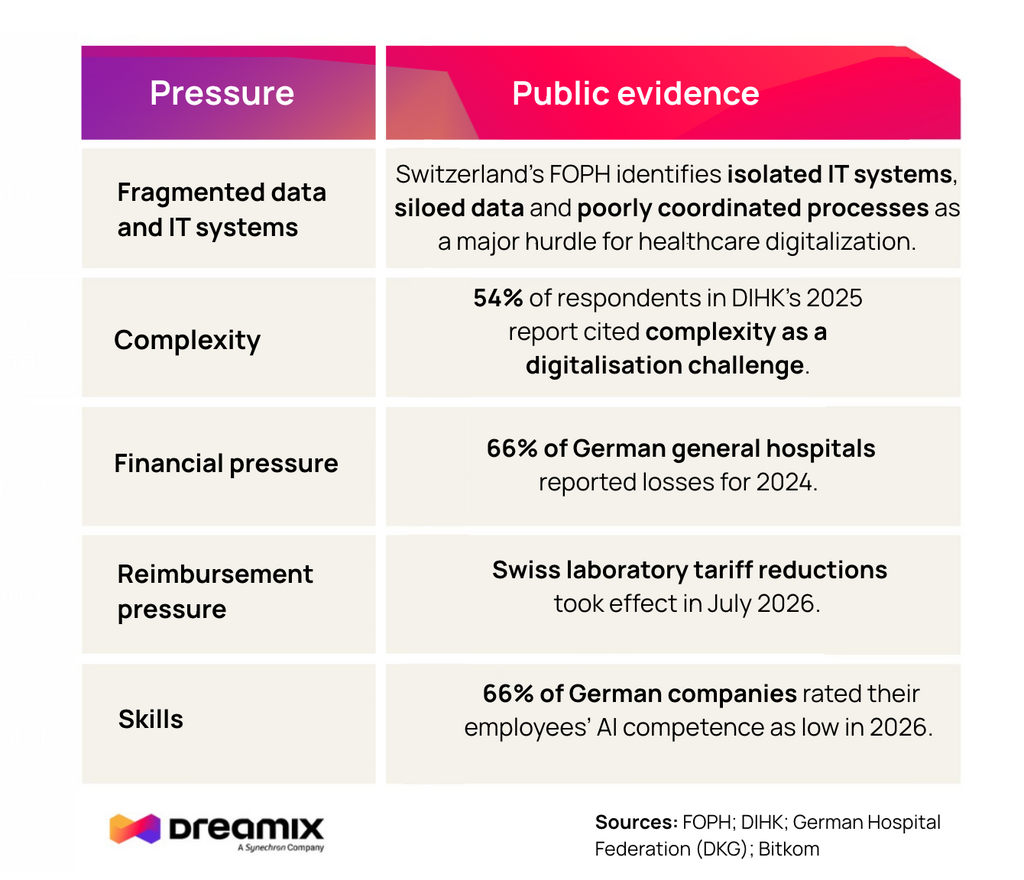
Evidence behind the problem, examples from the DACH region:
Real-life use cases for digital transformation in healthcare and life sciences
Radiology: improved detection rates with AI
There are already examples of what meaningful progress can look like in regulated settings. In Germany’s PRAIM observational study, AI was integrated into routine mammography screening to support radiologists’ double reading. The findings reveal that the AI-supported group had a 17.6% higher breast cancer detection rate, without an increase in recalls. The improvement was directly relevant to an existing clinical task, with radiologists continuing to read the scans.
Pharma reporting & documentation: increase in productivity
Another example comes from pharmaceutical operations, where Sanofi is applying a similar focus to a less visible bottleneck: regulated documentation. The company reports reductions of up to 80% in the time and effort for drafting reports, starting with annual Product Quality Reports. The opportunity is clear: spend less specialist time assembling information and more time on reviewing what it means.
Medical scribe: Saving time without measurable gain in clinical productivity
A new US study shows why saving time on a task is only part of the story. In this study of 902 clinicians and over 1.5mln encounters, frequent AI-scribe use was associated with around 2.5 minutes less spent working on notes per encounter but there was no improvement in the physician’s billing-based productivity. This result does not rule out non-monetary value such as more patient time and reduced work-related stress.
Digitalisation of healthcare systems: Some governments succeed, others struggle
Estonia and Denmark are two examples of a successfully digitalized healthcare system. In both countries healthcare digitalization is centrally coordinated and operated. In Estonia, the system allows patients to book appointments, get prescriptions and referrals, which makes it easier both for them and for the physicians. In Denmark, medical records have been systematically collected and digitalized over decades, and represent an invaluable resource for biomedical research.
Switzerland, on the other hand, illustrates what happens when that practical value is harder to secure. Despite years and millions poured in, the roll out of an electronic patient record has failed to gain adoption among patients and practitioners. The Federal Audit Office identified weak central steering and inadequate incentives for outpatient providers; it also warned that unclear governance and poorly integrated processes threatened the planned redesign. The Federal Council has since proposed a fundamental reorganisation through a new electronic health dossier (in German E-GD or elektronisches Gesundheitsdossier).
My perspective
My view is that boards and business owners need to give leadership the mandate to address these issues while managing today’s financial pressures. That means agreeing where the organisation needs to change, who owns the outcome and what investment will be protected. Once the strategic mandate is clear and aligned, the implementation can start with manageable first steps:
1) simplify an important workflow,
2) connect the information it depends on, and
3) introduce smart automation or AI where it can make a measurable difference.
Also, the people expected to use the new process (the end users) should help shape it from the beginning. If staff carry the extra workload without a clear incentive, or fear losing their job to AI, adoption will be difficult. The same applies to patients and customers: a new system should simplify or enhance a process they are directly involved in. AI literacy belongs in that implementation plan, with time for employees to learn approved tools, handle sensitive information and exercise professional judgement. Inevitably, such training needs a budget and protected time.
AI adoption rates alone tell us little about business or patient value. Organisations should rather measure the effect on specific work and its output. For a digital or AI-assisted booking system, that could mean fewer patient no-shows. For clinicians, it could mean less administration and more time for patients and case interpretation. Higher productivity also needs to translate into real value. How is the capacity released being used to improve care, reduce waiting times or strengthen financial performance? That assessment should include both implementation and ongoing costs.
Finally, I’d like to stress the growing cost of postponing digitization and AI adoption: fragmented systems and repetitive work consume resources that could support better care, innovation and growth. As budgets tighten, these inefficiencies leave less capacity to invest in resolving them, making it harder to break the cycle. In addition, organizations under pressure have a more difficult time to align the interests of the various stakeholders: business owners, leadership, staff, and patients.
Leadership needs to build the business case for digitalization and AI adoption, secure and protect the investment in this business-critical improvement, and work with employees and patients to identify where digitalization can make the greatest difference. Start with an important workflow, give people the skills and time to shape the change, and measure the results. The return should be visible in better care, more valuable work and stronger financial performance.
You already know where the friction sits. We know how to remove it without compromising on compliance, security or quality. Let’s build your custom healthcare software development solution.