In the rapidly evolving AI landscape, the concept of Human-in-the-Loop (HITL) is gaining traction as a pivotal component in developing robust, accurate, and ethical AI systems. These already play an increasing role in our daily lives: automated systems banks assessing the creditworthiness of credit applicants, or assisting doctors in diagnosing diseases. In fact, the global AI market is estimated to be worth $391 billion with a 37.3% CAGR from 2023 to 2030, GrandViewReasearch reports. The AI megatrend is here to stay.
While the number keep going up, many businesses strive to catch up, while others are already reaping the benefits on incorporating AI. But why do they do that? One of the most notable advantages is the acceleration of workflows and long-term cost savings. Plus, Human-in-the-Loop (HITL) systems contribute to data-driven decision accuracy, as human oversight can identify errors or biases that AI systems might otherwise miss. This leads to improved customer satisfaction, as AI systems can be fine-tuned to better meet customer needs. Additionally, HITL fosters innovation by enabling businesses to quickly test and iterate AI models with human input, thereby reducing the time to market for new AI software solutions.
Now, let’s dive deeper into the topic and explain what HITL actually is, its benefits and challenges as well as future outlooks.
Understanding the Human-in-the-Loop (HITL) concept
HITL refers to the integration of human judgment, input, and expertise in the ML training and decision-making processes. This design approach acknowledges that while machines can analyse vast amounts of data and identify patterns, human insights are still indispensable for ensuring that AI systems function effectively, ethically. What’s more, HITL is designed to complement, not eliminate the depth a natural human understanding provides.
The HITL processes can be performed either under supervised or unsupervised learning. In the latter example of unsupervised learning, a computer vision model is given largely unlabeled datasets, forcing them to learn how to structure and label the images or videos accordingly. In the supervised learning scenario of HITL-based AI development, data engineers give the computer vision model labeled datasets. This helps the algorithm get smarter, data scientists need to provide accurate feedback so the algorithm gets a clearer understanding of what it’s being shown. Let’s see a classic example of Human-in-the-Loop applied to training a computer vision model.
In the GIF picture below, you can observe aircraft parts being accurately identified by an AI-powered computer vision algorithm. Let's explain the concept with a real-world example from the context of aviation software development. Here, AI is increasingly being used in MRO (maintenance, repair and overhaul) operations. Enhancing MRO operations requires the use of advanced machine learning algorhitms, computer vision, and natural language processing to ensure improved predictions and recommendations as well as automated inspections.
Utilising HITL in developing ML-based software can directly tackle common problems such as high costs of manual inspection and reactive repairs, data silos from disparate data sources and unplanned disruptions. Besides, AI-based software solutions makes a huge difference in edge cases which humans might miss. Some examples here could be detecting micro-cracks or signs of material fatigue, early-stage corrosion, misalignment on the flaps or landing gear, and many more.

The HITL in machine learning
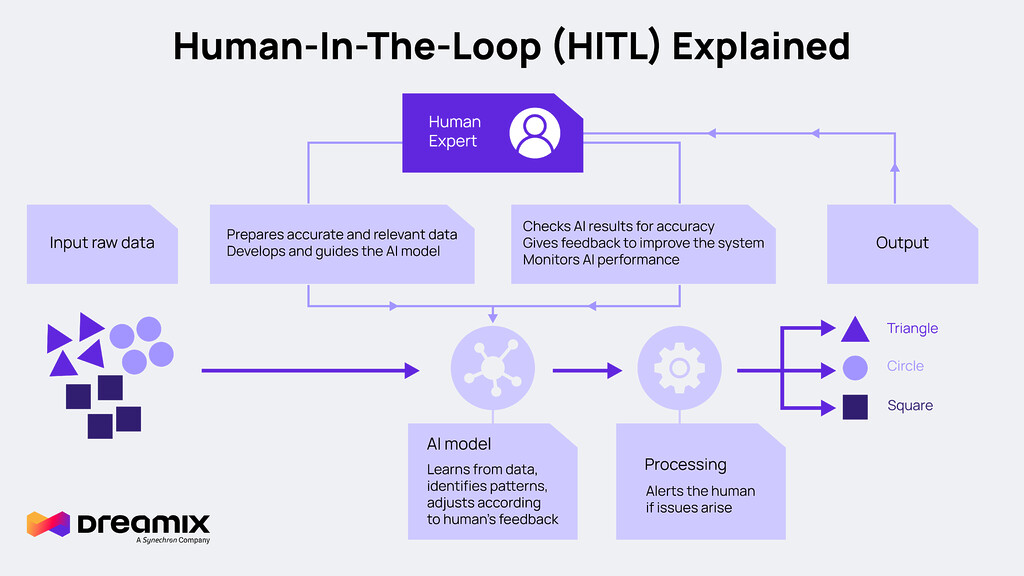
In a typical HITL system, a human receives data or results from a machine, evaluates them, and provides inputs or corrections back to the system accordingly. This ongoing interaction helps to enhance the machine's performance by allowing humans to handle unclear or complex decisions that are difficult for the machine to solve. This way, the system can continuously learn and adapt, reducing errors and increasing efficiency.
A classic example of HITL in machine learning training is image classification. In this case, humans can assist by labelling image data, correcting errors, and providing feedback to refine the models. This collaboration can lead to more accurate and reliable systems and is a valuable resource in improving the accuracy of machine learning models through human intervention.
HITL: How humans and machines interact
The human-machine interaction in HITL machine learning can have multiple scenarios:
Input and output: The human expert/annotator can provide the system with information in the form of raw data. Then, AI is fed accurate and relevant instructions, so that the system detects recurring patterns. In case of misinterpretation, the human revises the instructions making the clearer or gives more training data to improve the machine's output.
Monitoring and validation: A human expert monitors the system's result (be it a text-based response or visuals) and either validates it or corrects any errors if needed. This ensures that the system delivers reliable and accurate results and improves itself in the future.
Adjustments and feedback: During the processing phase, the AI alerts the human expert if potential issues arise. What might set off a red flag in AI-based systems will vary but some real-life examples include detecting data misclassification in a medical image recognition system or identifying untypical patterns in a cybersecurity system. Alarmed by the red flag, the human can then adjust the system by, for example, labeling training data or correcting certain behaviors of the system. The human's feedback is used to improve the system and reduce future errors.
Automated AI systems vs. HITL-based AI systems
AI software can be divided into two subcategories - fully automated systems and Human-in-the-Loop (HITL) systems. Both come with distinctive pros and cons as described below:
Automated AI systems
Automated AI systems are designed to operate independently, without the need for human oversight. They rely on predefined algorithms to gather and process data and are capable of performing analyse data from various business operations, e.g. customer interactions. Automated AI systems are perfect for high-speed processing (fraud detection, high-frequency trading or image processing) and tasks relating to scalability (cloud resource management, customer chatbots or recommendations).
Handling repetitive, well-defined and automation-prone tasks is the true strength of automated AI software. However well they perform such tasks, AI-powered automated software isn’t able to grasp the full context.
"Automated systems need to be monitored too, which essentially introduces a human in the loop. But only in the cases when the algorithm itself raises a red flag that something is wrong. Performance logs should be put in place to ensure that a human is alerted in case there are data quality issues or model drift, which means that the real-world processes have changed and the model no longer correctly reflects those processes. This can be the case in anomaly detection models used for fraud identification, for example. In classic ML cases, this is a more-or-less straightforward process. More complex applications, however, might require the algorithm and human to work "as a team" to perform the task, meaning a human needs to either inform, or validate every output of the machine, such as in radiology, or self-driving cars for example. Currently, a car is not allowed to move without anyone in the driver's seat. This means the driver's action or inaction is validating the self-driving car's every decision."
Kalina Cherneva, Head of Data Practice @ Dreamix
Missing the big picture makes such systems prone to ambiguity, biased behaviour or difficulty with edge cases when a human judgement decision-making would be essential. A systematic review (Ferrera, 2024) discusses the negative impact of biased AI in the healthcare or financial sector. For example, credit scoring systems can have adverse consequences on underrepresented groups (e.g.people of colour or from certain neighborhoods) by making it harder for them to get a loan or mortgage bank approval.
Therefore, fully automated AI systems' weak spot is making wrong decisions due to their limited contextual understanding and perpetuating biases, leading to ethical considerations.
HITL AI systems
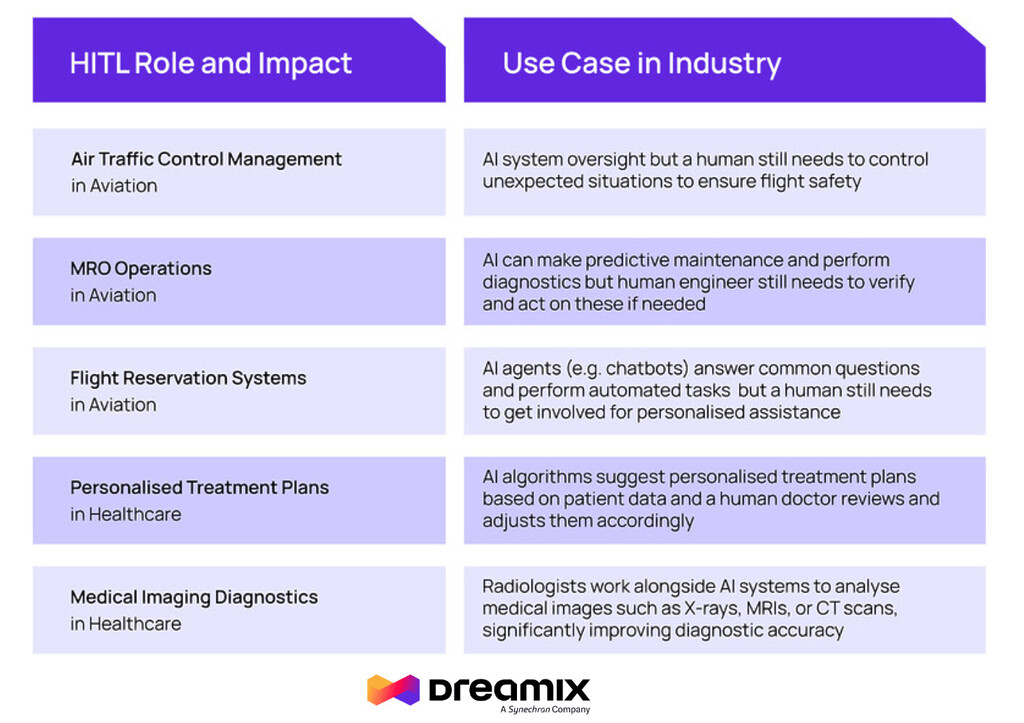
Compared with the fully automated AI software systems, the HITL-based ones rely on human oversight during any stage of the software development life cycle. From training and validation to real-time decision making process, a human expert’s invaluable input and judgement make the HITL system more accurate and reliable. For instance, in the field of radiology, a doctor may have the task to manually review and validate AI-generated diagnostics and recommendations to ensure patient’s safety.
On another level, HITL systems aim to optimise the behaviors and performance of both humans and machines. Human-machine team work has so far proven its significance and success in many academic studies and has outshined human-human or machine-machine teams. This has been validated in a game called Overcooked where a human and an AI agent try to cook and deliver soup to tables. The AI is closer to the tables, and the human is nearer to the ingredients, so optimal behavior involves the AI delivering soup and the human cooking it. Even such game scenarios emphasise the importance of superior outcomes reached through human-AI collaboration. Or as Paul R. Daugherty, author of “Human + Machine: Reimagining Work in the Age of AI” puts it:
“A key lesson here is that companies can’t expect to benefit from human-machine collaborations without first laying the proper groundwork. Again, those companies that are using machines merely to replace humans will eventually stall, whereas those that think of innovative ways for machines to augment humans will become the leaders of their industries."
Implementing HITL-based software solutions into your business will bring you many benefits but let's be honest - it doesn't come without challenges. Let's look at some of the most prominent ones in the next section.
Challenges of implementing HITL systems
Here are some of the most important ones you need to consider in advance:
Human-in-the-Loop depends on ... a human in the loop
Starting with the quite obvious one here but a HITL solution definitely relies on the availability of a human expert. What a human expert essentially brings is domain-specific knowledge and nuanced judgment that AI systems may still lack. An actual human is also needed for verifying the complex data interpretations provided by the AI algorithm and for handling exceptional situations that require immediate actions.
"Human-in-the-loop systems are best suited for complex applications, where the biggest business value comes not so much from cutting cost and downsizing teams, but rather from drastically reducing the error rate that a human alone is prone to make. Again, two very obvious scenarios are radiology and autonomous cars, where the value comes from saving human life, rather than cutting cost."
Kalina Cherneva, Head of Data Practice @ Dreamix
Plus, depending on the particular use case of the HITL system, the AI solution might be prone to biased performance and a human needs to serve as an ethical guide.
With that being said, human are not immune to errors and we know that they can depend on variety of subjective factors. For example, Harvard Business Review reports that over 80% of cybersecurity errors are linked to human errors, creating a cybercrime impact of $10 trillion in 2023. Surprisingly, AI-driven cybersecurity's market is estimated to $35 billion net worth by 2025 just because AI proves to be better at detecting cyber-anomalies.
Human-in-the-Loop solutions ... might be costly
Employing an actual human in the loop can be a costly endeavour. This goes into both directions: time and money. The role of a human expert to train and oversee the model's performance can be time-consuming if done by a single person. Bun then hiring a whole expert team can become expensive and this can be a barrier for SMEs with some budget restrictions. That's why businesses need to be clear about their objectives and priorities as well as possible project limitations.
Human-in-the-Loop systems ... need high data quality
One of the major challenges of HITL systems is their dependence on data quality. According to research paper by Kumar et al. (2024) "the quality of human input can be subjective, biased, or inconsistent" which contributes to a poor machine learning performance. Another potential concern are the different and sometimes subjective human interpretation of the same data. This might lead to problems with incorrect or inconsistent data labelling and categorisations. Employing several domain experts аs labellers and making sure they're aligned on the subject are proven best practices to prevent this.
Last but not least, human experts might struggle with providing high-quality data on a consistent basis. In most scenarios this issue occurs as data volumes rise, which might cause bottlenecks in the AI learning process. Teams might try automating repetitive tasks, focusing on the highly complex ones or use active learning techniques.
Industry examples of HITL-based software solutions
The HITL approach in AI development finds most value in the following industry use cases:
Data annotation: In the world of machine learning, the quality of training data is crucial. This is where humans come into play to review, add, and classify data, speeding up the AI learning process and boosting performance. British Board of Film Classification (BBFC) and Dreamix
Quality control: Being a crucial step in numerous industries such as pharma or manufacturing, quality control systems based on HITL design prove to be more effective.
Interactive systems: In interactive systems, such as customer support, humans can intervene in real-time to provide assistance when the AI reaches its limits.
Error-Tolerant Systems: In safety-critical applications, like autonomous vehicle control, HITL is essential for creating an additional layer of oversight that can minimise errors and enhance safety.
Dreamix is proud to have been an AI co-innovation partner of the British Board of Film Classification (BBFC). The partnership led to the development of a machine-learning algorithm for generating localised age ratings across over 100 countries, taking into account cultural nuances and sensitivities. After the initial prototype demonstrated the feasibility of the concept, further investment in a production-ready product followed by successful patent application.
In another case, PowerDrone has identified a niche in the energy sector, focusing on the inspection of hard-to-reach energy infrastructure using drones. Traditional ways of inspection were costly, hazardous, and often yielded insufficient data. PowerDrone partnered with Dreamix to develop a multi-tenant platform that automates image processing using machine learning. Our solution ended up providing clear visibility over power grids and enabling preventive maintenance, thus saving time and resources.
Wrap up
When asked about whether the future economy will be based on AI on the 2024 Estoril Conference, Prof. Robert Seamans gave a two-fold answer. First, that new technologies like AI are not simply "plug and play" and they might require two or three times higher complementary assets to perform well. His second point is that the most important complementary asset is the human capital (domain knowledge and hands-on experience).
Building on this thought, it's clear that AI technologies are paving their way into both personal lives and business. But one other aspect is also straightforward- that the human in the loop will remain. Despite their sophistication, AI systems lack essential human qualities like intuition, creativity, and ethical oversight to navigate the complexities of real-world applications effectively. But this is a positive thing. The business value of keeping a real human present in AI development is significant.
HITL ensures that AI solutions are not only technically sound but also aligned with strategic goals and customer needs.
Why should you partner with Dreamix for your next AI solution?
At Dreamix, our strong technological foundation and domain expertise in domains like aviation, transportation, healthcare and ESG helps us deliver world-class custom AI solutions that grow with your business. Whether you need:
- machine learning services
- data preparation
- data migration
- predictive analytics
- computer vision
- deep learning services or
- securing AI/ML models
we're ready to become your co-innovation partner. With our one team approach, minimal turnover and quick to onboard scalable teams, we're here for you.
We’d love to hear about your software project and help you meet your business goals as soon as possible.