In 2026, the landscape of software development is evolving faster than ever before and companies scramble to keep up. From the rise of AI agents, platform investments, low-code/ no-code - we’ve gathered the six major software development trends. With Garter predicting a worldwide IT spending to surge with 9,8% compared to last year’s numbers, it’s no wonder why decision makers should keep an eye on what custom software development companies are up to.
Software development trendsin 2026 will determine which organisations capture market leadership and which fall behind. The companies that understand and act on these shifts will gain competitive advantages that compound over time. And the ones that wait will find themselves wondering how to manage technical debt, dealing with talent shortages, and architectures that cannot support the pace of business change.
Ultimately, understanding the future of software development means recognising that technology decisions made today shape business outcomes for years to come.
2026 Snapshot: Software development market
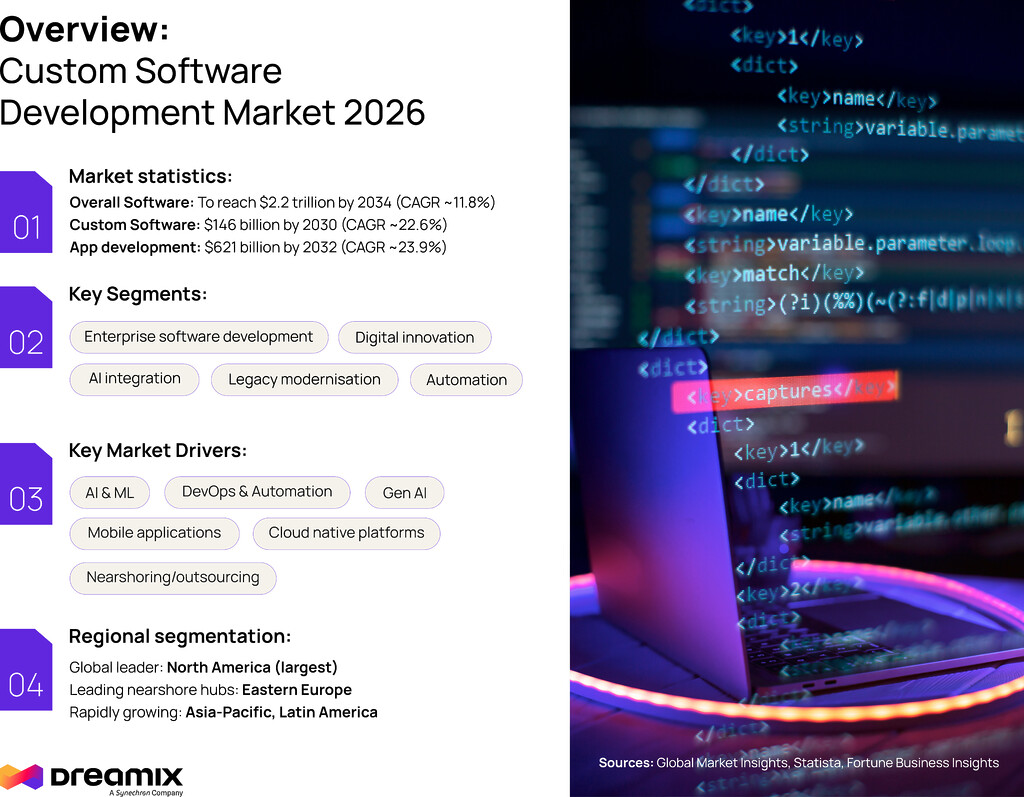
The infographic below shows key projections and trends shaping the custom software development market trends in 2026:
Market growth: Projected overall software market reaching $2.2 trillion by 2034, with specific figures for custom software and app development growth forecasts.
Key segments: Including enterprise software development, digital innovation, AI integration, legacy modernisation, and automation.
Key market drivers: Encompassing AI & ML, DevOps and automation, generative AI, mobile applications, cloud native platforms, and nearshoring/outsourcing.
Regional segmentation: Highlighting North America as the largest leader, Eastern Europe as a leading nearshore hub, and rapid growth in Asia-Pacific and Latin America.
1. AI-Native development
PwC 2026 Global CEO Survey states that AI has become the market separator between “leaders and laggards”. Even though only 12% report significant financial benefits from AI, the survey emphasises that companies need to act decisively in order to stay competitive and capitalise on emerging opportunities before the window narrows. In 2026, artificial intelligence is still among the top software development trends and has moved beyond experimental initiatives into production systems that generate measurable business value. GitHub reports that developers using AI coding assistants complete tasks 55% faster.
Key benefits of AI-driven development
Effective AI adoption offers high-impact outcomes:
- Faster development: Developers using AI assistants complete tasks 55% quicker
- Innovative business models: AI enables new revenue streams and automation of complex decisions
- Enhanced customer experiences: Natural language interfaces powered by large language models (LLMs)
- Operational efficiency: AI-powered testing and quality assurance streamline the development lifecycle
- Competitive advantage: Embedding AI from the start, rather than retrofitting, maximizes ROI
Strategic considerations for CTOs and tech leaders
AI-native initiatives require:
- AI infrastructure planning: Selecting platforms that align with existing tech stacks after a comprehensive AI readiness assessment
- Data governance: Managing training data, models, and deployment processes
- Team capability development: Building AI/ML expertise within teams
- Impact assessment: Identifying where AI creates the most business value
How Dreamix supports enterprises
- We specialise in custom AI development to architect competitive AI capabilities
- We help organisations leverage AI for business growth, not just technological novelty
- We support business leaders before committing with AI/ML consulting services
We at Dreamix have developed specialised expertise in custom AI and ML development, helping enterprises architect AI capabilities that deliver competitive advantages rather than just technological novelty.
Further reading: Agentic AI vs Generative AI: Strategic Decision-Making for Enterprise Leaders
2. Platform Engineering
Platform engineering represents one of the most significant latest major software development trends. Not only are platforms becoming more in-demand but they’re ultimately changing how organisations structure their development operations. Gartner predicts that by 2026, the majority of software engineering organizations, up to 80%, will form dedicated platform teams to serve as internal providers of reusable services, components, and tools
What makes platform engineering a key software development trend for 2026?
- Growing demand for scalable, reusable development platforms
- Organizations seeking to accelerate deployment and reduce operational complexity
- Companies prioritizing digital transformation and faster time-to-market
- Enterprises aiming to standardize tooling while maintaining security and governance
Core benefits of platform engineering
Effective platform engineering drives impactful results:
- Faster deployment cycles: Reducing release times from weeks to hours
- Cost efficiency: Lower infrastructure expenses through optimized resource utilization
- Enhanced developer experience: Improving satisfaction and talent retention
- Scalability: Building foundation for larger teams without increasing complexity
- Competitive advantage: Differentiating through automation and self-service development environments
3. Security-First Architecture
Why is security-first architecture critical in 2026?
- Cybersecurity threats are escalating in both sophistication and frequency, transforming security into a business imperative rather than just a technical consideration
- The Cost of a Data Breach Report 2025 by IBM found that the average cost of a data breach has reached $4.44 million globally, dropping 9% from last year thanks to rapid discovery and containment
- Security-first development emphasises integrating security controls throughout the entire software development lifecycle, from initial architecture to deployment and monitoring
- This approach includes implementing zero-trust architecture principles, securing software supply chains, and designing applications with privacy by default
Key drivers for adopting security-first architecture
Effective security strategies in development involve:
- Rethinking traditional practices to incorporate security considerations early in the process
- The latest GitLab survey reveals that 83% of DevSecOps experts would be willing to let AI agents fix security vulnerabilities with prior human approval workflows
- DevSecOps integration helps reduce vulnerabilities in production while maintaining development velocity
4. Low-code and no-code platforms
Why are low-code and no-code platforms transforming enterprise development?
- Low-code and no-code development platforms have matured to serve enterprise needs, enabling business users to build applications while freeing professional developers to focus on complex, high-value tasks
- Gartner forecasts that by 2026, at least 80% of the user base for low-code tools will be outside formal IT departments, up from 60% in 2024
- Organisations leverage these platforms for a wide range of uses, from internal workflow automation to customer-facing application
While low-code and no-code platforms are among the top software trends enabling rapid development, they often lack the flexibility required for complex, highly customised enterprise solutions. This can lead to scalability issues as business needs evolve, requiring organisations to eventually migrate to traditional development approaches, which can be costly and time-consuming. Further, governance, compliance and security risks might arise without stringent oversight. This is because in low-code/no-code approaches there’s a higher likelihood of insecure coding practices, data leaks, or non-compliance with regulatory standards.
5. Edge computing
Why is edge computing among the top software development trends for 2026?
- Edge computing moves data processing closer to the data source, reducing latency and enabling real-time decision-making that traditional cloud architectures cannot match
- IDC projects global spending on edge computing infrastructure will reach $380 billion by 2028, with a CAGR rate of 13,8%
- This shift fundamentally alters application architecture, requiring systems to operate across distributed environments, handle intermittent connectivity, synchronise data between edge and cloud, and manage security across multiple deployment points
- Industries like manufacturing, healthcare, and retail are leading adoption efforts due to their need for real-time data processing beyond what cloud latency can support
6. Sustainable software engineering
Why is environmental sustainability a strategic priority in 2026?
- Environmental sustainability has evolved from a corporate social responsibility to an operational necessity due to regulatory requirements, investor pressure, and shifting customer expectations around carbon emissions
- Data centers and data transmission networks currently consume nearly 3% of global electricity, with projections indicating significant growth in this footprint (European Environment Agency)
- Sustainable software engineering emphasises building applications that reduce energy consumption through efficient coding, optimised algorithms, and intelligent resource management
- Strategies include selecting energy-efficient cloud regions, implementing carbon-aware computing that shifts workloads to renewable energy availability, and designing applications that scale resources down during lower demand
On January 13, 2026 Synechron, of which Dreamix is part, has been recognised as an elite member of the CDP Climate List, placing it among the top 4% companies worldwide for their leadership in environmental sustainability. This acknowledgment highlights the growing importance for organisations to adopt energy-efficient and sustainable practices to meet global climate goals and regulatory standards.
Choosing the right development partner for future-ready applications
As organisations evaluate how to implement these software development trends, the choice of development partner becomes increasingly important. The right partner brings not just technical expertise but also industry knowledge, proven methodologies, and commitment to business outcomes rather than just feature delivery.
When evaluating potential partners, look for demonstrated experience and ask:
- Can they show successful AI implementations in production? (indicates depth of capability)
- Do they have platform engineering expertise?
- Can they architect secure, scalable systems that meet regulatory requirements? (indicates adherence to compliance and regulatory requirements)
- Do they have experience with software product development across diverse industries? (indicates adaptability and domain knowledge)
Equally important are partnership qualities that enable long-term success: transparent communication, flexibility to adapt as requirements change, commitment to knowledge transfer that builds your internal capabilities, and cultural alignment that enables smooth collaboration. Organizations should assess not just technical competence but also whether the partner's values, work practices, and communication style fit with your organisational culture.
Why choose Dreamix as your software development partner?
Dreamix is a trusted international software development provider with over 20 years of experience delivering innovative digital solutions across diverse industries. We specialise in creating custom software, web and mobile applications, AI-powered solutions, and cloud-based platforms tailored to meet your unique business needs.
At Dreamix, we have built our reputation on combining deep technical expertise with genuine business partnership.
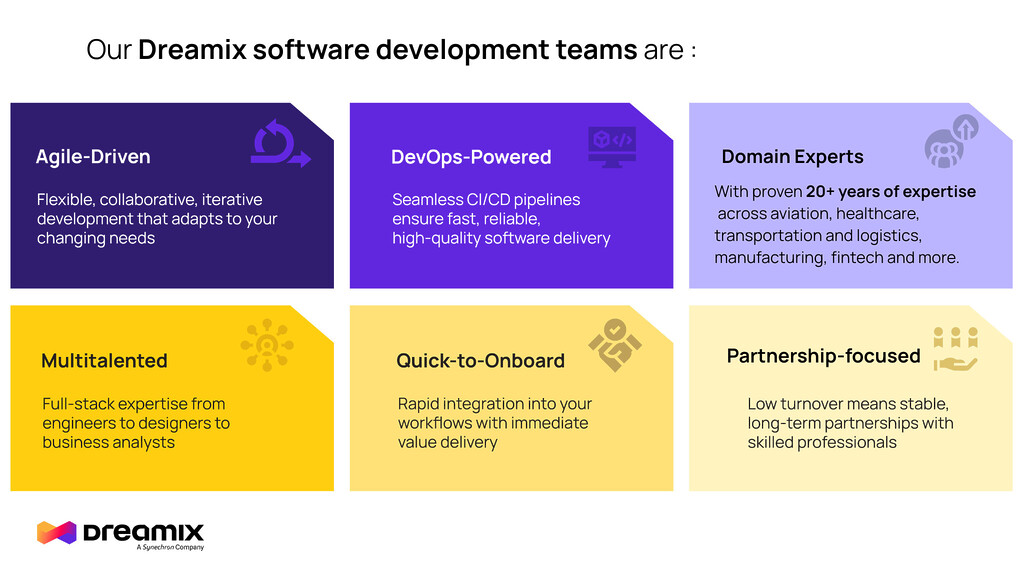
- Our 95% employee retention rate ensures project continuity and knowledge preservation.
- Our 20+ years of experience across aviation, healthcare, manufacturing, and transportation industries means we bring proven patterns and practices rather than experimental approaches.
- Our commitment to T-shaped skills, where developers combine technical depth that goes beyond software development trends into actual business value, ensuring we deliver solutions that create measurable ROI.
Ready to discuss which of these software development trends are the right fit for your organisation?