As budgets grow, so does the cost of choosing the wrong partner from the long list of enterprise application development companies. Companies will spend a lot more on technology in 2026 than they did last year. Gartner expects worldwide IT spending to reach $6.37 trillion this year, up 14.2% on 2025 (Gartner). The growth won’t be spread evenly, though. Gartner says most of the extra money is going to the parts of the market that get a direct boost from AI.
For a CEO, CTO or CIO, all of that spending only pays off if the systems behind it hold up under pressure. That could be an airline on its busiest travel day. It could be a bank getting ready for a new anti-money-laundering regime, or a hospital linking patient records across different platforms. AI now helps engineers write code much faster, so the code itself has become cheaper to produce. What has become scarce is knowledge of your industry: its rules, its risks and the way it makes money. That’s why we think the best enterprise application development companies are the ones whose engineers already have that knowledge.
How we chose these companies
We looked at firms that design, build and run custom enterprise applications for mid-size and large organisations. Every company on the list meets six criteria:
- Mid-sized scale: Roughly 100 to 2,500 people. That is large enough to staff complex programmes and small enough for senior leaders to stay close to each client.
- Enterprise track record: At least 15 years of delivering business-critical software.
- Complex and regulated sectors: documented work in areas such as aviation, financial services and RegTech, healthcare, transportation or the public sector.
- End-to-end capability: Discovery, architecture, engineering, QA, cloud operations and long-term support.
- Engineering depth and continuity: In-house teams, senior talent and strong retention rates.
- Responsible AI adoption: AI speeds up delivery, while named engineers stay accountable for quality, security and compliance.
- Verifiable footprint: Public company information, client references, and analyst or business press coverage.
We ranked the companies for one buyer profile: an enterprise with high regulatory exposure that needs a long-term engineering partner for business-critical systems. Global integrators score well on scale. Specialists score well on domain depth and senior attention. If your priorities differ, your ranking may differ too.
Disclosure: Dreamix publishes this article. We placed ourselves first because our profile fits these criteria most closely for regulated enterprises, and we set out the evidence below. We assessed every other company using publicly available information.
We left out global integrators and engineering firms with tens of thousands of employees. They serve a different buying need: very large, multi-country programmes where scale outweighs proximity. For most regulated enterprises, the mid-sized segment is the sweet spot. Beyond a certain size, firms run into diseconomies of scale, with more management layers between the client and the engineers doing the work. Mid-sized partners keep the decision-makers in the room.
Disclosure: Dreamix publishes this article. We placed ourselves first because our profile fits these criteria most closely for regulated enterprises, and we set out the evidence below. We assessed every other company using publicly available information.
Why human engineers are still vital with AI-assisted development
AI coding assistants are now widely accepted in enterprise software delivery. McKinsey research found that generative AI cut the time needed for code documentation by 45 to 50% and for writing new code by 35 to 45%. On high-complexity tasks, the time saved fell below 10% (McKinsey). Our internal AI-assisted delivery
That gap matters to executives, because enterprise systems in regulated industries are mostly complex work. A departure control flow, a KYC check under new EU rules or a clinical data integration with Epic or Cerner carries legal, safety and financial consequences that a model cannot weigh on its own.
Gartner reaches a similar conclusion. Its analysts expect AI to reshape the software engineer’s role, yet they state that human expertise and creativity will remain essential for complex software, and that organisations will need even more skilled engineers to meet demand for AI-powered applications (Gartner).
In economic terms, AI has lowered the marginal cost of code. The cost of a wrong decision in a production system stays as high as ever. The partners worth paying for use AI for speed and keep experienced engineers accountable for architecture, security, compliance and the final call. That accountability is your margin of safety.
The top 15 enterprise application development companies in 2026
1. Dreamix
Headquarters: Sofia, Bulgaria | Founded: 2006 | Best for: aviation, RegTech, fintech, healthcare and transportation enterprises that need domain experts and long-term delivery ownership
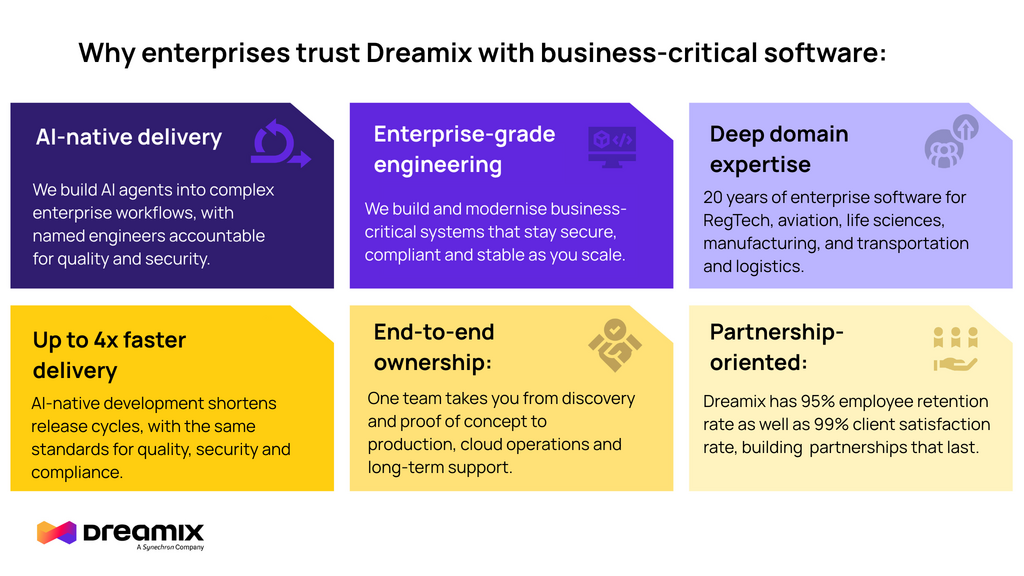
Dreamix celebrates 20 years of enterprise software delivery in 2026. The company started in a Sofia University dormitory, where final-year computer science students set out to build a business around talent and lasting relationships. Today it has more than 300 people serving enterprise clients across North America, Europe and the Middle East, and it has been part of Synechron since March 2024, which adds global reach while the Sofia engineering teams remain at the core.
Dreamix’s main differentiator is business domain knowledge in industries where software failure carries regulatory, safety or financial consequences:
- Aviation: Dreamix joined IATA’s Strategic Partnerships Program in September 2024, and its aviation clients include Icelandair and Aer Lingus. Its software accelerators cover group check-in, airport check-in, boarding, lounge management, crew and ground staff scheduling, aircraft MRO and airline fraud prevention. When a ransomware attack disabled check-in and boarding systems across major European airports in September 2025, an airline using Dreamix’s mobile boarding platform kept operating normally.
- RegTech and fintech: solutions for KYC, AML and AMLR 2027 readiness, trade surveillance, accountability regimes such as SMCR, and EUDI Wallet and eIDAS 2.0 compliance.
- Healthcare and life sciences: HL7-compliant systems, integrations with Epic and Cerner, and clinical decision support.
- Transportation and logistics: transport management, shipment tracking, customs integrations and route planning.
Continuity compounds that knowledge. Dreamix reports 95% employee retention, and some of its client partnerships have lasted more than a decade, so the engineers who learn your business stay on your programme. Delivery runs through product-oriented teams that bring product management, architecture, engineering, QA and UX together around measurable business outcomes. Nearly one in five Dreamix team members also teaches at a university, which keeps engineering standards sharp.
The model is growing fast. Dreamix appeared in the FT1000 ranking of Europe’s fastest-growing companies in third consecutive years - 2024, 2025 and 2026 the second time with a 63.4% compound annual growth rate from 2020 to 2023 (FT1000 by the Financial Times and Statista). For executives, the result is lower delivery risk: a partner that already speaks the language of your regulators, auditors and operations teams.
2. Zühlke
Headquarters: Schlieren (Zurich), Switzerland | Founded: 1968 | Team size: 1,600+ | Best for: healthcare, medtech and financial services firms with complex, regulated products
Zühlke is owned by its partners and works across Europe and Asia. It positions complex, regulated spaces such as health and finance as its core strength. Its team of more than 1,600 people combines software engineering with device and systems engineering, which suits programmes where software meets regulated hardware.
3. Trifork
Headquarters: Schindellegi, Switzerland | Founded: 1996 | Listed: Nasdaq Copenhagen | Team size: about 1,150 | Best for: public sector, healthcare and aviation organisations that want product-led engineering
Trifork has 1,148 employees in 16 countries. It designs, builds and operates software for public administration, healthcare, financial services, energy and aviation. In 2025 it reported revenue of EUR 220.9 million, a 7.2% increase, and public sector demand for its sovereign data and digital health offerings helped drive that growth.
4. Sigma Software
Headquarters: London, UK | Founded: 2002 | Team size: about 2,000 | Best for: aviation and aerospace companies that want a specialist with a broad engineering bench
Sigma Software has about 2,000 experts across 21 countries. It lists aviation, automotive and defence among its core areas of expertise. Its aviation portfolio covers flight management systems, aircraft maintenance software, aviation data analytics and air traffic management applications.
5. ScienceSoft
Headquarters: McKinney, Texas, US | Founded: 1989 | Team size: 750+ | Best for: healthcare providers, medtech firms and banks that need compliance-aware development
ScienceSoft has more than 750 engineers and consultants, and healthcare and financial services are its core verticals. The team has working experience with HIPAA and FDA regulations and with healthcare standards such as HL7 and FHIR.
6. Software Mind
Headquarters: Kraków, Poland | Founded: 1999 | Team size: about 1,600 | Best for: fintech and telecom companies scaling engineering capacity
Software Mind is a private company with about 1,600 employees, backed by Enterprise Investors and Ailleron. It began in 1999 as a two-developer startup. Today it delivers cloud, AI and embedded software for fintech, financial services and telecom clients.
7. Future Processing
Headquarters: Gliwice, Poland | Founded: 2000 | Team size: 750+ | Best for: insurers, financial services firms and utilities
Future Processing offers consulting, product development, cloud, data, AI and cybersecurity services. Its sectors include fintech, healthcare, transport and utilities (CB Insights). Its team of more than 750 professionals has a strong record with finance and insurance enterprises.
8. ELEKS
Headquarters: Tallinn, Estonia | Founded: 1991 | Team size: 2,000+ | Best for: finance, healthcare and logistics enterprises with long-running platforms
ELEKS began as a product company that built software for power distribution systems. It now provides custom engineering to enterprises in finance, healthcare, logistics, retail and media, with more than 2,000 people.
9. N-iX
Headquarters: Malta | Founded: 2002 in Lviv, Ukraine | Team size: about 2,500 | Best for: data, cloud and embedded engineering in finance and manufacturing
N-iX had 2,533 employees in 2025, and most of its workforce is based in Ukraine. It covers cloud, data analytics, embedded software, IoT and AI for clients in finance, manufacturing, supply chain and retail.
10. Grape Up
Headquarters: Kraków, Poland | Founded: 2006 | Team size: 150+ | Best for: insurers, automotive and aviation firms modernising mission-critical systems
Grape Up provides AI consulting, software engineering and cloud infrastructure services. It focuses on automotive, insurance, finance and manufacturing.). It also applies cloud-native engineering to mission-critical, regulated systems in aviation and manufacturing.
11. Infinum
Headquarters: Zagreb, Croatia | Founded: 2005 | Team size: 400+ | Best for: banks and telecoms launching customer-facing mobile products
Infinum made its name with mobile banking services for Erste and Raiffeisen. It has more than 400 people and serves automotive, finance, healthcare and telecom clients. That track record makes it a strong option for enterprise mobile application development.
12. Netguru
Headquarters: Poznań, Poland | Founded: 2008 | Team size: 500+ | Best for: enterprise web and mobile products where design drives adoption
Netguru has more than 500 people. It has worked with UBS, Merck and Volkswagen, and with fintech innovators such as Solaris. It has appeared in the FT1000 four times and has been a certified B Corporation since 2020.
13. STX Next
Headquarters: Poznań, Poland | Founded: 2005 | Team size: several hundred | Best for: Python-based data and AI platforms in fintech and logistics
STX Next builds on deep Python expertise to deliver AI and data engineering, cloud consulting and product design. Its clients include fintech, e-commerce, and transport and logistics companies.
14. Miquido
Headquarters: Kraków, Poland | Founded: 2011 | Team size: about 190 | Best for: fintech and healthcare products with AI features
Miquido covers web and mobile development, product strategy, UX design and AI consulting. Its clients come from fintech, e-commerce, healthcare and entertainment
15. 10Clouds
Headquarters: Warsaw, Poland | Founded: 2009 | Team size: 100-150 | Best for: banks and fintechs that want a compact, design-led team
10Clouds works across fintech, healthcare, blockchain, retail, security and transportation. It has a dedicated focus on banking, payments, insurance and leasing.
Choosing the right enterprise application development company
- Domain expertise first: The best enterprise application development companies to partner with combine engineering depth with real knowledge of the industries they serve.
- Lower risk in regulated sectors: In aviation, RegTech, healthcare and transportation, domain expertise shortens time to value, lowers compliance risk and protects the return on every euro you invest.
- Build your shortlist: Use this list of the top enterprise application development companies as your starting point, then test each partner on the systems you need most.
- Mobile products: When comparing enterprise mobile application development companies, ask for live customer-facing apps in your sector and their adoption results.
- Web platforms: When comparing enterprise web application development companies, check their record on core operational platforms, integrations and long-term support.
- AI governance: Ask every vendor who reviews AI-generated code and who signs off on security and compliance.
- Team continuity: Mid-sized specialists offer senior attention and engineers who stay with your programme, at a scale that suits business-critical systems.
FAQ regarding working with an enterprise software development company:
We’d love to hear about your enterprise software project and help you meet your business goals as soon as possible.