Agentic AI in compliance is quickly becoming the dividing line between organisations that scale their regulatory operations and those that drown in them. A single LLM prompt cannot cross-reference three databases, apply a sanctions list, check a customer's transaction history against a risk model, draft a due diligence report, and route it for human approval. Compliance work is a multi-step, multi-system, judgment-heavy workflow. And in 2026, AI-enabled workflows have caught up with that reality.
AI agents that autonomously screen customers, triage alerts, compile due diligence reports, and monitor regulatory changes in real time are already in production at leading institutions. But deploying agentic AI in compliance comes with a requirement that other business functions do not face: every step the AI takes must be explainable, auditable, and traceable. The question is no longer whether to deploy AI agents. The question is whether you buy an off-the-shelf platform, partner with a regtech software development company to build custom AI compliance agents, or risk falling behind entirely.
RegTech industry trends shaping the AI compliance landscape
The RegTech market is growing above 20% year-over-year, according to Fortune Business Insights, and for good reason. Regulatory complexity is outpacing what manual teams and rules-based systems can handle. Three trends stand out for anyone making compliance infrastructure decisions in 2026:
- The RegTech market is scaling fast. The global RegTech market was valued at roughly $19 billion in 2025 and is projected to exceed $100 billion by 2034, growing at a CAGR above 20%, according to Fortune Business Insights. This growth reflects the widening gap between regulatory complexity and the capacity of manual compliance processes.
- AI agents are going live, but governance is lagging behind: Gartner expects 40% of enterprise applications to include task-specific AI agents by end of 2026. Meanwhile, Deloitte found only one in five companies has a mature model for governing them.
- Single agents are being replaced by coordinated teams: The industry is moving past isolated AI pilots toward multi-agent systems where specialised agents handle screening, document analysis, risk scoring, and reporting under a single orchestration layer. Both Forrester and Gartner see 2026 as the inflection point for this architecture shift.
- Cloud is the default: Over half of RegTech deployments now run on cloud infrastructure, as per Grand View Research. When your compliance agents need to monitor transactions across jurisdictions in real time, on-premise setups simply cannot keep up.
One constant across all three trends: human-in-the-loop remains invaluable. A Moody's study found that only 4.5% of organisations trust AI to act fully autonomously in compliance. Nearly half require AI to recommend while humans decide. The fastest-moving organisations are not removing people from the process. They are redesigning where human judgment sits so that experts focus on the decisions that actually need them, while agents handle the volume around it.
Read next: Data Readiness for AI: 3 Barriers Companies Still Overlook
The regulatory landscape: What should be on every executive's radar
The compliance environment is shifting on multiple fronts simultaneously. Engineering leaders and C-suite executives need visibility into several regulatory developments that directly affect how and when they deploy AI agents.
The EU AI Act is the most immediate deadline: The EU AI Act becomes fully applicable for most high-risk AI systems on 2 August 2026. If your AI touches credit scoring, financial crime detection, or employment screening in the European market, it must demonstrate full data lineage, human oversight checkpoints, and technical documentation. Non-compliance penalties reach up to 7% of global annual revenue or €35 million. That deadline is not moving.
DORA and NIS2 are already enforceable: DORA covers 20 categories of financial entities and their ICT vendors, with penalties up to 2% of global turnover. It mandates incident reporting within hours and holds financial entities accountable for their third-party vendors' operational resilience, meaning if you buy an AI agent platform, the vendor's reliability is your regulatory problem. NIS2, on the other hand, expands cybersecurity obligations to eighteen sectors, including pharma, transportation, and manufacturing, with fines up to €10 million and personal board-level liability. Both regulations demand audit-grade logging, rapid incident escalation, and supply chain oversight - requirements that feed directly into how you architect and govern compliance agents.
The US is consolidating, not relaxing: The December 2025 Executive Order on AI signals federal intent to unify the patchwork of state-level AI laws now taking effect in Colorado, California, and Texas. At the same time, sector regulators like the SEC, FCA, FinCEN, and FDA are each tightening explainability and fairness standards within their domains.
Governance maturity is low, and the legal exposure is growing: Gartner warns that AI-related legal claims will exceed 2,000 by 2026 due to insufficient guardrails. In the ‘’State of AI trust in 2026” survey by McKinsey among 500 organisations, experts found only one-third have reached meaningful maturity in AI governance.
The regulatory landscape favours organisations that move early and deliberately. Waiting for perfect clarity is itself a risk.
Why LLM prompts on existing data are no longer enough
The first wave of AI in compliance was retrieval-augmented generation (RAG): connect an LLM to your internal documents, let it search and summarise. This works well for knowledge retrieval. It does not work for operational compliance workflows.
Consider what a compliance analyst actually does when investigating a suspicious transaction. They pull customer records from the CRM. They cross-reference transaction history from the core banking system. They check the name against sanctions lists. They review previous case notes. They assess the risk score from the monitoring system. They compile their findings into a structured report. And they escalate it based on organisational thresholds. That is a coordinated, multi-step workflow spanning multiple systems that requires judgment at every handoff.
A single LLM prompt cannot do this. It lacks the ability to plan a sequence of actions, call external tools and databases, carry context across steps, retry failed tasks, or escalate when confidence is low. That is precisely what agentic workflows provide. As Dreamix's analysis of agentic workflows explains, the business value comes from AI handling the handoffs that currently slow everything down, not from doing isolated tasks faster.
And here is where explainability becomes a non-negotiable requirement. Every handoff between agents, every tool call, every decision point must produce a traceable record. Without it, a multi-step agentic workflow becomes a multi-step black box, and regulators will treat it as such. Now, let’s briefly go through what de-risking actually consists of when it comes to agentic AI in compliance.
What explainability looks like in an agentic compliance workflow
To make an AI agent's actions explainable in a regulated environment, every step in the agentic workflow must produce a complete, auditable trace. This goes beyond logging an output. It means capturing the full decision chain so that a compliance officer, auditor, or regulator can reconstruct exactly what happened, why, and on what basis.
For each step in the workflow, the following must be recorded:
1. Input from previous AI steps: What data or conclusions did the agent receive from earlier stages in the workflow? If a risk scoring agent passed a "high risk" classification to a due diligence agent, that handoff must be logged with the exact values, timestamps, and source agent identity.
2. Tools called: Every external action the agent took must be recorded: web searches executed, structured database queries run, API calls made to sanctions lists or transaction monitoring systems, document retrieval operations. Each tool call should capture the query parameters, the system queried, the response received, and the time of execution.
3. Policies referenced: Which internal policies, regulatory guidelines, or compliance rules did the agent consult during its reasoning? If the agent applied a KYC threshold from an internal policy document or referenced an AML regulation, that reference must be traceable to the specific document version and section.
4. The exact prompt for the task: What instruction did the orchestrator or the agent's configuration provide? In agentic workflows, prompts are not static. They are often dynamically assembled based on context. The full prompt, including any system instructions, contextual data injected, and task-specific parameters, must be captured.
5. The reasoning and internal steps the agent took: This is the chain-of-thought trace: the agent's step-by-step logic, sub-goals it identified, options it considered, and the rationale for the path it chose. In regulated environments, this reasoning log is what turns a "black box" AI into an auditable system. It should capture not just what the agent decided, but what alternatives it evaluated and why it rejected them.
6. The output of the agent: The final result produced by the step: a risk score, a drafted report, a classification decision, an escalation recommendation. The output must be stored alongside all the preceding trace data so that the full decision chain can be reviewed end-to-end.
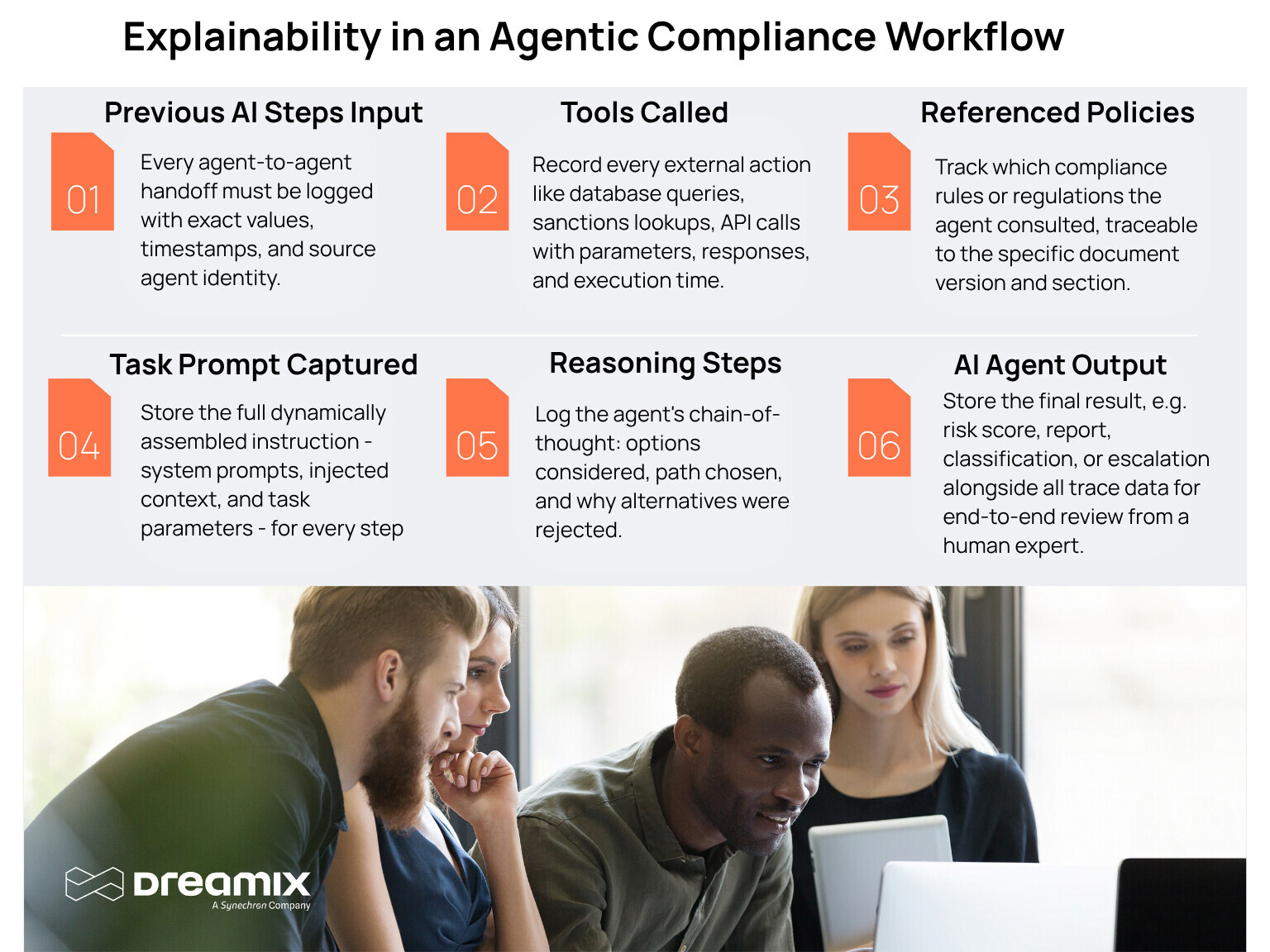
This six-layer traceability model maps directly to the requirements of the EU AI Act (Articles 12 and 14), the NIST AI Risk Management Framework's emphasis on documentation and accountability, and the practical expectations of auditors and regulators in financial services, pharma, and aviation. It also satisfies the emerging US state-level requirements for explainability in high-impact AI decisions.
Build vs. Buy: Making the Right Call
This decision will shape how your compliance function operates for the next 3-5 years and deserves more than a vendor comparison spreadsheet.
When building makes strategic sense
Investing in building AI compliance agents with an expert technological partner is viable given that:
Your regulatory requirements are highly specific: If you deal with complex multi-jurisdictional AML requirements, bespoke transaction monitoring thresholds, or compliance workflows tailored to a specific financial regulator's expectations, off-the-shelf platforms will get you 70% of the way and leave the 30% that regulators actually care about. Custom agents trained on your domain data and compliance history will outperform anything you can buy.
Your data is a genuine competitive advantage: Years of case resolution history, proprietary risk profiles, transaction patterns no vendor has access to. That data moat only compounds if you own the agent architecture.
Your engineering team has already shipped AI into production: McKinsey found only one-third of organisations have scaled AI beyond pilots. If your team has not done it before, a compliance workflow is not the place to learn.
Read next: AI Proof of Concept: 5 Steps to Build One That Scales
When you should rather buy
- Your compliance needs follow well-established patterns: KYC/AML screening, SOC 2 certification, GDPR data management, standard regulatory reporting - platform vendors have spent years solving these at scale. Rebuilding that capability internally is expensive and slow.
- You are working against a regulatory deadline: The EU AI Act takes effect in August 2026. A platform can get you to a compliant baseline in weeks. A custom build may take 6-12 months before your first agent hits production.
- Your engineering team is already stretched: Deloitte's State of AI 2026 report identified the AI skills gap as the single biggest barrier to integration. Every senior engineer you pull into a compliance build is an engineer not working on your core product.
When hybrid is the right architecture
Most organisations will not land cleanly on build or buy. The practical answer for the majority of CTOs is a hybrid approach when:
Your compliance stack spans both commodity and jurisdiction-specific workflows: Standard KYC/AML screening, sanctions list checks, and regulatory reporting are well-served by mature platform vendors. But the moment you need agents that apply jurisdiction-specific thresholds, cross-reference proprietary risk models, or handle sector-specific due diligence logic, you are in custom territory. Buying the baseline and building the orchestration layer on top gives you speed where it counts and control where it matters.
You need to own the governance layer regardless of what sits underneath: No vendor will take liability for your audit trail. Whether the screening agent is bought and the risk-scoring agent is built in-house, the data lineage, decision logs, human-in-the-loop checkpoints, and regulatory reporting infrastructure need to be yours. This is where the EU AI Act, DORA, and NIS2 requirements converge - and where accountability lands if something breaks.
Your team has strong engineering talent but limited compliance-domain bandwidth: A hybrid model lets your engineers focus on the orchestration, integration, and governance layers - where general software expertise translates well - while a platform handles the domain-heavy, regulation-tracked screening logic that takes years to build and maintain from scratch.
How Dreamix helps companies navigate the RegTech compliance landscape
The build vs. buy decision is complex precisely because it sits at the intersection of technology, regulation, and business strategy. Most organisations need a partner who understands all three.
This is where Dreamix operates.
Dreamix is an end-to-end digital product development company with deep domain expertise in fintech, RegTech, aviation, pharma, and transportation. Founded in 2006 and bootstrapped for nearly two decades, the company was acquired by Synechron in 2024, a global digital transformation consulting firm with 13,500+ professionals across 48 offices in 19 countries.
That combination gives Dreamix clients the technical depth and cultural cohesion of a focused engineering organisation with the global delivery reach, financial services pedigree, and AI capabilities of one of the largest consulting firms in the sector. Partnerships with clients typically last 5-10+ years, and a 95% employee retention rate - built on a team drawn from the top 10% of engineering talent - means the people who architect your compliance agents today are the same ones maintaining them two years from now.
Read next: 3 things to consider when choosing a software development partner by our CTO, Denis Danov
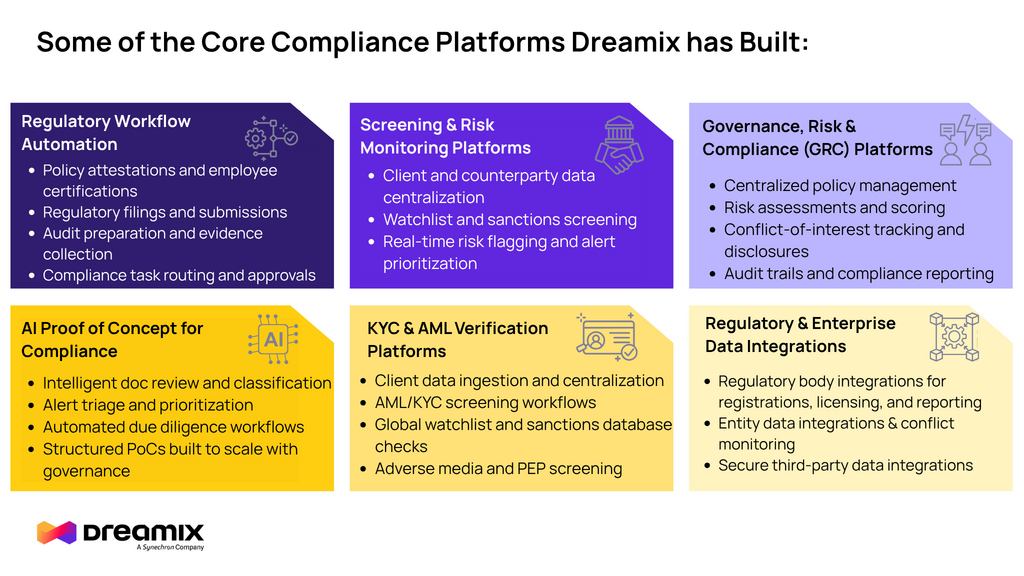
For companies navigating the AI compliance landscape specifically, Dreamix brings several capabilities to the table:
Custom AI compliance agent development: For organisations with unique regulatory requirements that platform solutions do not cover, Dreamix builds tailored AI agents designed for specific compliance workflows. These are built with governance, auditability, and human oversight embedded from the architecture level, not added as an afterthought.
RegTech platform integration and customisation: For organisations that choose a buy or hybrid path, Dreamix helps integrate platform solutions into existing technology stacks, customise them for jurisdiction-specific requirements, and build the connective tissue between off-the-shelf compliance tools and proprietary systems.
AI governance and infrastructure design: Dreamix helps organisations design and implement the governance layers that regulators and auditors expect: data lineage tracking, audit trail infrastructure, human-in-the-loop workflow design, access control architectures, and continuous monitoring systems. This governance infrastructure is essential regardless of whether you build or buy your compliance agents.
Domain-specific compliance expertise: With active engagements in fintech/RegTech, aviation, pharma, and transportation, Dreamix understands the regulatory nuances of each sector. The company's growing investment in AI, data, and security capabilities, combined with nearly two decades of engineering delivery in regulated industries, means compliance projects benefit from domain knowledge as well as technical execution.
Long-term partnership model: Compliance is not a one-time project. Regulations change. Models drift. New requirements emerge. Dreamix's partnership approach, where relationships typically span years rather than months, ensures that compliance infrastructure stays current as the regulatory landscape shifts. The majority of Dreamix's partners have been working with the company for more than three years, with many extending beyond five and even ten years.
The compliance AI landscape rewards organisations that combine strategic clarity with execution capability. Dreamix provides both. Whether you are building custom agents for a niche regulatory environment, integrating a platform solution into a complex technology estate, or designing the governance framework that ties it all together, Dreamix helps you move with confidence in a market where falling behind carries immense financial and reputational consequences.
FAQs about AI in compliance and RegTech:
We’d love to hear about your compliance and RegTech software needs and help you meet your business goals as soon as possible.