![female software engineer coding on computer 3861972 scaled 1 - What is a CI/CD Pipeline? [Updated 2026]](https://dreamix.eu/wp-content/uploads/2023/09/female-software-engineer-coding-on-computer-3861972-scaled-1-750x676.jpg "female software engineer coding on computer 3861972 scaled 1 - What is a CI/CD Pipeline? [Updated 2026] 2")
In today's fast-paced world of software development, delivering value quickly while maintaining high quality is essential for success. For custom software development companies, it's crucial that professional developers focus their efforts on activities that deliver the most value. This is where CI/CD pipelines play a vital role in modern development practices.
In a custom software application development company it is crucial that the effort of the professional developers is focused on delivering value. This is achieved through maximising the time spent on executing the work that they are most proficient at doing. The delivered value for example could be a newly added functionality or improved existing functionality.
This may sound pretty attractive - maximising the time that you spend, doing the things that you are most proficient at, providing the maximum value that you could generate. Let's start delving into what is a CI/CD pipeline.
What is a CI/CD Pipeline?
A CI/CD pipeline is an automated workflow that enables development teams to integrate code changes, run tests, and deliver applications quickly and reliably. The pipeline consists of two main components:
- Continuous Integration (CI) - The automated process of integrating code changes from multiple developers into a shared repository frequently throughout the day, with automatic verification through builds and tests.
- Continuous Delivery/Deployment (CD) - The automated process of delivering validated code to different environments after successful integration, ultimately making it available to users.
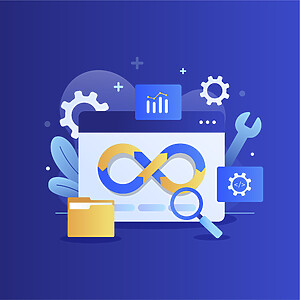
The term "pipeline" represents the connected sequence of automated processes that code travels through from development to production. As of 2025, CI/CD pipelines have evolved from a best practice to a fundamental requirement for competitive software development.
According to recent market analysis from Mordor Intelligence, the global continuous integration tools market reached nearly $1.73 billion in 2025 and is projected to grow at a CAGR of 21.18% to reach $4.53 billion by 2030, demonstrating the critical importance of CI/CD pipelines in modern development workflows
What is Continuous Integration (CI)?
Continuous integration (CI) is the automated process of integrating newly added code by a software developer to a common codebase.
“Continuous” entails that this is a process that each and every developer of the team is doing repetitively and often. Eventually, it’s done multiple times a day within the same team/codebase. As part of the process, it is expected that the newly introduced changes are validated and tested through automated builds so that they don’t break existing functionality.
The processes/builds that are repetitively executed in an automated way are often implemented and referred to as pipelines.
Goals of CI
- automating the tedious repetitive manual labor
- enabling developers to focus on development
- accelerating delivery of new features
- frequent integration cycles / small Pull Requests (PRs)
- improving the quality of delivered features
- improving the quality of an existing codebase
- catching errors earlier lowering cost of errors and bugs
The CI Part of a CI/CD Pipeline
Continuous integration (CI) is the first major component of a CI/CD pipeline, where developers frequently merge their code into a shared repository—usually multiple times a day. Automated tests immediately validate these changes, catching conflicts or errors before they pile up.
In modern CI/CD pipelines, the CI phase typically handles:
- Code compilation - Converting source code to executable format
- Dependency resolution - Managing and verifying external libraries
- Unit testing - Validating individual components
- Static code analysis - Checking code quality without execution
- Security scanning - Identifying potential vulnerabilities
What is Continuous Delivery (CD)?
Continuous delivery (CD) is a software development practice that ensures code changes are automatically built, tested, and prepared for release to production at any time. The goal of CD is to enable teams to release software faster and more reliably by automating every step of the release process after code integration.
- After continuous integration (CI) has validated that the new code passes all tests and quality checks, continuous delivery takes over by deploying the changes to staging or testing environments. From there, the software is only one manual approval step away from going live. This method provides rapid feedback, reduces risk, and supports a culture of frequent and confident releases.
- CD allows organisations to test how the application behaves in real-world-like environments well before it reaches production. This is especially useful for complex applications, microservices architectures, and cloud-native deployments.
By automating delivery to environments such as QA, staging, or UAT, teams can detect and fix problems earlier, respond to business changes faster, and maintain a more predictable deployment cycle. Continuous delivery is often a precursor to continuous deployment, where changes are released to production automatically.
The CD Part of a CI/CD Pipeline
Continuous delivery (CD) is the second major component of a CI/CD pipeline, automating the delivery of validated code to various environments. In 2025, CD has become more sophisticated, with advanced deployment strategies and environment configurations.
The primary goals of the CD portion of a CI/CD pipeline include:
- Automated, reliable deployments - Ensuring consistent, error-free deployment processes
- Reduced time-to-market - Getting new features to users faster
- Environment consistency - Maintaining identical configurations across environments
- Deployment flexibility - Supporting various deployment strategies (blue-green, canary, etc.)
- Risk reduction - Limiting the impact of deployment issues through automation
- Rapid feedback loops - Enabling quick validation of new features by stakeholders
- Infrastructure as Code (IaC) - Managing environment configurations through version-controlled code
- Release on demand - Making business-driven deployment decisions
- Deployment visibility - Providing transparency into the release process
- Environmental efficiency - Optimising resource utilisation for deployments
CI/CD: What is the Difference?
So, to recap what we have so far:
- Continuous integration (CI) takes care of integrating and validating the quality of the newly introduced code by developers to the common codebase in an automated way.
- Continuous delivery (CD) takes care of delivering a specific version (usually the latest) of our codebase to a specific environment in an automated way, making it available for a specific user groupContinuous deployment takes continuous delivery on steroids, the process is no longer only done in an automated way, it is being triggered and executed automatically.
- The CI and CD processes are responsible for different parts of the end-to-end software product development process. One affects existing codebase, the other affects existing environments.
Modern CI/CD pipelines
Modern CD pipelines deliver to various environments:
- Development - For ongoing development work
- Preview/Feature - For testing specific features in isolation
- Staging/Demo/Acceptance - For pre-production validation
- Production - For end-user access
- Sandbox - For experimentation and innovation
- AI Training - For custom AI development, training and validation
- Agentic AI development - For building custom AI agents for your business
CD processes can be triggered manually or automatically, depending on business requirements. For non-production environments, automatic CD pipelines often activate after successful CI completion. Production deployments typically require manual approval, though in 2025, more organisations are implementing fully automated production deployments with appropriate safeguards.
The continuous delivery process could be either a manually triggered or an automatically triggered one, depending on what the business desires. For example we could want an automatic CD pipeline to be run when we have successfully finished the execution of our CI pipeline and our fresh code increment was just merged to the common codebase. Such CD pipelines often deliver the latest state of our codebase to environments that are not being used by our end-users. In the case of delivering to a production environment, the business often prefers that this step is triggered manually.
In the case where we have an automatic deployment of software that passed successfully CI the process is called continuous deployment (not to be confused with continuous delivery).
Best CI/CD pipelines tools for 2026
The CI/CD pipeline landscape has evolved significantly. Here are the current best practices based on the latest industry standards. Leading CI/CD pipeline tools in 2026 include:
- Jenkins and Jenkins X - Mature, highly customisable platforms
- GitLab CI/CD - Integrated with the popular GitLab platform
- GitHub Actions - Tightly integrated with GitHub repositories
- Travis CI - Simple, cloud-based CI
- CircleCI - Cloud-native CI/CD platform
- Harness CI - AI-powered CI platform
- Bamboo - Enterprise-focused CI
- Azure DevOps - Microsoft's integrated DevOps solution
- AWS CodeBuild/CodePipeline - Amazon's cloud-native CI/CD services
Best CI/CD practices (from real life experience):
- Write tests for all mission-critical functionalities, functional and non-functional qualities that you want your system to comply to.
- Run all available tests on each integration build.
- Having more and better written tests will lower the time that you spend on debugging.
- Write a failing test, add just enough production code for the test to pass, refactor the production and test code, repeat.
- This is also known as Test driven development (TDD), a concept similar to behavior driven development
- Become aware of the testing pyramid and the value and impact that the tests on each layer have.
- Do not disregard manual and exploratory testing.
- Have people that take care specifically for that part of the software development process like SysAdmins or DevOps.
- Enable developers to focus on what they are good at writing code and producing features for the product.
- Enforce static analysis on the code, e.g. with SonarQube and SonarGraph so that the quality of the code can become transparent in order for it to be observed in time.
- It is a good idea that there is a quality gate enforced on each Pull Request (PR) as part of the CI process that will not allow code with low quality to get integrated into the common codebase.
- CI/CD pipelines are also helpful in regard to how to manage technical debt without sacrificing innovation.
- Enable developers to test the code-to-be-integrated into the common codebase as easily and as quickly as possible. Literally this means being able to create an environment from the code version of a particular pull request. These are known as preview environments or feature environments.
Conclusion: The future of CI/CD pipelines
CI/CD pipelines have evolved from optional best practices to essential foundations for modern software development. In 2025, these pipelines have expanded beyond basic automation to incorporate AI, advanced security, and sophisticated monitoring. Organisations that excel at implementing CI/CD gain significant competitive advantages through faster delivery, higher quality, and more sustainable development practices.
By implementing the principles and practices outlined in this guide, your organisation can harness the full power of CI/CD pipelines to deliver exceptional software that meets the demands of today's rapidly changing market.
We’d love to hear about your software project and help you meet your business goals as soon as possible.