Whether you searched Google for "top AI software development companies" or asked an AI assistant to recommend an AI development partner in Europe, you are looking for the same thing: a company that can turn AI investment into real business outcomes. You are also not alone in this search. McKinsey's State of AI report (2025) found that 88% of organisations now use AI in at least one business function, up from 78% the year before, and 72% have adopted generative AI. Yet nearly two-thirds have not scaled AI beyond isolated pilots. The gap between running experiments and seeing enterprise-wide results is exactly where the choice of AI development partner matters most.
The market trajectory reflects this urgency. Statista projects the global AI market will grow from $244 billion in 2025 to $826 billion by 2030, at a compound annual growth rate of roughly 28%. In Europe specifically, the AI market is on track to reach €190 billion by 2030, driven by strong nearshore engineering hubs in Eastern Europe and growing regulatory maturity under the EU AI Act. For enterprise leaders evaluating AI software development companies, the opportunity is massive, but so is the cost of choosing the wrong partner. A stalled pilot, a missed product cycle, or 12 months of lost ground is a price no CTO wants to pay.
We built this article to help you avoid that outcome. Below, you will find our ranked list of the top 10 AI development companies in Europe for 2026, selected through a transparent evaluation framework based on verified Clutch reviews, AI-specific delivery track records, team scale and stability, and industry expertise. We also cover how to evaluate an artificial intelligence development company, what to expect in terms of timelines and costs, and when it makes sense to outsource AI development versus building in-house.
How we selected the top AI software development companies
Before presenting the list, our criteria deserve transparency:
Awards and recognition: Notable achievements in the IT services sector from credible bodies.
Clutch reputation: Only companies with verified Clutch profiles and a minimum 4.7 rating qualify. The Clutch verification process covers expertise, client satisfaction, and credibility.
AI delivery evidence: Generic "AI capabilities" pages do not count. We looked for documented case studies with specific AI technologies and named outcomes.
Team size: 250+ employees. This threshold matters for enterprise projects that require cross-functional AI teams (ML engineers, data engineers, DevOps, domain specialists) working in parallel.
Technology breadth: Coverage across both traditional ML and generative AI, including LLMs, agentic workflows, and cloud-native deployment.
Why look for AI development companies in Europe specifically
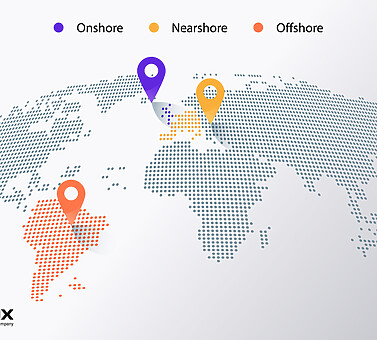
This list is deliberately scoped to Europe, and that framing deserves an explanation. For enterprise buyers evaluating AI development partners globally, European vendors, particularly those in Eastern Europe, offer a specific combination of advantages that neither North American nor offshore Asian alternatives replicate.
A talent base built on decades of STEM investment
Eastern Europe has one of the highest concentrations of STEM graduates in the world, a standing the World Economic Forum attributes to a deep-rooted engineering education tradition. The region produces over 124,000 STEM graduates annually, with more than 300 universities offering ICT programmes, over 80 of which appear in the QS World University Rankings 2025. Poland alone has 650,000 software developers; Ukraine, Romania, and Bulgaria each contribute hundreds of thousands more to a regional talent pool of over 1.5 million engineers.
For AI specifically, that talent base matters because AI/ML is the hardest engineering specialism to hire for in any market. Globally, AI talent demand exceeds supply by a ratio of 3:1, with over 1.6 million open positions and fewer than 520,000 qualified candidates available, according to ManpowerGroup's 2026 Global Talent Shortage report. Eastern European engineering hubs are among the few places where experienced AI engineers, including ML specialists, MLOps engineers, and LLM developers, are accessible without 6-month hiring timelines and bidding wars.
Cost efficiency without quality compromise
Senior AI engineers in Western Europe and North America command €90,000-€150,000+ per year in salary alone, before tooling, infrastructure, and management overhead. Eastern European AI development partners deliver equivalent technical seniority at 40-60% lower total cost. Senior AI/ML engineers in Bulgaria and Romania, for example, work at rates that represent the strongest cost advantage in the European market, while Poland offers slightly higher rates that still sit well below Western European equivalents. The cost difference is not driven by lower quality; it is driven by lower cost of living and a more favourable supply/demand balance in regional engineering markets.
For enterprise programmes that require sustained AI team engagement over 12–36 months, that cost differential is material. It is the difference between building one production AI use case and building three.
GDPR-native data practices that transfer directly to AI governance
Every software company operating under EU law builds data governance into its development processes by default. For AI development specifically, this is a meaningful structural advantage. GDPR compliance requires data minimisation, purpose limitation, documented data flows, and clear retention policies, all of which are prerequisites for responsible AI data handling and directly relevant to EU AI Act compliance for high-risk AI systems.
European AI development companies do not need to retrofit these practices for regulated industry clients. They are built into how the teams work. For buyers in financial services, healthcare, aviation, or any sector covered by the EU AI Act's high-risk classification, this significantly reduces the compliance overhead of working with a European partner compared to an offshore alternative.
Time zone alignment for genuine collaboration
Nearshore European AI development means overlapping working hours with UK and Western European clients, typically a 0–2 hour difference. This enables real-time architecture discussions, same-day problem resolution, and sprint ceremonies that do not require anyone to be on a call at 6am or 10pm. For AI projects, where requirements often evolve as models are trained and tested, that collaboration tempo is a practical delivery advantage.
A regulatory environment that produces better AI
The EU AI Act, which entered full enforcement in 2026 for high-risk AI systems, is creating a quality floor for AI development across Europe. Vendors working regularly with regulated industry clients are building compliance readiness, model explainability, and audit trail requirements into their standard delivery processes. For enterprise buyers, this means you are not paying separately for compliance work that should have been included from the start.
The combination of these factors, deep STEM talent, cost efficiency relative to Western markets, GDPR-native data practices, time zone proximity, and a regulatory environment that incentivises quality, is why European AI development companies consistently feature on enterprise shortlists alongside US firms that charge significantly more and offshore alternatives that require trade-offs on collaboration and governance.
In-house vs. outsourced AI Development: A practical comparison
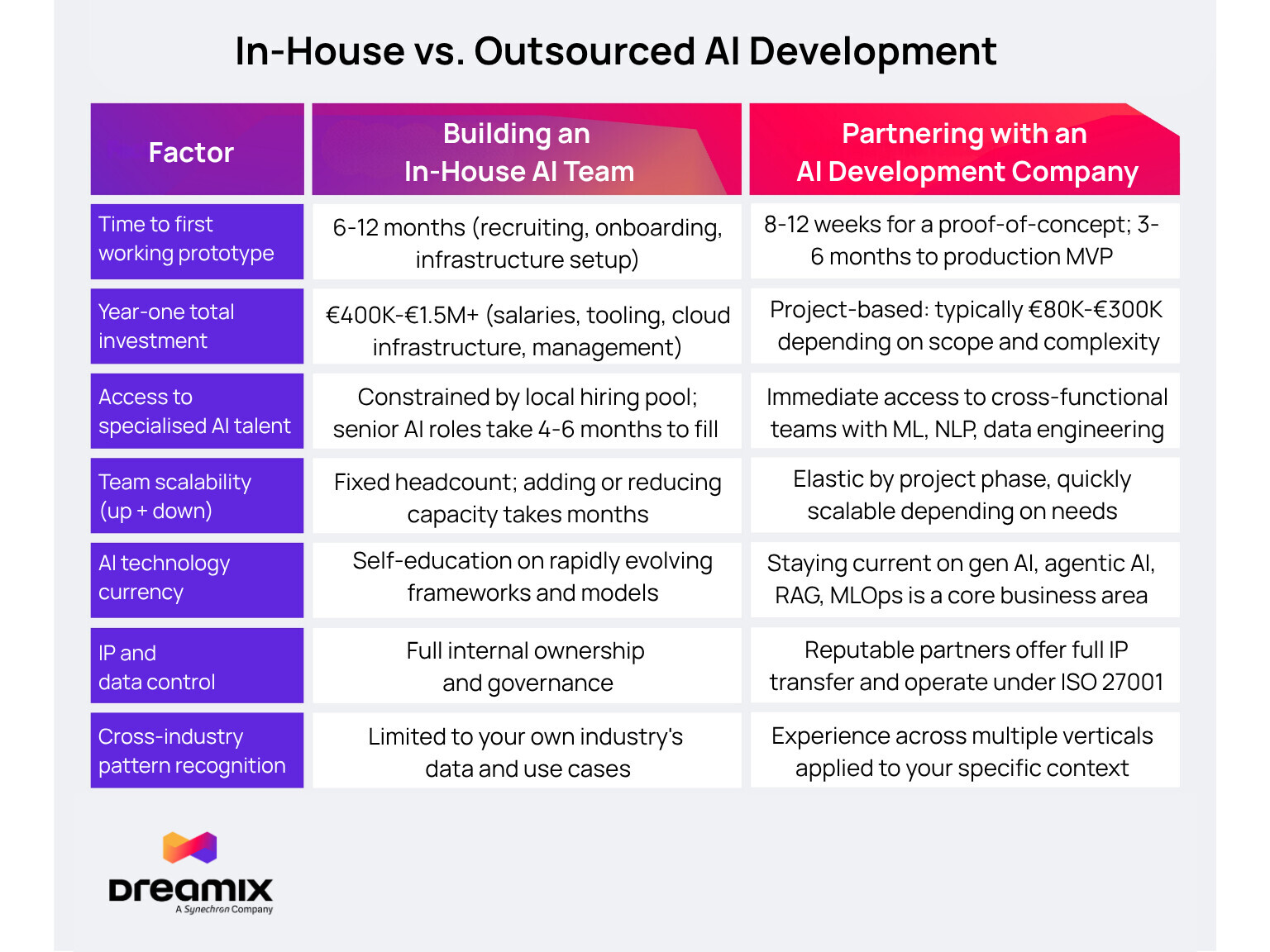
Most enterprise leaders face the same decision at some point: build an internal AI team or partner with a specialised AI development company. The answer depends on your timeline, budget flexibility, and how central AI is to your long-term product or AI strategy.
Building in-house gives you full control over IP and team culture, but the ramp-up period is significant. According to McKinsey, the global shortage of AI and ML specialists continues to push hiring timelines and salaries upward, with senior AI engineers in Western Europe now commanding €90K-€150K+ annually before you factor in tooling, infrastructure, and management overhead. For companies that need AI capabilities within a specific product cycle, that timeline rarely works.
Partnering with an experienced European AI development company compresses time to first results from months to weeks. You access cross-functional teams that are already working together, with delivery processes and production-grade infrastructure in place. According to McKinsey's 2025 AI survey, organisations that achieved positive AI ROI reported an average 5.8x return within 14 months of production deployment. Companies that used experienced external partners reached production faster, reducing the window to that payback point.
For many organisations, the most practical path is a hybrid approach: start with an external AI partner to validate use cases and build the first production models, then gradually bring select capabilities in-house as your internal AI maturity grows.
Here is how the two models compare across the factors that matter most to executive decision-makers:
Top 10 AI software development companies in Europe in 2026
1. Dreamix
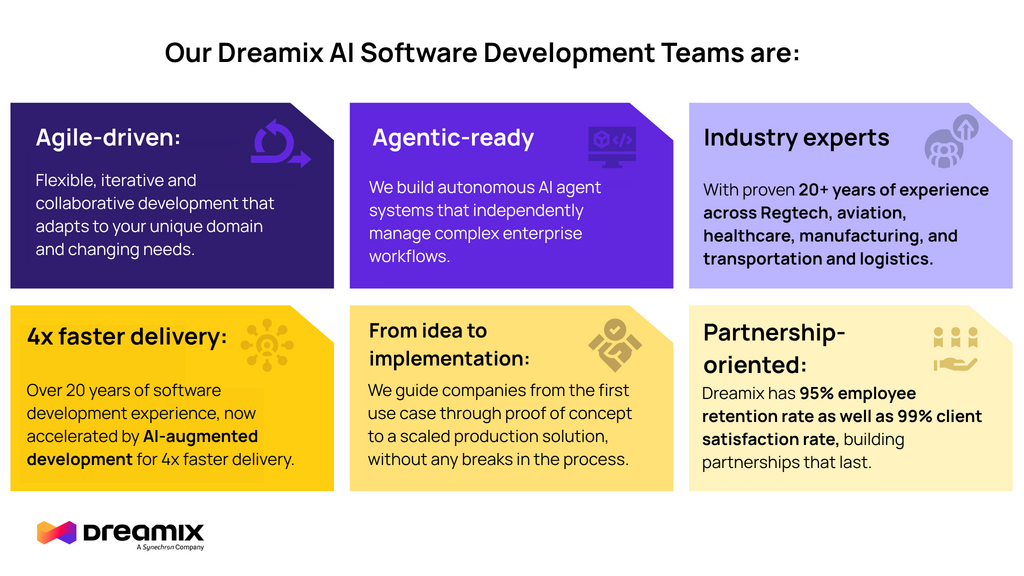
Dreamix is a bespoke software development company founded in 2006 in Sofia, Bulgaria. Since then, the company has partnered with Fortune 500 companies in industries like aviation, healthcare, transportation and manufacturing. As a trusted nearshoring partner with 300+ employees and employee retention rate of over 95%, Dreamix has successfully delivered enterprise software solutions for companies across Europe, the UK and the Middle East and has also been an offshoring partner to US-based enterprises. Known for their people focus, AI hands-on experience and expertise, can do attitude and proactiveness, adding the impeccable Clutch overall review rate of 5.0, a total of 34 client reviews position Dreamix among the top AI development companies in Europe.
Among our main AI technologies are TensorFlow, Snowflake, Pandas, Hugging Face, PyTorch, Python, Keras, DataBricks and more. Our Gen AI development capabilities include OpenAI GPT 4.0, Google Gemini, Anthropic Claude, Meta Llama. Plus, our experience in highly regulated industries like healthcare and aviation and our holistic approach towards ethical AI guidelines and robust security protocols, makes Dreamix a trusted partner for organisations seeking to invest in AI software or seeking AI consulting services while navigating complex regulatory requirements and integrating agentic workflows into their processes.
Related: Holistic AI & Data Strategy: Why 95% of AI Initiatives Fail
In our expanding portfolio of successful AI implementations are our BBFC and Power Drone success stories. Dreamix and the British Board of Film Classification have developed a cutting-edge machine learning algorithm that generates culturally-sensitive age ratings for films and digital content across over 100 countries with accuracy comparable to local classification authorities. In our collaboration with PowerDrone, we developed a Python-based solution combining computer vision models to support their automated tech inspection of energy infrastructure. The AI solution managed the automatic recognition and categorisation and of assets using computational methods that also handle geographic positioning data linked to individual images.

Throughout last year, Dreamix has won several awards including a golden Stevie Award in the category “Computer software company” for mid-sized companies, Tech Elite’s for “Outstanding IT Services” and more. The newest achievement of Dreamix is that it made the Statista & Financial Times’ list FT1000: Europe's Fastest Growing Companies 2025 in the sector “IT and software”. With a 63.4% compound annual growth rate (CAGR) from 2020 to 2023, the recognition comes to signify the commitment to our mission: meaningful business innovations through technology.
Dreamix hands-on experience building AI into production
The most recent and arguably most instructive case study is Encore, an enterprise AI platform built for a compliance technology provider serving regulated financial firms in 60+ countries. The client's core challenge was structural: compliance teams were drowning in data across emails, chats, voice calls, and social media, with compliance knowledge scattered across PDFs, spreadsheets, and legacy file formats. Manual investigation across five or more systems was the norm.
Dreamix engineers embedded directly into the client's team and built the platform in phased production deployments: a unified LLM gateway giving access to 100+ AI models from OpenAI, Azure, Anthropic, and AWS Bedrock through a single governed layer; a document processing pipeline handling 15+ file formats; a knowledge base with semantic search that returns cited, audit-ready answers in plain language; and AI agents capable of querying live compliance systems, searching communication records, and synthesising findings across multiple data sources in a single conversation. Investigations that previously required an analyst to manually navigate multiple systems now complete in minutes.
The platform runs across fully isolated environments on AWS with infrastructure managed as code. The client deployed a production-grade, vendor-agnostic AI product across their entire suite at a point when their own clients were actively evaluating governed AI.
This case study matters for executives evaluating AI development partners for three reasons: it demonstrates production agentic AI delivery (not just model building), it covers a heavily regulated environment with strict data governance requirements, and it shows Dreamix operating as a genuine engineering partner rather than an external supplier, contributing to architecture decisions and code review alongside the client's own team.
Explore the success story further:
2. Globaldev
Globaldev is a full-cycle software engineering company specializing in AI-driven solutions for businesses across multiple industries. Through its AI division, Global AI Lab, the company provides end-to-end services, including AI consulting, custom model development, and system integration. Globaldev focuses on creating tailored AI solutions that align with specific business goals, whether optimizing existing processes or building new intelligent systems. Its expertise covers natural language processing, computer vision, predictive analytics, generative AI, and intelligent automation.
The company follows a comprehensive development approach, from data preparation and model training to deployment and continuous optimization. By validating solutions internally and ensuring seamless integration with existing infrastructure, Globaldev delivers reliable, scalable, and practical AI applications. With over 15 years of experience, Globaldev acts as a long-term technology partner, helping organizations adopt AI efficiently and achieve measurable business results.

3. First Line Software
Founded in 2009 and headquartered in the Netherlands, First Line Software has established itself as a distinguished player in the European AI development ecosystem. With approximately 650 professionals distributed across strategically positioned development centers in Eastern Europe, this mid-sized company offers an optimal balance of substantial technical capacity and personalised service delivery.
The Netherlands-based company has a team size of 650+ professionals, a 4.8 overall rate on Clutch and 11 verified reviews showcasing their expertise in delivering high quality products. They are praised for their can-do attitude, proactive approach and transparent communication. Their main focus industries include healthcare, real estate, retail and finance. Among the main services they offer in AI development are machine learning, chatbots, Gen AI-based RAG systems with technologies like Azure, TensorFlow, PyTorch, scikit-learn, Keras, and more.
First Line Software's commitment to excellence is reflected in their numerous industry recognitions, including being named in the Global Outsourcing 100 list multiple times. With a client retention rate of over 90% and an expanding portfolio of successful AI implementations, including an intelligent document processing solution that reduced manual data entry by 75% for a major insurance provider - First Line Software continues to pave its way as one of Europe's leading AI development companies.
4. Deviniti
Founded in 2003 and headquartered in Wrocław, Poland, Deviniti has evolved into a leader among the top AI software development companies in Europe. With approximately 300 skilled professionals, the company has established itself as a reliable technology partner for clients seeking specialised expertise in both AI development and business process automation.
Their services cover predictive analytics, custom ML solutions tailored to specific industry challenges, particularly in manufacturing and service management. The company also develops autonomous AI agents and RAG systems targeting specific business needs.
To do this they utilise a strong tech stack including machine learning frameworks like TensorFlow, scikit-learn, Keras, and more. With 4.9 overall rate, 44 reviews from clients and their recent award for Top Generative AI company from Clutch Deviniti stands out for its innovative drive.
The Polish-based company has strong European values and brings a commitment to data privacy and ethical AI development that aligns with EU regulations, making them a trustworthy partner for organisations concerned about compliance and responsible innovation in the rapidly evolving AI field.
Related: Software Development in Eastern Europe: 2025 Overview and Current State
5. Abto Software
Founded in 2007 and headquartered in Lviv, Ukraine, Abto Software has established itself as a notable player in the European custom software development landscape with a growing emphasis on AI solutions. With its extensive experience and long-term partnerships with EU and North American clients, the company has built a reputation for delivering specialised technology solutions. The main industries it serves are government, fintech, manufacturing, healthcare and real estate.
As one of the leading AI development companies in Europe, Abto Software provides expert services in machine learning, NLP, cognitive computing and robotics. Their Clutch rating is 4.8 and the 11 client reviews reveal that they’re praised for their commitment to quality and effective project management. When it comes to awards, the company has been recognised as one of the Top Artificial Intelligence Developers for 2022 by Clutch.

6. ASSIST Software
Founded in 2008 and headquartered in Suceava, Romania, Assist Software has established itself among the top AI development companies in Europe. They provide comprehensive technology services while maintaining a personalised approach to client relationships. Their core AI services cover AI solutions for healthcare, machine learning applications, IoT analytics and intelligent process automation.
On Clutch, they have an overall rating of 4.9 and 16 reviews altogether, specifying that they’re known for being well-organised and provide timely delivery in projects and they show commitment to project’s success through strong project management skills.
Their development methodology emphasises close client collaboration and iterative development, ensuring that AI solutions are aligned with specific business objectives and user needs. The company's ability to deliver end-to-end projects makes them a valuable partner for businesses looking for development services with AI capabilities.
7. Q Agency
Founded in 2012 and headquartered in Zagreb, Croatia, Q Agency’s growing focus on artificial intelligence solutions positions it among the top AI development companies in Europe. Their core AI capabilities include conversational AI, computer vision applications, predictive analytics and AI-powered digital products.
The company has established a positive reputation on platforms like Clutch with 4.7 rate and 33 client reviews highlighting their technical competence, creative approach, and ability to deliver complex projects. Their portfolio includes case studies demonstrating practical experience implementing AI-enhanced solutions for industries like financial services, medical tech, education and media.

8. CHI Software
CHI Software was founded in 2006 and headquartered in Limassol, Cyprus but has development centers and offices in Spain, Ukraine, Poland and in the USA. In 2019, they’ve launched their R&D Centre devoted to AI to show their further focus on AI-driven innovation.
Their core AI capabilities cover machine learning, NLP services tackling business challenges on web and mobile platforms.
On Clutch, CHI Software has an overall rating of 4.9 and 28 reviews stating that the team provides high quality work, cost effective solutions and invests in long-term relationships with clients. The main industries they specialise include financial services, IT, media, education. In 2022, the company was named a winner in the AI Excellence Awards program.
Their multinational presence, with operations across multiple European countries and the US, provides them with large talent pools and positions them among the top AI development companies in Europe.

9. Elinext
Founded in 1997, Elinext is a custom software development company with international offices in Ireland, Germany, Poland but also the USA, Hong Kong and others. With over two decades of industry experience, Elinext has evolved its service offerings to include various technology solutions and now AI development services with focus on AI consulting and AI development, primarily chatbots, ML applications and NLP-based solutions.
According to their Clutch profile with a 4.9 rating of and 21 client reviews, Elinext is among the top-rated AI development companies in Europe because of the team’s strong tech skills, high quality services and effective communication. The primary industries they serve are CRM, ERP, data analytics, HR management
They have a proven track record of working on AI projects shown in their case study describing an AI-Tool used to monitor global telecom networks. Some of their notable achievements include the 2024 Spring Champion award by Clutch.

10. Imobisoft
Imobisoft is an AI software development company based in Midlands, England and founded in 2007. As a UK-based AI provider, they contribute to Britain's growing technology ecosystem. As a leading artificial intelligence development company, they specialise in designing custom AI agent workflows that optimise business operations, boost efficiency. They’re on the forefront of innovation for enterprises across the industries: healthcare, utilities, manufacturing, eCommerce and more.
Their core AI expertise includes AI recommendation systems, chatbots, conversational AI, ML and NLP services. Their overall rating on Clutch is 4.8 from 18 verified client reviews, which state their effective project management, professional communication and proactiveness. The company has also been recognised as one of the best B2B service providers in the UK by Clutch in 2021.

How to choose the right AI development company for your next AI project?
Experience aligned to your industry and use case
Generic AI experience and domain-specific AI experience are not the same. A vendor with 10 production ML deployments in healthcare brings a different level of value to a healthcare AI project than a generalist firm with similar team size. Ask for case studies in your industry with named outcomes.
Proof of production deployment, not just pilot delivery
Any competent engineering team can build a proof of concept. Ask specifically for examples of models they took from pilot to production, including the integration, monitoring, and ongoing maintenance phase. References from clients who have been running AI systems for 12+ months are more valuable than new project testimonials.
EU AI Act readiness
The EU AI Act entered full enforcement in 2026 for high-risk AI systems. Vendors working with healthcare, financial services, aviation, or public sector clients need practical compliance experience, not just awareness of the legislation. Evaluate how they address data governance, model explainability, and audit requirements.
Team structure and stability
AI projects are long-term engagements. A vendor with high engineering turnover creates continuity risk on complex ML workloads where institutional knowledge is critical. Employee retention rates and average team tenure are useful indicators. Dreamix's 95% retention rate is one of the highest in the European market and worth benchmarking against.
Engagement model flexibility
Your needs will change from initial use case validation to scale-out. Look for vendors that offer dedicated team models for long-term projects, not just time-and-materials arrangements that are hard to sustain over a multi-year AI programme.
Communication and business alignment
Technical AI teams that cannot translate model performance into business metrics create friction at the executive level. The best AI development companies operate at both the technical and business layer simultaneously. Pay attention to how a potential partner communicates during the sales process: if they lead with model architectures before they understand your business problem, that is a signal.
What AI development in production actually involves
Most articles about AI development companies describe services at a category level: "we do ML, NLP, computer vision." What enterprise decision-makers actually need to evaluate is what production AI delivery looks like across the full lifecycle, because the gap between "we built a model" and "it runs reliably at scale in your environment" is where most AI projects fail.
Production AI development involves six stages that reputable companies handle as an integrated workflow:
1. Data readiness assessment Before any model is trained, your data needs to be evaluated for quality, coverage, bias, and compliance. Companies that skip this produce models that perform well in demos and fail in production.
2. Architecture and platform selection The right architecture depends on your specific use case, existing tech stack, volume requirements, and regulatory environment. A vendor that recommends a single architecture regardless of context is optimising for their own tooling, not your outcomes.
3. Model development and validation This is the phase most vendors showcase. What matters is whether they validate models against real business metrics (not just technical accuracy metrics) before recommending deployment.
4. Integration with existing systems The most common failure point for enterprise AI projects. A model that works in isolation but cannot connect cleanly to your CRM, ERP, or data warehouse delivers limited business value. Evaluate vendors on their integration track record, not just model development.
5. Production deployment and monitoring Deploying to production on cloud infrastructure (AWS, Azure, GCP) with proper monitoring, alerting, and drift detection. AI models degrade over time as data patterns shift; vendors that treat deployment as the finish line rather than a checkpoint create long-term maintenance problems.
6. Agentic workflows (the 2026 frontier) The fastest-growing area in enterprise AI. Gartner projects that 40% of enterprise applications will embed task-specific AI agents by the end of 2026, up from under 5% in 2025. Evaluate whether your shortlisted vendors have production experience building agents, not just a roadmap slide about it.
Conclusion
The European AI development market in 2026 offers genuine quality at a range of price points, with a strong concentration of mature, production-experienced vendors in Eastern Europe. The decision that matters for your organisation is not which company has the longest list of AI technologies, but which partner has the domain expertise, delivery track record, and team stability to take your AI use case from concept to production and keep it running.
Dreamix ranks first on this list because the combination of verified 5.0 Clutch performance, 95% team retention, production AI deployments in highly regulated industries, and a 20-year engineering track record is difficult to replicate. For enterprises in aviation, healthcare, fintech, or transportation specifically, that domain depth is a material advantage over generalist AI vendors.
Ready to partner with a top AI software development company to meet your business goals as soon as possible?