
With talk of data being the new oil and driving all manner of new technologies, you may be considering hiring or even becoming a data engineer. But have you taken a deeper dive into the data engineer salary ranges? Whether you're building an in-house team or partnering with a company for bespoke software development and data engineering, understanding market rates is essential for competitive hiring and budget planning. Let’s explore their salary ranges by country and experience.
Data engineers – a profession in increasing demand
Data engineers are rapidly becoming essential players in the modern technological landscape, with their demand soaring in recent years. As companies harness the power of big data to drive decision-making and innovation, the need for skilled professionals to manage, process, and analyze this data has grown exponentially. Data engineers fill this crucial role by designing, constructing, and maintaining the systems and architecture necessary for handling vast amounts of data efficiently and securely.
Their responsibilities include developing pipelines for data ingestion, transformation, and storage, ensuring data quality and reliability, and implementing solutions for scalability and performance optimization. With the proliferation of IoT devices, social media platforms, and digital transactions, the volume and variety of data generated continue to expand, fueling the demand for proficient data engineers across industries such as finance, healthcare, e-commerce, and more.
Moreover, as machine learning and artificial intelligence technologies continue to advance, data engineers play a pivotal role in building the infrastructure required for training and deploying models, further cementing their position as indispensable assets in the data-driven economy.
Do data engineers make good money?
Naturally, for those looking to transition to, or pay for, data engineering, salary is one of the main aspects to consider. However, salary ranges can vary significantly by region, industry, level of expertise, and organization size.
In this article, we’ll look at what data engineers can expect to earn based mostly on their years of experience and region, relying on reports from Indeed, Glassdoor, and other sources.
Data engineers typically command lucrative salaries due to their specialized skill set and high demand in the job market. Their expertise in designing, implementing, and maintaining data infrastructure is invaluable for companies aiming to harness the power of big data for strategic decision-making and innovation. Salaries for data engineers can vary based on factors such as experience, location, industry, and company size. However, in many cases, data engineers enjoy above-average compensation compared to other IT professionals.
According to various industry reports and salary surveys, data engineers often earn salaries that exceed the national average for IT professionals. Additionally, as the demand for data engineers continues to rise, so does their earning potential. With experience and expertise, data engineers can negotiate even higher salaries and attractive benefits packages, making it a financially rewarding career choice for those with a passion for data management and analytics.
Is AI going to take over data engineering jobs?
Since data analysis is one of the tasks AI seems to be best at, it’s logical to wonder if artificial intelligence will replace data engineers or at least significantly reduce the number of jobs available. In reality, this isn’t something data engineers need to worry about as the job is much more complex than simply pulling information from a database.
However, AI data analytics tools do have their place in the industry and have been adopted by nearly everyone in IT. This has enabled them to streamline work processes and speed through routine tasks so they can focus on the more difficult aspects of their job. AI-augmented data prep and ETL, for example, have been tremendously helpful for data engineers, enabling them to meet the ever increasing demand for analytics and process larger amounts of data faster.
Ultimately, data engineers won't be replaced by AI because their role involves more than just data processing. They design, build, and maintain complex data infrastructure, requiring human creativity, problem-solving skills, and domain knowledge. Moreover, AI relies on data engineers to develop and optimize the very systems it operates within. You can rest assured there will be lots of work for skilled data engineers in the future.
Data engineer rates – outsource or direct hire?
For those looking to become data engineers, working directly for a single company or as a contractor each offer their own benefits.
Direct employment offers stability, benefits, and potential career growth within a company. It provides a sense of belonging, opportunities for skill development, and a steady income stream. This makes being a direct hire a fantastic choice for data engineers looking to bulk up their portfolio and gain experience that will allow them to get significantly better pay later on.
On the other hand, being a contractor offers flexibility, autonomy, and potentially higher pay rates. Freelancing data engineers have more control over their projects, schedule, and clients, but they also shoulder more risk - work and therefore their income can be somewhat unpredictable. This way of working is best suited for those who handle uncertainty well and thrive on variety, as it allows them to work on several different projects simultaneously, exploring diverse opportunities. Unless you’re well-established and in-demand, you’ll have to be proactive in looking for new clients and projects. As you’re essentially self-employed, you’ll also have to manage a few administrative tasks.
Ultimately, the decision depends on individual preferences, career goals, and risk tolerance. Some data engineers thrive in the freelance lifestyle, while others prefer the stability and benefits of traditional employment. It's essential to carefully weigh the pros and cons before making a decision.
Average data engineer salary range in the United Kingdom
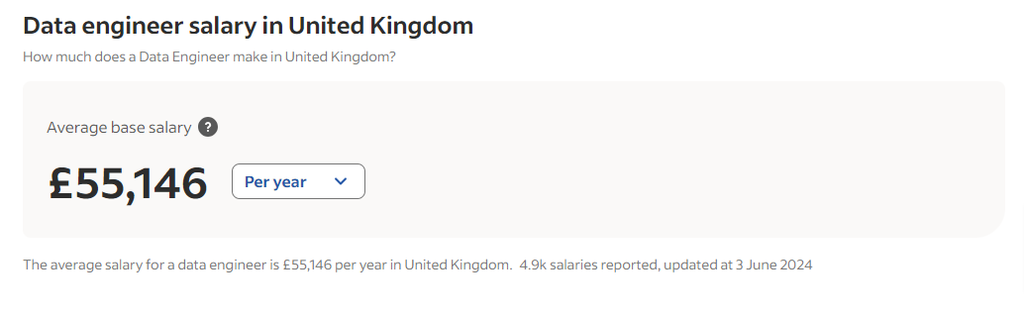
Average salaries for data engineers in the United Kingdom vary greatly based on their location and level of expertise. As you can imagine, someone working in London would make significantly more than a data engineer (DE) employed in, say, Edinburgh. But in all cases, you can expect the salary to rise for positions requiring more experience.
According to Indeed, the avery data engineer salary in the United Kingdom is currently £54,147, with the highest average being £62,679 for London, closely followed by Cambridge at £62,350 per year, and then dropping to around £50k for Bristol, Birmingham, Glasgow, Manchester, and Leeds.
Salary by level of experience
It’s obvious that data engineers with more experience earn higher salaries, but let’s put that into numbers. There are three main levels - junior, mid, and senior, but there’s also lead and principal data engineers.
A junior data engineer is generally expected to be familiar with the common tools and data relevant for their team, build very simple pipelines with low downstream dependency, work on simple ad-hoc queries, and be working on advancing their knowledge. Salaries for junior and entry-level data engineering positions can vary quite a bit depending on the company and the education of the candidate. On average, a junior data engineer can expect to make about £40k a year, but they can get an offer as high as £49k.
Mid-level data engineers need to be more independent in their work, be able to figure out a solution for a problem that lacks detail, know when and who to ask for help, be comfortable optimizing pipelines, and be building an understanding of best practices.
Senior data engineers need to have subject matter expertise in several different business areas and the soft skills necessary to communicate why and how their suggested solutions will work to equivalent & senior colleagues. Mentoring junior and mid DE’s is a big part of their role, so they need to have a thorough understanding of the tradeoffs between data sources and tools in their organization.
Mid-level data engineers typically command salaries ranging from £35,000 to £60,000 annually, while senior data engineers with extensive experience and managerial responsibilities can earn upwards of £60,000 to £100,000 or more.
Lead and principal data engineers oversee teams, imparting knowledge and devising development strategies. They manage departmental scope, orchestrating data architecture to ensure scalability and sustainability. Their expertise lies in constructing intricate pipelines that drive significant business improvements.
Based on 86 salaries submitted anonymously, Glassdoor puts the average salary for lead data engineers in the UK at £88,845 per year for London (the range is £64K - £95K).
Average data engineer salary range in the USA

Data engineering has emerged as one of the highest-paid remote tech jobs for 2024, making it a very attractive and therefore highly competitive field for job seekers in the US. As companies increasingly rely on data-driven insights to fuel decision-making and innovation, the demand for skilled data engineers continues to soar.
While Indeed presents the average base salary for data engineers in 2024 as $128,385 for the US, the sheer size of the country means there’s a great deal of variation in pay based on location alone. As with any other position, level of expertise and size of the organization also significantly impact the salary range.
To give you an idea, the average salary for the highest paying city for data engineers - San Jose, CA, is reported as $170, 459 per year, while in Irving, TX, the average of 50 reported salaries is $118,378 per year.
By level of experience
One of the biggest factors for finding high-paid work in the industry remains the level of experience. A highly-skilled data engineer with years of experience will be sought after and naturally command an enviable salary. While entry-level and junior DE’s might have a tougher time landing a well-paid offer, their future career prospects are excellent, making venturing into data engineering well worth the upfront investment of time and effort.
Junior data engineers average an annual salary of about $71,799 in the US, but anything in the range $60-80k would be realistic. For mid-level DE’s the range goes from $110k to about $130k per year. Keep in mind that there is a huge delta in capabilities between candidates at this level and that is reflected in the salaries offered. Senior data engineers in the US can make well over $200k a year, but are typically given great bonuses and stock options in addition to their base salary.
Like with most other tech jobs in the US, if you’re an experienced candidate, you can expect a signing bonus and yearly bonuses after that on top of your annual salary, but those vary greatly between different companies and industries, and according to your expertise. As an anecdotal example, one Seattle-based Reddit user with 7 years of experience reported a signing bonus of $20k and base salary of $190k for a Senior Analytics Engineer position, and then a total of $120k in bonuses spread evenly over the course of 4 years.
Granted, they got their signing bonus over 4 years ago, around 2020, so that would have to at the very least be adjusted for inflation to get a more current number. Seattle also has quite a high standard of living, which further impacts salaries.
Average data engineer salary range in Germany
Glassdoor reports the average data engineer salary in Germany as being in the €60k - €78k per year range, the breakdown being €58k - €72k base pay with roughly €3k - €7k additional pay. Naturally, salaries vary greatly depending on experience, location, and specific organization. The average salary for a mid-level DE in Germany is about €75k. A senior data engineer position can pay in the €85k - €95k base salary range and lead/staff engineers can earn over €120k.
Salaries can be higher in cities like Berlin, Munich, and Frankfurt, where the tech industry is thriving. Additionally, industries such as finance, automotive, and e-commerce often offer higher compensation due to the critical role data plays in their operations. Advanced degrees, certifications, and specialized skills in areas like cloud computing and machine learning can also influence salary levels within the data engineering field in Germany. Understanding these salary dynamics is essential for any data engineers looking to land jobs in Germany.
Since Germany is in the EU and remote jobs have become quite common, there’s loads of foreign applicants, so keep in mind the job market can be quite competitive.
Average data engineer salary range in Switzerland
Data engineers in Switzerland typically earn an annual salary of approximately 110,000 CHF, with most salaries falling between 87,500 CHF and 137,500 CHF per year. The top 25% of data engineers in Swiss companies earn above 132,500 CHF annually, with the top 10% surpassing 137,500 CHF. On the other hand, 25% of lower earners make below 100,000 CHF, with 10% earning less than 87,500 CHF.
Salaries differ across Swiss cities as does the average cost of living, so always take the location into consideration when assessing job offers from Switzerland. For example, a data engineer in Zurich could earn as much as 127k CHF and experienced engineers can exceed that. One of the best paid sectors is the banking one, with smaller companies and startups paying less as they tend to have smaller budgets overall.
Average data engineer salary range in Eastern Europe
Eastern Europe has emerged as an attractive outsourcing market for the West, as there’s a wealth of talent while salaries tend to be lower when compared to the same positions in the West. Data engineers are no exception to this trend. However, this doesn’t necessarily mean being a data engineer in Eastern Europe is badly paid since the cost of living is also much lower than in Western countries, essentially evening out the pay discrepancy.
It’s worth taking into account that thanks to the normalization of remote work, data engineers can take advantage of the low cost of living in Eastern Europe while freelancing for clients based in the West and earning a Western salary to match. In addition, because many Eastern European countries are in the EU, there are few if any barriers to such work.
In Eastern Europe, countries like Bulgaria offer competitive salaries for IT specialists like data engineers. We'll focus on Bulgaria and its tech labor market to explore salary ranges for data engineers, comparing them with other Eastern European countries such as Ukraine, providing valuable insights into nearshore outsourcing decisions.
Average data engineer salary in Bulgaria
In general, salaries for data engineers in Bulgaria are on par with the rest of the IT sector and employees enjoy lots of benefits on top of their salary. The salaries are, of course, much lower compared to those in the West, but so is the cost of living. Meanwhile, Bulgarian data engineers perform to a high standard, making the country an attractive choice for Western companies looking to outsource some of their IT workload.
It can be difficult to find work starting out, as most companies are looking for mid-level data engineers and up, so junior DE’s might have to adjust their salary expectations accordingly. But they can expect a high return on their upfront investment of time and effort learning the ropes of the job. Senior data engineers can get paid in the range of BGN72k - BGN240k per year, depending on their experience, level of expertise, and the industry they’re in.
While the IT industry in Bulgaria is extremely open to working from home, location is not as big of a factor, but there are still some differences. As expected, the highest salaries are in the capital of Sofia, but other big cities such as Varna and Plovdiv don’t fall too far behind.
Average data engineer salary range in Ukraine
In Ukraine, the average salary range for data engineers varies based on factors like experience, location, and industry demand. Entry-level positions often offer salaries starting from $10,000 to $20,000 annually, while mid-level roles can range from $20,000 to $40,000. Senior data engineers with extensive expertise and managerial responsibilities may earn upwards of $40,000 to $70,000 or more.
Salaries may vary across cities like Kyiv, Lviv, and Kharkiv, with higher compensation typically found in the capital, Kyiv. Industries such as IT outsourcing, software development, and finance often offer competitive salaries due to the growing demand for data expertise. Proficiency in specific tools and technologies such as SQL, Python, and cloud platforms can positively impact salary levels for data engineers.
Average data engineer salary range in India
In India, the average median salary for data engineers stands at $21,000 annually. Junior data engineers typically earn around $14,000 per year, reflecting entry-level positions with opportunities for skill development and growth within the field. As data engineers gain experience and expertise, their salaries increase significantly. Senior data engineers, with their advanced skills and leadership responsibilities, can command salaries of approximately $36,000 per year.
Since industries across the board have to handle ever-increasing quantities of data and are looking to make good use of it, we can expect to see an rise in the demand for skilled data engineers. Many companies see outsourcing handling of data to countries with lower costs of living as the most cost-efficient option, making places such as India an attractive option.
How to hire data engineers
If you’re on the lookout for a good data engineer, you’ve probably noticed there’s no shortage of candidates but finding the right fit for your organization is a whole other issue in its own right.
The main qualities you want to look for are technical know-how, problem-solving skills, and good communication skills. To accurately assess these, look at candidates’ past work, get to know your top choices through interviews, and conduct practical tests.
Besides the obvious routes of advertising on job websites, going to networking events, and relying on recruitment agencies, it’s worth it to ask your current employees if they can recommend someone. This way you might also find someone who’s pre vetted and you can trust.
You might also come to the conclusion that the best option for you and your company is to outsource this position. This is the optimal route for organizations whose needs are too varied to be met effectively by one or two data engineers, but at the same time the workload is not enough for full-time hires. It could also just be the more budget-friendly option, especially if you are, say, US-based and decide to work with companies based in Eastern Europe or India.