

Staying innovation-driven as a way to respond to the ever-changing market demands is a key factor for companies to stay relevant. With GenAI being a major disruptor, we've observed how tech innovation has made remarkable progress with a quick and real impact. Businesses operate under constant pressure to adapt, provide more value to end-clients and stand out from competitors. Leveraging new technologies and exploring data-driven insights are cornerstones of innovation, enabling organisations to navigate these challenges successfully. And custom enterprise software development can play a pivotal role in this innovation journey by targeting unique business requirements.
Industry-experienced custom software developers can help you identify and address potential bottlenecks such as legacy technologies or streamline internal operations to boost productivity. On a global level, nearly 85% of all software development projects are enterprise applications, which makes custom enterprise software development an essential component of companies’ efforts to remain competitive. In this article, we’ll explore why partnering with an industry-experienced enterprise software development company can help your business thrive.
The Evolution of innovation strategy in the Digital Age
The post-pandemic business landscape has fundamentally transformed innovation priorities, pushing digital capabilities from supporting functions to core strategic assets. Organisations that once approached innovation incrementally now embrace rapid transformation as market demands and competitive pressures accelerate.
The pandemic's disruption forced companies to compress years of planned digital initiatives into months, permanently altering executive perspectives on technology's strategic value. Meanwhile, technology-enabled innovation has emerged as the primary competitive differentiator across industries, with market leaders increasingly defined by their ability to harness data, automation, and digital experiences rather than traditional advantages like physical scale or distribution networks.
Companies leveraging custom technology solutions typically achieve 2-3x greater returns on innovation investments compared to those relying on standardised approaches. Yet traditional enterprise software approaches fundamentally constrain this innovation potential. Off-the-shelf solutions, designed to serve broad market segments, inevitably embed assumptions and limitations that force organisations to adapt their processes rather than enabling truly differentiated capabilities. They create homogenisation precisely when strategic differentiation delivers maximum value.
The rigid update cycles and standardised functionality of packaged software also severely limit an organisation's ability to rapidly experiment, learn from market feedback, and continually refine the company's innovation strategy.
Tech innovation adoption
CIOs will inevitably continue to focus on technology innovation in 2025, Gartner reports. By re-evaluating their core roles, CIOs will need to pay close attention to key pillars and be on the forefront of co-creating innovation within business areas. These cover the development of a compelling platform and the inhouse enterprise talent along with inspiring architectural awareness and further. But when talking about tech innovations, we can’t miss discussing that companies' adoption levels vary across different industries and company sizes.
McKinsey findings discuss that the trajectory of enterprise technology adoption follows an S-curve with the following pattern: technical innovation and exploration, experimenting with the technology, initial pilots, scaling and fully scaled tech adoption. This chart provides a comprehensive overview of the self-reported adoption rates by tech type.
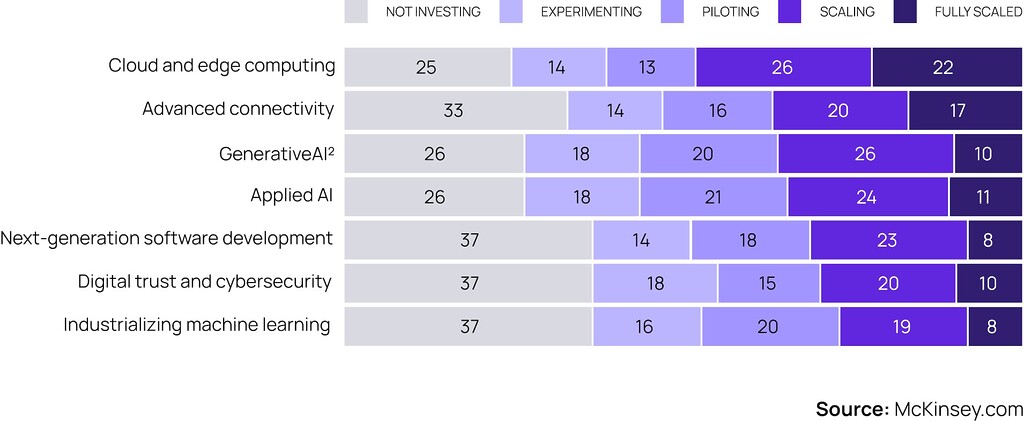
We see that cloud and edge computing are still high-priority tech trends shaping the companies' innovative strategies. Followed by advanced connectivity (IoT, 5G, APIs) and GenAI and applied AI (e.g. virtual assistants), next-generation software development is also making an impact. In this particular area, low- or no-code platforms, cloud-native development and DevOps continue to gain popularity. Security-first development is also gaining traction since organisations put a high priority on digital trust while partnering with vendors. 2020 study findings report that 52% of B2B clients stopped doing business with a company that failed to protect their customer data.
Implementation roadmap: From innovation strategy to execution
The above mentioned emerging technologies, while promising, require a structured implementation approach to deliver tangible business value. Organisations must move beyond trend-watching to strategic execution by first assessing their current innovation gaps and technology limitations against these opportunities. A comprehensive capability audit reveals where your existing systems constrain your ability to leverage these next-generation technologies and identifies specific areas where investment would yield the greatest strategic returns.
With this understanding, leadership teams can prioritise development projects based on strategic impact, balancing the transformative potential of technologies like GenAI against their implementation complexity and organisational readiness. Successful organisations adopt a phased approach to custom development initiatives, breaking complex transformations into manageable components that deliver incremental value while maintaining alignment with long-term objectives. In custom software development this becomes possible through agile development.
Related: Pros and Cons of Agile Software Development
Only 9% of Agile implementations result in failure, with those cases typically stemming from inadequate execution practices. By partnering with Dreamix, you gain access to nearly twenty years of business experience combined with deep technical and industry knowledge. This comprehensive expertise ensures your project achieves success through proper implementation of agile software development methodologies.
How custom enterprise software development supports innovation
To support innovation using software, the enterprise software must possess two key quality characteristics: its performance must be measurable, and the software itself must be adaptable. Changeable software is a must-have in many custom enterprise projects and a clean architecture and high-quality code are the usual measures to ensure that the software can be changed.
Process automation
Automating repetitive tasks can significantly contribute to your innovation strategy. Many valuable resources can be redistributed towards more strategic endeavors and out-of-the-box thinking. By developing custom enterprise software solutions businesses can address operational needs such as data input, monitoring and reporting or process management. For example, developing an automated workflow system can significantly enhance efficiency and reduce the potential for human error, while saving time and costs in the long run.
Data-driven decisions
Moving beyond pure task automations, custom enterprise software solutions can help CEOs, CIOs and CTOs make more data-driven decisions. However, this is the ultimate end goal of data management and there are several necessary steps to be taken. The usual roadmap consists of data science steps such as data acquisition, ETL, data storage, data governance and some type of reporting tool. Utilising data-driven insights as part of your custom enterprise software development lets you make market forecasts, mitigate risks, or innovate strategically.
AI-powered business capabilities
Thinking beyond the everyday hype around AI towards more real-life business scenarios, more and more companies are actively exploring how to use both GenAI and applied AI for success. Experienced custom software developers can help you effortlessly and effectively integrate AI into your organisation based on your needs. For example, AI can play a crucial role in upskilling employees, as relying solely on external help is not a sustainable long-term practice. A custom Al software solution can also be used internally in HR or marketing departments to save valuable time in research or personalise offers. Collaboration with trusted custom AI development company can enhance capabilities and improve customer interactions.
Enhanced customer experience
If your custom enterprise software development project is a client-facing app, enhancing customer experience is a critical element of your success strategy. First, customisation can lead to increased customer satisfaction and loyalty, helping you gain a competitive edge. Second, with user-friendly design and seamless functionality, you can ensure that customers find the app intuitive and easy to navigate, which can lead to higher engagement rates.
Collaboration and knowledge sharing
Custom software solutions can facilitate collaboration and knowledge sharing among employees, departments, and even external stakeholders. For example, project management software can provide a centralised platform for teams to collaborate, share ideas, and track progress. This fosters a culture of innovation by encouraging cross-functional communication and the exchange of innovative ideas. To get more inspiration on how other companies innovate, I encourage you to read our interview with Martin Mitev, Head of Innovation at AirBaltic.
Key benefits of custom enterprise software development
Custom enterprise software solutions are tailored to the specific needs of your business, making them the perfect tool to reach your unique business objectives. Unlike ready-to-use software solutions, custom software takes some time to develop but once released, it becomes your own business asset. Let’s look at some of the key advantages of tailor-made software:
Integrates with existing systems
When creating a custom enterprise software application, you can rest assured that it will fully and flawlessly integrate with your existing software and hardware components. For instance, it can be configured to interact with legacy systems, databases, and third-party applications, ensuring effortless data flow. This compatibility minimises disruptions, reduces the risk of data silos, and enhances overall operational efficiency.
Grows with you
Custom software developers create a solution with your business plan and goals in mind. This gives you the competitive advantage to future-proof your operations using the right technologies. Plus, investing in custom enterprise software development gives you the freedom to scale up or down according to your current workloads and demands, and add more personalised features when needed. The high degrees of scalability and flexibility are key for introducing new features and functionalities without causing disruptions. Last but not least, a flexible software system is easier to maintain, complementing your cost optimisation efforts.
Complies with industry regulations
Keeping pace with the ongoing compliance requirements is crucial for avoiding potential legal and financial penalties. For example, in the healthcare industry, custom enterprise software can be designed to comply with HIPAA regulations, ensuring that patient data is protected according to privacy standards. By embedding compliance features directly into the software, organisations can automate the monitoring and reporting processes that are often required by regulatory bodies. This automation not only reduces the administrative burden on employees but also enhances the accuracy and reliability of compliance-related data.
Pro tips for innovation strategy development: Investing in custom software
Developing an effective innovation strategy requires more than just good intentions—it demands a structured approach to technology investments that align with your strategic objectives. As organizations increasingly recognize the limitations of off-the-shelf solutions for enabling true market differentiation, custom software development has emerged as a critical enabler of sustainable innovation.
The following pro tips represent best practices distilled from companies that have successfully leveraged custom software as a cornerstone of their innovation strategy, providing a framework for maximising the strategic impact of your technology investments while avoiding common pitfalls that can derail even well-funded innovation initiatives.
Start with strategic problem definition, not technology
Before committing to custom software development, rigorously define the specific business challenges or market opportunities you aim to address. The most successful innovation investments begin with clear strategic objectives rather than technology infatuation. Document exactly how your current capabilities limit your innovation potential and precisely how custom software would enable your strategic differentiation.
Prioritise platform thinking over point solutions
Design custom software as innovation platforms rather than single-purpose tools. The highest ROI comes from creating foundational systems that can support multiple innovation initiatives over time. Build core capabilities that can be extended and recombined rather than isolated solutions that solve only immediate needs.
Establish clear innovation metrics before development
Define specific, measurable outcomes that will indicate success for your innovation investment. Whether market share gains, operational efficiency improvements, or customer experience enhancements, these metrics should directly connect to strategic business goals. Without predefined success indicators, innovation investments often lose focus and support before delivering value.
Adopt a portfolio approach to innovation investments
Balance your custom software investments across different risk profiles and time horizons. Allocate approximately 70% to incremental innovations that enhance existing capabilities, 20% to adjacent innovations that extend your current business model, and 10% to transformational innovations that could create entirely new markets or business models.
Create cross-functional innovation teams
Form dedicated teams that combine business strategists, technologists, and user experience specialists rather than treating software development as a purely technical function. These integrated teams create solutions that balance technical excellence with business strategy and user needs, significantly increasing adoption and strategic impact.
Related: What are Agile POD teams, and how to make them work for you
Implement fast learning loops
Structure your custom development process to maximise organisational learning. Release minimum viable capabilities quickly, gather market feedback, and iterate rapidly. This approach accelerates your innovation timeline while reducing the risk of investing heavily in unproven concepts. The most effective innovation strategies prioritise learning velocity over perfect initial execution.
Design for data capture from day one
Ensure your custom software systematically captures user behaviour and performance data that can fuel ongoing innovation. The most sophisticated innovation strategies recognise that proprietary data is often more valuable than the initial software capabilities themselves, creating a continuous feedback loop for future innovations.

How to choose your custom software development partner?
Finally, let's also explore how to find a custom enterprise development company that's the right fit for your organisation:
Industry expertise
One of the first things to consider is the company's industry expertise. A vendor with a proven track record in your industry will be more adept at understanding your unique challenges and requirements. This expertise is shown in their case studies, client testimonials and reviews on platforms like Clutch that highlight their experience and expertise. This can provide assurance of their capability to handle projects similar to yours.
Flexibility
Flexibility in scaling teams up or down on demand is another important consideration. A reliable custom enterprise software development company should be able to adjust the size and composition of their team based on your project's immediate needs. This flexibility ensures that you have the right resources at the right time, optimising both efficiency and cost. Whether you need to accelerate development or streamline operations, the ability to scale flexibly can significantly impact the success of your project.
Quality and scalability
Finally, consider the quality and scalability of the software solutions they provide. A trusted company should adhere to high-quality standards, employing rigorous testing and quality assurance processes to deliver robust and reliable software. Additionally, the solutions should be scalable, allowing your software to grow and adapt as your business evolves. This scalability is crucial for long-term success, ensuring that your software can handle increased loads and new functionalities without compromising performance.
Conclusion
Developing a forward-thinking innovation strategy remains the defining factor separating market leaders from followers in today's technology-driven landscape. Organisations that strategically align their business transformation initiatives with custom software development create powerful innovation ecosystems that consistently outperform competitors relying on standardised solutions. As we've examined throughout this analysis, a well-crafted innovation strategy serves as both compass and catalyst—directing technological investments toward high-impact opportunities while accelerating the delivery of market-differentiating capabilities.
The most successful companies recognise that their digital advancement framework must be as unique as their business model, embedding their strategic innovation vision directly into their technological foundation. By embracing custom enterprise software development as an extension of their creative business thinking and inventive approach, organizations can translate strategic innovation concepts into tangible competitive advantages that drive sustainable growth. As technology continues evolving at unprecedented speeds, your innovation strategy will increasingly determine not just how effectively you compete, but whether you remain relevant in rapidly transforming markets.
Let's discuss you innovation strategy and business needs, schedule a call with one of our Dreamix representatives.