Choosing where to build software costs you money, speed, and talent quality. A poor decision locks you into a partnership for months. A smart one compounds your advantage.
This guide ranks the top software outsourcing countries for 2026 so you can match your software development project needs to the right location - whether you're chasing cost savings, speed to market, domain expertise, or timezone coverage.
What is software outsourcing?
At its core, software outsourcing is the process of hiring an external team, typically from a custom software development services company and delegate a particular development process. This might be to save on costs. Or, in other cases, it may simply not make sense to hire a full team internally. If your organization only needs to build one piece of software, hiring a team of full-time developers just doesn’t make sense.
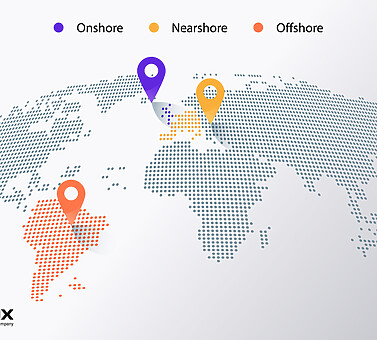
But software outsourcing can be further broken down into several basic categories. Onshore outsourcing involves working with a partner in the same country. Nearshore generally involves partners in physically and culturally close countries. Lastly, offshore outsourcing brings the software development work to countries that are farther away.
In most cases, as you move from onshore to nearshore and offshore, costs rise. Quality can also rise, though there’s a tremendous amount of variation in quality offered with each category.
Read next: The Ultimate Guide to Nearshore Software Development for 2026
What is the outsourcing strategy of software?
The strategy for software outsourcing involves working with a partner to both access the talent you need and reduce costs. The result is a win-win as the outsourcing company is able to specialize in delivering software to businesses like yours. Meanwhile, your company can devote more resources to its own specializations.
But within that basic framework are nearly infinite ways to approach such a partnership. For example, do you want to work with the V-model or Agile? Do you want to develop a Minimum Viable Product (MVP) to test some ideas before building the final software? Do you want to structure the relationship to incentivize on-time delivery, pay by the hour, or pay in a lump sum?
All that is to say, the outsourcing strategy of software is really all about customization and optimization to meet your unique needs. That’s why the most important element of a software development outsourcing strategy is always going to be understanding your own needs. That understanding should always serve as the foundation for your approach.
How the market shifted (2023–2026)
| Trend | 2023 Data | 2024–2025 Data | Direction | Reason |
|---|---|---|---|---|
| Eastern Europe dominance | ~35% combined | ~40% combined | ↑ +5% | Cost arbitrage narrows in Asia; EU companies shift to nearshore; high service quality |
| India's lead | Still #1 | Still #1 at 17.58% | — Stable | Volume dominates, but growth slower than Eastern Europe |
| Brazil's growth | ~10% | 12.5% | ↑ +2.5% | LatAm companies prefer nearshore; timezone advantage; 750k+ tech professionals |
| Poland's rise | ~10% | 12.12% | ↑ +2% | EU membership advantage; fintech/aviation specialization; talent concentration |
| Philippines | ~11% | 13.5% | ↑ +2.5% | Customer support expertise extending to development; Australia timezone advantage |
| China | Largest absolute size | Still largest absolute, declining share % | ↓ Relative decline | Wage inflation; geopolitical risk; customers diversifying away |
Sources: Statista, Grand View Research, Deloitte, Precendence research
Why software outsourcing matters now
The global IT outsourcing market reached approximately $591.24 billion in 2025 and continues expanding. Within that, software development outsourcing is the fastest-growing segment, with a compound annual growth rate of 11.5% - significantly outpacing broader IT services.
This growth isn't driven by cost-cutting alone. Modern outsourcing is about accessing specialized talent you can't afford to hire full-time. Whether you need a fractional team for a 6-month project, domain experts in aviation or fintech, or round-the-clock operations, outsourcing lets you scale without bloating payroll.

The global outsourcing market in 2026
Market size: The global IT outsourcing market stands at approximately $591.24 billion in 2025 and is projected to reach higher figures by the end of 2026.
Growth Drivers:
- Cloud computing adoption (90% of enterprises cite it as a key enabler, per Deloitte's Global Outsourcing Survey)
- Remote work normalization removing geographic barriers
- AI and data engineering specialization creating new skill gaps companies can't fill internally
Key insight: 92% of the world's largest 2,000 companies use IT outsourcing. It's no longer a cost-reduction tactic - it's a core operating model for enterprises.
Source: Deloitte Global Outsourcing Survey & Report
The top software outsourcing countries ranked
1. Poland: Europe's outsourcing powerhouse
Market Share: 12.12% | Market Size: ~$3 billion USD (2024) | Growth Rate: 12.12% CAGR
Poland dominates European outsourcing, and for good reason. Over 400,000 people work in the IT sector, creating a deep talent bench for scaled deliveries. The country combines EU regulatory compliance, timezone overlap with Western Europe, and quality standards that rival Western European firms - without the Western European price tag.
Why Poland:
- EU membership means GDPR compliance, stable legal frameworks, and trusted data handling
- Warsaw and Kraków have thriving tech ecosystems with dedicated software development companies
- Labor costs ~30-40% lower than Germany or Switzerland, but quality competitive
- English proficiency is standard among software developers
Best for: Fintech teams, regulated industries, EU-expanding startups, companies needing 3–5 year partnerships
Consideration: Costs are rising as the talent pool tightens. If budget is the primary driver, look at Bulgaria or Ukraine for similar quality at lower rates.
2. Bulgaria: Best ROI for European expansion
Market Share: 8% | Market Size: ~$180.43 million USD (2025) | Growth Rate: 8% CAGR
IT outsourcing to Bulgaria is a best option for companies building EU operations, Bulgaria delivers exceptional value. Sofia, the capital, has become a tech hub with world-class infrastructure, digital product development focus, young talent, and startup culture.
Recent growth acceleration: Bulgaria's IT outsourcing market expanded significantly from approximately $144.7 million in 2024 to $180.43 million in 2025 - a 24.6% year-over-year increase. This growth outpaces earlier 8% CAGR projections, signaling accelerating demand from Western European clients seeking nearshore alternatives to India and Eastern European competitors.
Why Bulgaria stands out:
- Smallest country on this list, yet commands 8% of global outsourcing demand (population: 6.5M)
- IT outsourcing represents 5.5% of Bulgaria's GDP—highest concentration of any country in Eastern Europe
- Average developer salary ~50% lower than Poland, 70% lower than Western Europe
- 95% employee retention rate at leading outsourcing firms - talent actually stays
- EU membership + timezone overlap makes integration seamless
- Strategic government support through Digital Bulgaria 2025 program (€690 million in digital transformation funding)
Best for: Early-stage startups, SME enterprises, scale-ups, healthcare/fintech MVPs, nearshore teams that need frequent sync calls
Expert domains: Fintech, Regtech, aviation, healthcare, transportation, and more.
Related: Why More and More Irish Businesses Are Turning to Bulgaria for Strategic IT Partnerships
3. India: Scale and specialization at volume
Market Share: 17.58% | Market Size: ~$10.51 billion USD (2024) | Growth Rate: 17.58% CAGR
India remains the largest absolute outsourcing market globally. If you need to hire 50 developers tomorrow, India is the only place that can do it without a 6-month recruitment cycle. The ecosystem is mature, and specialized firms now dominate legacy low-cost vendors.
Why India still leads:
- 1.4+ billion population creates inexhaustible talent supply
- Lowest total labor costs globally
- Massive offshore development industry matured over 30+ years
- Strong specialization in AI/ML, data engineering, infrastructure work
The reality check:
- Timezone means asynchronous communication (9.5-hour gap with US)
- Quality varies dramatically by vendor tier
- Cost arbitrage is narrowing as wages rise
- Communication overhead can slow certain project types
Best for: 24/7 operations, large-scale team augmentation, AI/ML infrastructure, cost-sensitive projects, established processes that work async
Growing challenge: You're competing globally for Indian talent, and prices are rising. Mid-market vendors are catching up on quality, making India less of a steal than it was five years ago.
4. Brazil: Emerging superpower for the Americas
Market Share: 12.5% | Market Size: ~$6.13 billion USD (2024) | Growth Rate: 12.5% CAGR
Brazil is the biggest story in Latin America. The country spans multiple timezones, giving companies easy coverage of both US and European business hours. With 750,000 tech professionals and growing venture capital activity, Brazil is becoming the nearshore choice for North American companies.
Why Brazil:
- Timezone advantage: offices operate in overlap with both US East Coast and Western Europe
- Trilingual talent pool: Portuguese, Spanish, English (increasingly fluent)
- Startup culture and entrepreneurial mindset create high-ownership teams
- Growing specialization in fintech and AI
Best for: US/Canadian expansion, 24/7 coverage, fintech, growth-stage companies wanting cultural fit
5. Ukraine: Resilience under pressure
Market Share: 10.37% | Market Size: ~$3.7 billion USD (2024) | Growth Rate: 10.37% CAGR
Ukraine's outsourcing sector has proven remarkably resilient despite ongoing conflict. 96% of client relationships have survived the war. Most specialists have stayed (only 16% relocated), and the software development outsourcing industry continues delivering.
Why Ukraine remains competitive:
- Exceptional technical talent from Soviet-era math/engineering education traditions
- Cost advantage similar to Bulgaria/Poland
- EU timezone, EU mindset
- Proven ability to execute under uncertainty
The reality: Working with Ukraine now requires explicit conversations about continuity planning, data residency, and communication protocols during air alerts. Not impossible—many companies maintain successful partnerships—but requires maturity.
Best for: Companies comfortable with geopolitical risk, teams already familiar with distributed work, cost-conscious EU expansion
6. Romania: Eastern European alternative
Market Share: 8.74% | Market Size: ~$415.2 million USD (2024) | Growth Rate: 8.74% CAGR
Romania hosts over 200,000 IT specialists across 440+ software development companies. The country invests heavily in developer incentives (special tax rates) and digital infrastructure, yet remains less saturated than Poland.
Why consider Romania:
- Lower cost than Poland, comparable quality
- EU membership and timezone convenience
- Special tax incentives for software developers (12% flat rate)
- Less competitive hiring than Poland—easier to find your exact skillset
Best For: Smaller projects, specialized roles (security, embedded systems), companies wanting to avoid Poland's tight labor market
Related: Top 20 Software Development Companies in Europe
7. Mexico: North America's nearshore hub
Market Share: Not in top global percentage, but dominates North American nearshoring | Market Size: ~$5.06 billion USD (2024) | Growth Rate: 6.89% CAGR
Mexico is the obvious choice for US/Canadian companies. Proximity, timezone alignment, and cultural familiarity reduce friction.
Why Mexico Dominates Nearshoring:
- 1–2 hour timezone overlap with US across the board
- Geographic proximity enables occasional in-person sprints
- Spanish-fluent workforce reduces coordination overhead
- Mature vendor ecosystem with established quality standards
The Gap: Slower CAGR (6.89%) than Eastern Europe or Brazil suggests market saturation. Pricing is competitive but not the lowest globally.
Best For: US startups, companies needing frequent sync, projects requiring cultural alignment, Spanish-language teams
8. Argentina: South America's Quality Leader
Market Share: ~2% | Market Size: ~$417.2 million USD (2024) | Growth Rate: 9.17% CAGR
Argentina hosts some of South America's highest-quality developers. English proficiency is strong, and the tech culture is genuinely entrepreneurial. Economic uncertainty has been a drag, but improving currency stability is changing the outlook.
Why Argentina stands out:
- Highest English fluency among outsourcing countries in the region
- Strong STEM graduate pipeline
- Similar timezone to Brazil (covers US + EU)
- Startup mentality attracts ownership-oriented developers
Challenge: Historical currency instability made pricing unpredictable. Recent stabilization is changing this.
Best For: LatAm expansion, teams wanting high-ownership culture, quality-first mindset, companies comfortable with some economic risk
9. Philippines: Underestimated for tech development
Market Share: 13.5% | Market Size: ~$686 million USD (2024) | Growth Rate: 13.5% CAGR
The Philippines dominates customer support outsourcing, but software development capability is growing. Strong English and cultural compatibility with Western companies are genuine advantages.
Why consider Philippines:
- Excellent English fluency and customer service mindset
- Timezone advantage for Australia/Asia-Pacific companies
- Low cost with improving quality
- Growing specialization in cloud development and modern stacks
The Reality: Philippines software development lags India/Poland in scale and mature processes. Best for companies with flexible deadlines or Australia-facing work.
Best For: Asia-Pacific companies, teams that value communication fluency, 24/7 customer-facing operations
10. China: Scale with complexity
Market Share: Largest absolute market | Market Size: ~$28.76 billion USD (2024) | Growth Rate: 7.76% CAGR
China has the largest IT outsourcing market in absolute terms. But it's also the most opaque and most regulated. Geopolitical risk, language barriers, and data sovereignty rules complicate partnerships.
Why China remains relevant:
- Massive AI/ML infrastructure investments
- Lowest labor costs at scale
- Specialized expertise in certain technology areas (blockchain, payment systems)
- Dominant for companies serving Asian markets
The complexity: Data residency, IP security concerns, communication barriers, and geopolitical tensions make China best avoided unless you have specific technical requirements impossible to meet elsewhere.
Best for: Companies with deep China expertise, AI infrastructure projects, established vendor relationships
How many companies outsource software development?
As the statistics listed above indicate, that number varies dramatically based on size. Yet, this sounds counterintuitive because large companies would also be more likely to have the internal resources needed for software development. So what explains this discrepancy?
In short, nearly all companies of any size require software to operate today. But as companies grow it becomes more likely that off-the-shelf solutions no longer meet their needs. Yet while enormous multinationals could in theory hire their own software development teams, this isn’t common.
The reason goes back to the specialization mentioned previously. With so many high-quality custom software outsourcing firms out there, large organizations are spoiled for choice. Even if they could in theory develop the software they need in-house, the ease with which they can outsource that work without sacrificing quality helps explain why the practice is so common. In such cases, companies will often turn to end-to-end custom software development partners.
So there isn’t a single answer for the question of how many companies outsource their software development. Instead, answering this question relies on understanding the important trends, how company size affects the choice, and other considerations.
2026 outsourcing market size by country
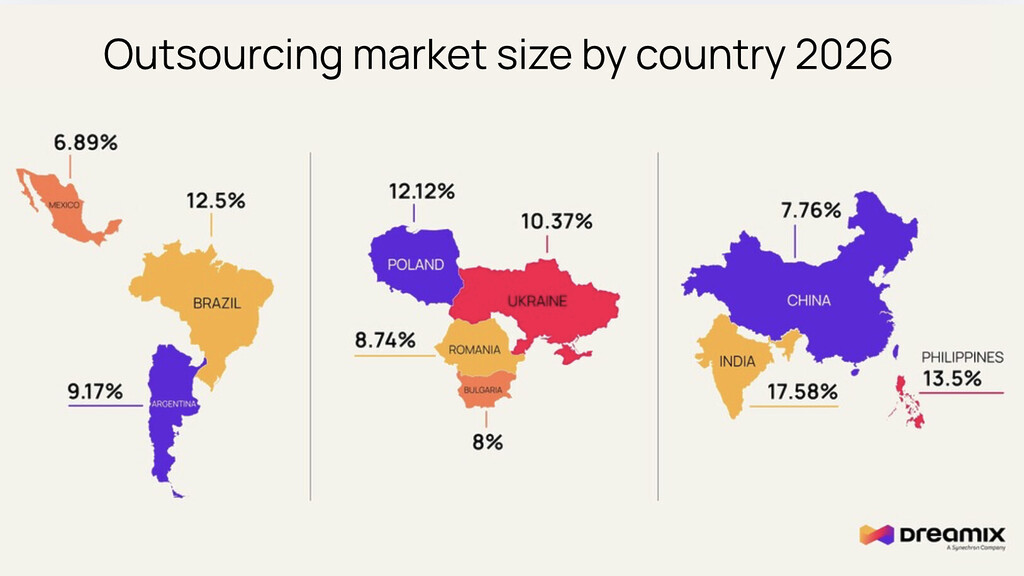
The 2026 software outsourcing market showcases significant Eastern European growth, with Poland (12.12%), Ukraine (10.37%), Romania (8.74%), and Bulgaria (8%) collectively representing nearly 40% of the global market share. This impressive regional concentration demonstrates Eastern Europe's rising prominence as businesses seek high-quality technical expertise at competitive rates.
Related: Software Development in 2026 Eastern Europe
While India maintains its dominant position at 17.58% of the global software outsourcing market, the Philippines (13.5%) and Brazil (12.5%) also command substantial shares. This diversification across multiple global regions indicates a maturing software outsourcing market where companies can strategically select partners based on specific needs rather than simply seeking the lowest cost provider.
Trends that affect global software outsourcing markets
Now, it’s important to consider global trends affecting software outsourcing markets well.
Increased focus on data analytics
More organizations are recognizing the immense competitive advantage data provides. However, in today's dynamic software outsourcing market, success requires more than indiscriminate data collection. Companies must strategically determine what data to gather and how to analyze it effectively.
Modern businesses demand software solutions capable of collecting, analyzing, and leveraging data to drive informed decision-making. With complex privacy regulations and compliance requirements surrounding data usage, many organizations are turning to the software outsourcing market for custom development expertise. This growing trend in software outsourcing allows companies to access specialized data engineering skills without maintaining expensive in-house teams, making it an increasingly popular strategy for businesses looking to maximize their data potential while navigating regulatory challenges.
Greater Personalization
Across industries, one of the most powerful overarching trends is one of personalization. Customers are increasingly demanding more personalized options and services. The result is that companies which are able to deliver such personalization grow far faster than those that aren’t.
Building personalized experiences at scale manually is virtually impossible, driving businesses to the software outsourcing market for solutions. Leading companies in the software outsourcing market specialize in developing systems that maintain user profiles, analyze behavioral data, and generate sophisticated personalized recommendations. This specialized development approach enables businesses to implement AI-driven personalization without building extensive in-house teams. As the software outsourcing market continues expanding, even mid-sized companies can now access custom personalization capabilities previously available only to tech giants, creating competitive advantages through data-driven customer experiences that increase engagement, conversion rates, and loyalty.
Greater customer interaction

Another element of the broader personalization trend is a shift to more direct interaction. Often, this comes in the form of AI-driven chatbots. These chatbots can answer simple customer queries and gather useful data about the contents of those queries. Armed with this data, customer success, sales, marketing, and other functions can improve their offerings and level of personalization.
The rapidly growing software outsourcing market has become the primary resource for businesses seeking to implement these advanced chatbot solutions without building in-house AI teams. Companies partnering with software outsourcing market leaders gain access to specialized expertise in conversational AI development, natural language processing, and seamless integration with existing systems. This trend in the software outsourcing market enables businesses of all sizes to deploy sophisticated customer interaction tools that previously required massive technology investments. By leveraging software outsourcing market resources for chatbot development, companies can transform customer engagement while gathering actionable insights that help customer success, sales, and marketing teams deliver increasingly personalized experiences.
Automation powered by AI
While AI plays a major role in data analysis, chatbots, and personalization, automation represents another critical application transforming businesses worldwide. Companies across the global software outsourcing market are increasingly implementing AI solutions that streamline operations by automating formerly manual tasks like data entry.
The global software outsourcing market has responded with specialized expertise in developing these automation solutions, allowing organizations to achieve faster processes with greater accuracy without building extensive in-house AI teams. This enhanced data quality empowers departments from sales to logistics to make better-informed decisions.
Partners in the global software outsourcing market deliver customized automation solutions that go beyond cost reduction, enabling employees to focus on higher-value activities that drive innovation and growth. As the global software outsourcing market continues to evolve, organizations leveraging these AI automation capabilities gain significant competitive advantages through improved operational efficiency and strategic resource allocation.
Related: 10 Top AI Software Development Companies in Europe in 2026
Growing importance of security
Data privacy and protection from malicious actors are both increasingly important today. Data leaks can easily bring serious legal and reputational costs. The theft of proprietary data or technology likewise can translate into massive losses for organizations that have invested heavily in such assets.
It’s hardly surprising that security is a major driver for organizations investing in custom software. While off-the-shelf options can bring quality security, their scale makes them a target for malicious actors. Combining bespoke software solutions with exceptionally high security standards brings a greater level of security and protection.
Focus on higher quality partnerships
The increasing importance of software for nearly everything modern businesses do, means the quality of that software is vital. This has been driving a shift in how software outsourcing partnerships are structured and function. Whereas in the past, these may have been fairly hands-off, today that approach is widely seen as inadequate.
Instead, organizations want strong partnerships, closer integration, and developers who can understand their business challenges. These partnerships are better able to deliver the precise kind of software needed to really move the needle for those businesses. There’s also a preference for longer-term partnerships, so choosing the right developer is more important than ever.
Shift in outsourcing locations
While Asian countries like The Philippines, India, and China have long dominated this market, that dominance is changing. The other trends on this list are pushing more and more companies towards nearshore outsourcing destinations in Europe and Latin America instead.
Many of these countries are now focusing on developing quality and proximity as their competitive advantages. For example, custom software development in Bulgaria may not compete with options in India on price. But doing business with an experienced partner within the EU brings enormous benefits.
So when you’re searching for the right kind of software outsourcing partner, be sure to balance considerations of cost, experience, quality, and expertise. The right partnership comes from finding an ideal balance between these factors.
FAQs about the best outsourcing countries:
We’d love to hear about your software outsourcing project and help you meet your business goals as soon as possible.
We’d love to hear about your software project and help you