
AI in Quality Assurance (QA) is transforming traditional data management and testing practices. While data sanitization—hiding sensitive information in databases—has long been a staple, AI is pushing the boundaries of QA capabilities. As more QA teams start using AI, experts predict that efficiency and accuracy will improve significantly.
Yet, this shift brings its own set of challenges. While AI offers benefits like enhanced testing precision and faster time-to-market, it also raises issues such as data privacy concerns, implementation complexity, and potential algorithmic bias.
This article explores the current landscape and future of AI in QA, examining both the opportunities and challenges. By understanding these factors, businesses can effectively integrate AI into their QA strategies, leading to more reliable software solutions.
Benefits and risks of AI in Quality Assurance
Here's a closer look at how AI can enhance QA and the challenges it might introduce:
Generating test cases
AI can efficiently analyze requirements and past defects to suggest detailed test cases, reducing manual effort and improving test coverage.
However, if too much sensitive information is shared with AI, it could lead to data exposure. Skilled prompt engineers might exploit public models to retrieve leaked information, sometimes within hours.
Enhancing automation scripts
AI can assist in creating and optimizing automation scripts by offering code suggestions and identifying the so-called ‘flaky tests’. A flaky test is an unreliable software test that sometimes passes and sometimes fails, even when the code hasn't changed.
Nonetheless, be cautious as AI tools might inadvertently suggest code snippets containing sensitive API keys, database credentials, or proprietary algorithms. This not only risks exposing your own information but also potentially using proprietary content from other companies.
Intelligent test data generation
AI can generate diverse and realistic test data, ensuring better coverage and compliance with data privacy regulations.
However, if AI is trained on unsanitized datasets, it might create test data that resembles real customer information, leading to privacy violations.
Code review & optimization
AI can analyze automation code for inefficiencies, suggest improvements, and flag potential security vulnerabilities.
Yet, there's a risk that AI-powered tools might store and expose snippets of proprietary frameworks or critical business logic.
AI-driven exploratory testing
AI can autonomously simulate user behavior and perform exploratory testing, uncovering ‘edge cases’ that manual testers might miss. Edge cases are rare bugs that users rarely encounter. They can be consistent but only affect specific devices or happen infrequently across many. These issues can be minor, like color mismatches, or severe, like crashes.
However, this process could log sensitive interactions, potentially revealing private workflows, authentication mechanisms, or internal endpoints.
Read next: Outsourced Software Testing: Complete Executive Guide 2025
Log & defect analysis
AI can process vast amounts of logs to identify failure patterns, root causes, and correlations between defects.
Despite these benefits, AI might inadvertently expose stack traces, internal IP addresses, user credentials, or personally identifiable information (PII).
Intelligent test reporting
AI can generate detailed test reports with actionable insights, summarizing trends and providing recommendations for improvement.
However, ensure these reports do not include raw execution data, API responses, or database queries containing confidential or proprietary information.
Solutions to prevent AI-related data leaks in Quality Assurance
In order to continue taking advantage of AI in quality assurance while minimizing risks, consider implementing these strategies to protect sensitive information:
Careful use of public AI models
- Avoid sharing sensitive information: Refrain from inputting proprietary code, logs, or detailed test cases into public AI tools. This includes avoiding the use of specific company, personnel, or application names.
- Use AI for research: Use AI's deep search capabilities to conduct research rather than relying on it for direct answers. For example, instead of inputting sensitive data into an AI model to get a solution, use AI to gather and analyze relevant information that can guide your problem-solving. This approach reduces the need to share sensitive information while still benefiting from AI's efficiency.
- Generic task assistance: Even without sharing specific data, AI can significantly streamline generic tasks and story generation, saving time and resources.
Controlling internal AI training data
- Data classification rules: Establish clear guidelines to exclude confidential or sensitive information from AI training datasets. This ensures that AI models are trained without risking data exposure.
- Use of synthetic data: Train AI models with synthetic or anonymized data to prevent unintentional leaks of real customer or internal information.
- Regular audits: Conduct regular audits of AI outputs to verify that they do not inadvertently reveal internal system details or sensitive information.
- Engage with operations teams: If you're not directly responsible for training internal AI models, collaborate with your Operations Team to explore secure and capable internal AI solutions. Remember, even internal models can pose risks, especially in multi-client or multi-project environments.
Securing AI-generated artefacts
- Automated scans: Implement automated scans on AI-generated test cases, reports, and scripts to detect potential leaks before they become a problem.
- Data masking techniques: Apply data masking techniques in AI-assisted test data generation to protect sensitive information.
- Monitoring and alerts: Set up systems to monitor AI interactions and alert relevant teams if sensitive information may be involved. Early detection of leaks internally is crucial to prevent external exposure.
Ethical and legal considerations
- Regulatory аlignment: Ensure that AI usage policies comply with relevant regulations, such as GDPR and HIPAA, to mitigate compliance risks.
- Training and аwareness: Educate teams on AI risks and best practices for data handling, emphasizing the importance of security in AI-assisted workflows.
- Continuous review: Regularly review AI-assisted processes to adapt security measures as AI technology evolves. Following established information security policies can serve as a helpful guideline.
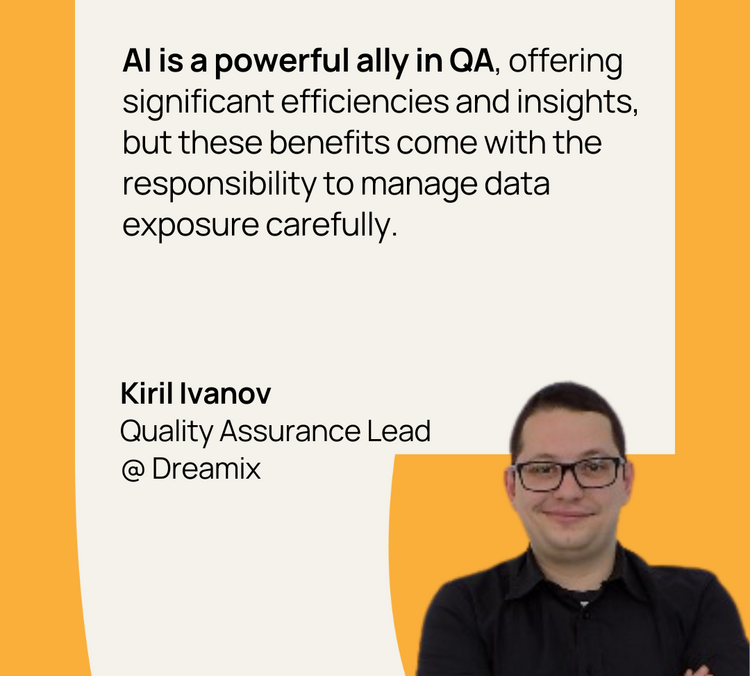
AI is a powerful ally in QA, offering significant efficiencies and insights. However, these benefits come with the responsibility to manage data exposure carefully. By implementing a robust AI strategy that prioritizes speed, security, and compliance, QA teams can innovate safely and effectively.
We pride ourselves in being a trusted provider of top Quality Assurance and Testing services. Our team consists of highly skilled professionals with years of industry experience. We understand that each project is unique, so we offer flexible engagement models and cost-effective testing solutions tailored to your needs. With our expertise in various testing tools and technologies, we are able to provide customised testing services that ensure your product is of the highest quality.