With B2B automation investments, the software testing landscape has fundamentally shifted. In fact, the global software testing market is bound to projected growth from USD $48.17 billion in 2025 to USD $93.94 billion by 2030, according to latest Mordor Intelligence insights. This explosive growth reveals a strategic truth: leading organisations no longer view software testing as merely a technical checkpoint but as a competitive differentiator that demands specialised expertise from a proven software testing company.
For CEOs, CTOs, and delivery managers navigating digital transformation initiatives, the question isn't whether to invest in quality assurance but how to access world-class software testing and quality assurance services most effectively. Over 80% of enterprises now use DevOps methodologies, and approximately 67% of financial services firms outsource testing services, signaling a fundamental shift in how forward-thinking companies approach software quality (Data source: Business Research Insights).
This comprehensive guide examines outsourced software testing through the lens of business value, strategic alignment, and operational excellence to help you make informed decisions that accelerate time-to-market while maintaining enterprise-grade quality standards.
What is outsourced software testing?
Outsourced software testing involves partnering with external quality assurance specialists to execute testing activities ranging from functional and performance testing to security assessments and test automation. Rather than building and maintaining internal QA teams, organisations leverage specialised vendors who bring deep expertise, proven methodologies, and advanced testing infrastructure.
This strategic approach encompasses various engagement models including full outsourcing where external providers manage all testing activities, partial outsourcing for specialised testing needs like security or performance testing, and staff augmentation to temporarily scale internal QA capacity during critical project phases.
Why outsourced software testing matters in 2025
The cost of quality versus the cost of failure
The complexity of modern software development has intensified dramatically. The increased use of and market demand for AI applications, ML algorithms, and emerging technologies is fundamentally reshaping quality assurance requirements. These advanced systems demand specialised testing expertise that extends beyond traditional functional validation - requiring performance testing under unpredictable AI model behavior, validation of ML training data integrity, and assessment of algorithmic bias that could impact business outcomes. In fact, a recent Forrester report with 2026 B2B predictions states that companies might risk losing up to $10 billion in enterprise value due to the combination of rapidly deploying untested AI features and employees lacking the skills to use them effectively.
In this demanding environment, modern software systems operate where a single defect can trigger cascading business consequences. For example, payment processing failures lose revenue, security vulnerabilities expose customer data, and performance issues damage brand reputation. The recent events of Europe airports cyberattack that targeted major boarding systems and caused chaos is a perfect example. The attack clearly demonstrates how software vulnerabilities can paralyse critical infrastructure, disrupt thousands of travelers, and inflict millions in operational losses within hours.
Such incidents underscore a fundamental truth: the cost of inadequate testing far exceeds the investment in comprehensive quality assurance. The financial impact extends beyond immediate bug fixes, encompassing customer churn, regulatory penalties, and emergency remediation costs that dwarf proactive testing investments. When security vulnerabilities or system failures make headlines, organisations face reputational damage that persists long after technical issues are resolved.
Organisations partnering with specialised software testing services gain access to advanced testing methodologies, and compliance validation capabilities that prevent incidents before they occur - transforming testing from a cost center into strategic risk mitigation.
Read next: Quality Assurance Within the SWAL3 Framework in Aviation
Accelerating innovation velocity
In markets where competitive advantage hinges on rapid feature deployment, testing bottlenecks can directly impact revenue potential. The pressure to deliver new capabilities faster has never been more intense, yet speed without quality creates technical debt that eventually stalls innovation entirely. This is where strategic outsourcing transforms testing from a constraint into an accelerator.
Businesses using DevOps and agile testing methodologies report software deployment speed increases of 45%. Outsourced testing enables continuous integration and delivery by providing specialised expertise that accelerates testing cycles without compromising thoroughness.
External QA partners providing outsourced software testing bring cross-industry experience and exposure to diverse technology stacks that enrich test coverage and identify edge cases internal teams might overlook. They implement parallel testing strategies across multiple environments, browsers, and devices simultaneously - compressing testing cycles that might take weeks internally into days or even hours.
Strategic benefits of outsourced software testing
Superior software quality and reliability
Systematic testing methodologies by outsourced software testing companies ensure your applications function flawlessly across multiple environments. External quality assurance teams bring rigorous validation frameworks that identify functional defects, usability issues, and performance bottlenecks before they impact users.
Key quality improvements include:
- Comprehensive test coverage across diverse environments and usage scenarios
- Rigorous validation techniques that spot weaknesses before production deployment
- Proven testing methodologies that ensure highest software product quality
- Executive-level visibility into product readiness through quality metrics
- Disciplined approaches that meet exacting quality standards
Organisations leveraging outsourced software testing benefit from proven testing frameworks rather than discovering defects post-launch, deploying with confidence knowing software has undergone thorough validation by experienced QA professionals.
Substantial cost optimisation
Partnering with an outsourced software testing company eliminates defects early in development cycles when remediation costs remain minimal. The economics prove compelling: fixing bugs during development costs exponentially less than emergency patches after release, customer-reported defects that trigger support escalations, or critical failures that damage brand reputation.
Financial advantages of partnering with a software testing company include:
- Cost reduction compared to maintaining in-house QA teams
- Elimination of capital expenditure on testing infrastructure
- Avoidance of tool licensing fees that can reach six figures annually
- No ongoing training investments to maintain QA expertise
- Reduced hidden costs of employee turnover that disrupts testing continuity
Beyond direct labor savings, organisations convert fixed overhead into flexible costs that scale with project demands.
Elevated customer satisfaction and retention
Software quality directly determines customer perception. Applications that perform reliably, respond quickly, and provide intuitive experiences build user trust and encourage long-term engagement. Conversely, buggy software triggers frustration, negative reviews, and customer churn that undermines marketing investments.
Customer experience benefits:
- Validation of functionality across real-world usage patterns
- Testing across diverse device configurations and network conditions
- Higher satisfaction scores and improved retention rates
- Positive word-of-mouth that reduces customer acquisition costs
- Enhanced UX that builds long-term brand loyalty
Software testing services ensure your products deliver exceptional experiences by validating comprehensive scenarios that reflect actual user behavior.
Regulatory compliance and risk mitigation
Organisations operating in regulated industries face stringent compliance requirements where non-compliance triggers substantial penalties, legal liability, and reputational damage. The recent cyberattack on European airport systems illustrates how compliance failures cascade into operational catastrophes affecting thousands of users.
Compliance capabilities:
- Deep expertise in industry-specific compliance frameworks (HIPAA, GDPR)
- Comprehensive security standards validation
- Data protection regulation adherence verification
- Implementation of comprehensive audit trails
- Validation of security controls through rigorous testing
- Documentation demonstrating due diligence to auditors and stakeholders
In highly regulated sectors like healthcare, managing these compliance demands requires advanced technology support. Solutions such as ComplyAssistant’s software for healthcare compliance help organisations strengthen oversight, streamline risk assessments, and maintain adherence to evolving healthcare standards—ensuring data security and operational integrity remain uncompromised.
A specialised software testing company brings regulatory expertise that reduces risk while providing evidence of compliance to stakeholders.

Enhanced team productivity and focus
Testing activities consume significant engineering resources that could otherwise drive product innovation. When development teams shoulder QA responsibilities, they context-switch between building features and validating functionality - a workflow that reduces efficiency across both activities. Market research reports that outsourced software testing helps businesses reduce testing cycles by up to 40%, enabling continuous integration and delivery.
Productivity gains of outsourced software testing include:
- Internal teams concentrate on core competencies and architectural decisions
- Development focuses on feature innovation that differentiates products
- External QA specialists execute comprehensive test plans
- Engineers advance roadmap priorities without testing bottlenecks
- Accelerated time-to-market through specialised focus
- Improved quality across both development and testing activities
Outsourced software testing liberates internal teams while external specialists handle comprehensive validation, creating parallel workflows that accelerate delivery.
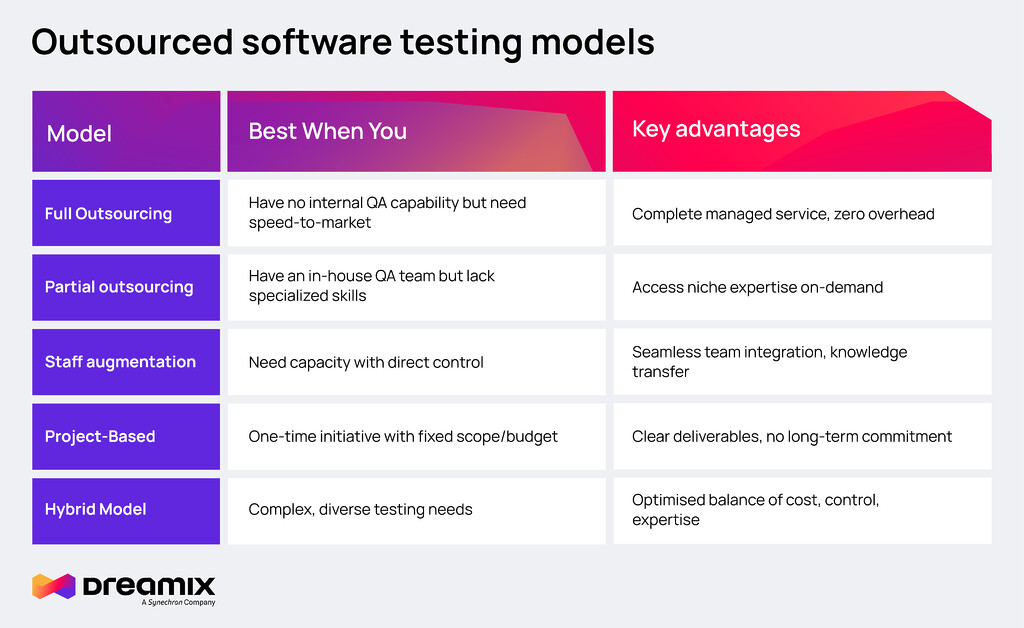
Outsourced software testing models: Choosing the right approach
Organisations interested in outsourced software testing can choose from several engagement models, each offering distinct advantages depending on project requirements, budget constraints, and internal capacity.
Fully outsourced software testing
In this model, the external provider manages all testing activities end-to-end, from strategy development to execution and reporting. The vendor assumes complete responsibility for quality assurance, supplying methodology, infrastructure, tools, and team members while your organization defines requirements and reviews deliverables.
Best for: Startups and scale-ups lacking QA infrastructure, companies prioritizing speed-to-market over internal control, organisations without dedicated testing expertise, businesses wanting to eliminate fixed QA overhead.
Partial QA outsourcing
In this scenario, organisations maintain core functional testing in-house while outsourcing specific specialised domains like security testing, performance engineering, or accessibility validation or specialised acceptance testing such as FAT and SAT testing for mission-critical aviation systems. The external provider works independently on designated testing areas, delivering specialised expertise for high-complexity activities.
Best for: Mid-sized to enterprise organisations with established internal QA teams, companies needing specialised capabilities unavailable internally, businesses in regulated industries requiring third-party validation, teams facing temporary capacity constraints.
Staff Augmentation
External QA professionals temporarily join your internal team as embedded resources working under your direct management. These specialists adopt your processes, tools, and workflows, functioning as extensions of your workforce while you maintain complete control over daily tasks and priorities.
Best for: Organisations with mature QA processes and strong internal testing leadership, companies needing rapid capacity scaling without permanent hiring, businesses requiring specialized skills for defined project phases, teams wanting knowledge transfer from senior QA professionals.
Project-Based Outsourcing
Engaging external providers for specific, time-bound projects with defined scope, deliverables, and timelines such as product launches or system migrations. This model typically uses fixed-price or milestone-based pricing, with the engagement concluding when the project completes.
Best for: Companies with one-time major initiatives, organisations with irregular or unpredictable testing needs, projects with well-defined requirements and fixed budgets, businesses wanting minimal long-term vendor commitment.
Hybrid Model (Multi-Model Approach)
Customised combinations of multiple engagement models tailored to specific organizational needs, allowing different approaches for different testing types or project phases. Organizations might use managed services for regression testing, staff augmentation for new features, and partial outsourcing for annual security audits simultaneously.
Best for: Mature organisations with sophisticated QA strategies, large enterprises with diverse product portfolios, companies optimising for both cost efficiency and strategic control, businesses with established vendor relationships seeking maximum value.
How to select the right outsourced software testing partner
Technical expertise and domain knowledge
Your testing partner should demonstrate deep expertise in your technology stack and industry vertical. Request case studies showing successful projects in similar domains, evaluate their technical certifications, and assess their familiarity with relevant compliance requirements.
Evaluation criteria:
- Years of experience in your industry
- Certifications in relevant testing methodologies (ISTQB, ISO/IEC 29119)
- Technology stack alignment with your development environment
- Understanding of industry-specific regulatory requirements
Proven track record and client references
Past performance predicts future results. Investigate potential partners' reputation through client testimonials, case studies with measurable outcomes, and direct reference calls with similar organisations.
Key questions for references:
- Did the partner deliver on commitments consistently?
- How did they handle unexpected challenges?
- What was the quality of their communication?
- Would you engage them again for future projects?
Security certifications and compliance experience
For enterprises operating under regulatory constraints, security certifications prove non-negotiable. Verify partners maintain relevant compliance credentials and understand your industry's data protection requirements.
Essential certifications:
- ISO 27001 for information security management
- Industry-specific certifications (e.g. HIPAA for healthcare)
Scalability and flexibility
Your testing needs will evolve. Select partners capable of scaling capacity rapidly, adapting to changing requirements, and supporting long-term growth rather than merely completing isolated projects.
Cultural fit and communication style
Technical capability alone doesn't ensure partnership success. Evaluate whether potential partners' communication style, work ethic, and business values align with your organisational culture. Misalignment creates friction that undermines collaboration effectiveness.
The Dreamix approach to outsourced software testing
At Dreamix, we understand that software testing extends far beyond defect detection. Our comprehensive quality assurance services help organizations deliver exceptional digital experiences while maintaining development velocity.
Our testing expertise
- Functional testing: Comprehensive validation that software meets business requirements and user expectations
- Performance testing: Load testing, stress testing, and scalability assessments ensuring systems perform under real-world conditions
- Test automation: Strategic automation frameworks accelerating regression testing while maintaining comprehensive coverage. One of QA colleagues Petko Petkov recently spoke at the SEETEST event talking precisely about automation testing for asynchronous events.
- Mobile testing: Cross-device compatibility testing ensuring seamless experiences across platforms
- API testing: Integration validation confirming system components communicate correctly
Why organisations choose Dreamix
Proven expertise: With 19+ years of market experience and partnerships spanning decades, we bring deep technical knowledge across aviation, healthcare, transportation, and manufacturing verticals.
End-to-end capabilities: Unlike vendors offering isolated testing services, Dreamix provides comprehensive support from requirements analysis through deployment and maintenance, eliminating coordination complexity across multiple providers.
Quality-focused culture: Our 95% employee retention rate ensures project continuity and preserves institutional knowledge that accelerates testing effectiveness over long-term partnerships.
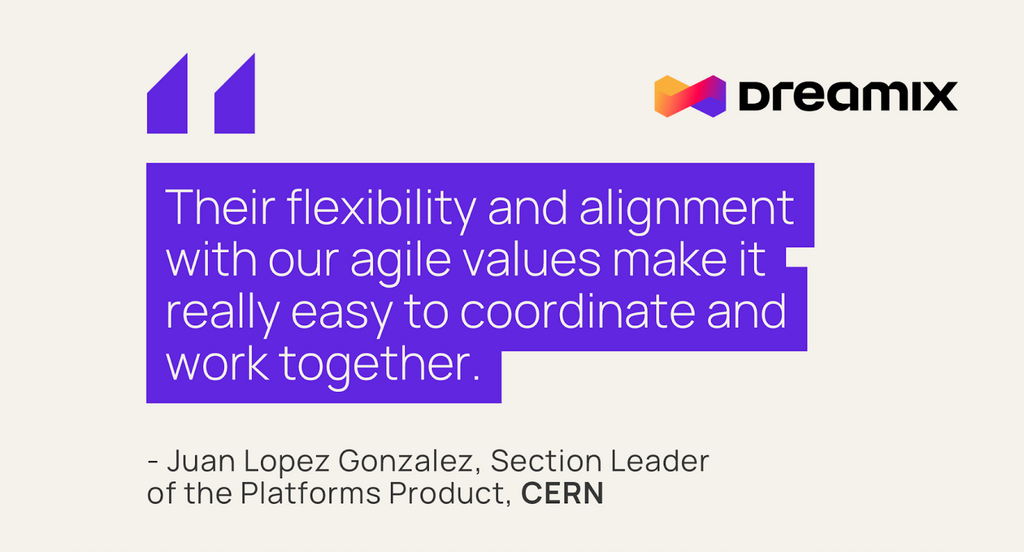
Transparent collaboration: We integrate seamlessly with your development processes using Agile methodologies, clear communication protocols, and collaborative tools that maintain visibility throughout testing cycles.
Conclusion
The decision to pursue outsourced software testing represents a strategic choice between building comprehensive internal QA capabilities or leveraging specialised expertise that accelerates time-to-market while optimising costs.
Successful outsourcing hinges on selecting partners who understand both technology and business context, establishing governance frameworks that maintain quality standards, and building relationships that evolve beyond transactional vendor management.
The organisations that thrive in increasingly competitive digital markets will be those that view software testing not as a necessary expense but as a strategic investment that protects brand reputation, accelerates innovation velocity, and delivers exceptional customer experiences.
Last updated: January 2026
FAQ:
We’d love to hear about your outsourced software testing needs and help you meet your business goals as soon as possible.