In the post-pandemic era, the aviation industry has experienced a robust resurgence, with traffic levels rebounding to pre-pandemic levels. Experts like Timothy Colehan from IATA even predict a potential doubling in passenger numbers with an estimated annual count of 8 billion by 2043. All these staggering figures translate into massive data streams, offering business opportunities but also posing challenges at the same time.
Aviation technology is a sector that thrives and relies on strategic and collaborative R&D. To stay competitive, airlines need to continuously seek new ways to fine tune existing business processes and operations and innovate even more while remaining reliable. On the one hand, air carriers need to provide more consumer-centric products and services to both delight passengers and drive higher revenue.
On the other hand, there is the industry-wide push towards using sustainable processes, optimising supply chains and enhancing the entire passenger experience such as smart airports, day of travel assistants, personalised offers. Filling all these gaps and more, digital transformation continues to be a key industry innovation driver nurturing data-driven insights and more meaningful and profitable decision-making.
In this article, we will explore key trends in digital transformation in aviation and see how airlines can maintain a competitive edge by embracing them. At Dreamix, drawing from our expertise in custom aviation software development, we will discuss the state of digital transformation in aviation.
These are exiting times for the aviation sector. New technologies will continue to reshape the industry landscape, helping companies tackle challenges from a different angle. For me, finding the right balance between reliability, scalability and advanced process optimisations will remain one of the central challenges.
Gary Kenny, Head of Aviation Solutions at Dreamix
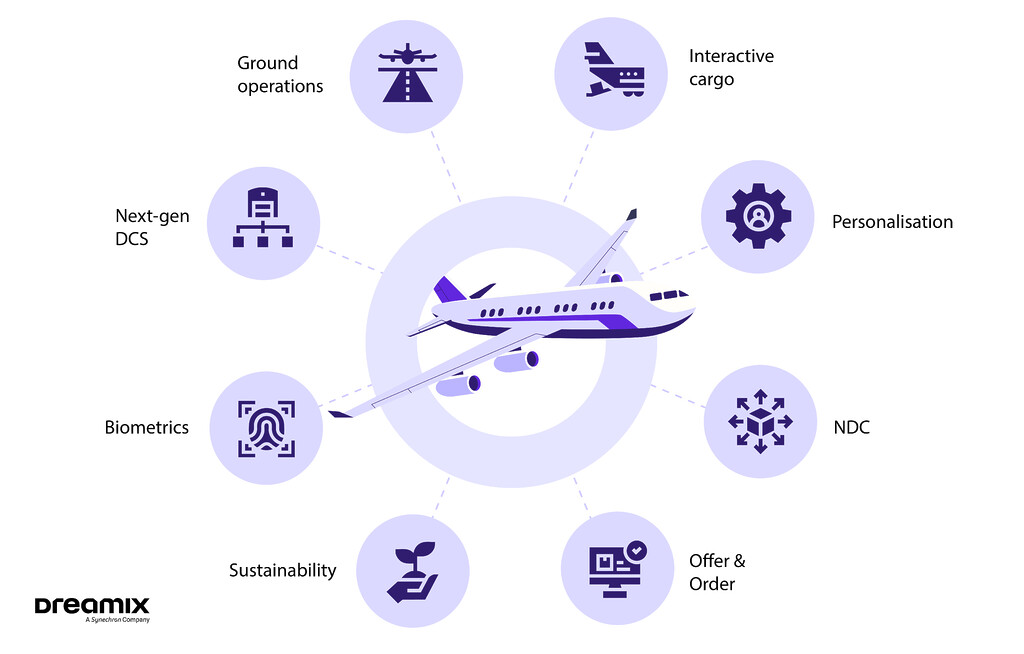
1. Ground operations: Advanced automations
A lot must happen before a plane takes off, and ground operations handle each step. Driven by technological advancements, environmental concerns, and the push for greater efficiency and safety, Ground Ops need to continuously improve. The International Air Transportation Association (IATA) advocates for more automation and digitalisation to meet these objectives. Let’s take a closer look at the aviation technology trends in two specific areas of ground ops:
Baggage handling automation
Until recently, baggage handling has remained unchanged territory for decades. However, the ever-growing passenger expectations towards shorter waiting queues for baggage drop-off call for more automation. In fact, SITA’s Baggage IT insights for 2024 reveal that 66% of airlines and 88% of airports are already implementing touchless self-service baggage handling and investments will continue in 2025. This doesn’t only satisfy passenger’s expectations but also tackles staff shortages linked to the major COVID-19-provoked layoffs.
Digital transformation in aviation: Interactive cargo
The newly formed post-pandemic online spending habits of people boosted the e-commerce sector to an impressive $6.9 trillion in 2024. A huge number of all those purchased parcels are handled by ground handling service providers and then shipped by air cargo.
Along with enhanced security protection, technologies such as IoT can also solve consumer’s demand for more visibility and real-time parcel tracking. Not only end-clients but also online retailers wish for more shipment transparency. That’s why IATA aims to “make the cargo talk” with approved tracking devices onboard and leverage one of the top aviation technology trends. IoT-enabled solutions can deliver real-time monitoring and tracking of essential parameters such as location, temperature or humidity of sensitive goods during transportation.
Loading efficiency
Loading efficiency refers to the ability of airlines to efficiently load passengers, baggage, and cargo onto an aircraft while keeping delays at minimum and aiming for maximum space utilisation. By enhancing existing loading processes, airlines can enjoy improved operational efficiency, reduced aircraft ground time, and increased passenger satisfaction. For instance, increasing airports’ self-serving capabilities with self-check-in kiosks, and automated boarding and baggage handling processes can significantly shorten boarding and as a result, turnaround time.
2. Personalisation: Serving the digital traveller even better
Almost the entire passenger’s travel journey is now digital. From flight searching, booking, check-ins, flight updates and ancillary services: Digital travellers are the new normal. In fact, SITA expects that the demographic shift in the post-digital age will profoundly change how passengers expect to interact with airports and airline technology.
Eighty-three per cent of IT aviation experts identify personalisation as one of the top aviation technology trends and as a key factor shaping their passenger solution strategies by 2025. There is always room for improvement and airlines are super rich with customer data. If they manage to use it wisely and strategically, they can be able to provide even better products and services. Let’s take a look at what airlines can do to improve their personalisation offerings.
NDC solutions
While passengers can handle many aspects of their journey online, there is still a strong demand for a seamless, personalised travel experience. Whether it's through improved shopping experiences, greater product differentiation, or tailored offers, there are ways to further satisfy the digital traveller. One effective approach is leveraging NDC, the airline industry's omnichannel distribution standard.
NDC stands for New Distribution Capability and is an XML-based data communication standard launched by IATA. It allows airlines to better serve passengers by providing rich content and ancillaries (e.g.excess baggage, onboard services, day of travel updates, etc.) to online travel agencies (OTAs) and flight resellers. In comparison to the legacy GDSs (global distribution systems) EDIFACT that has been around since the 80s, NDC offers richer data distribution, allowing carriers to merchandise additional products and services to passengers for greater profit. According to a McKinsey report, aviation can reach $45 billion in additional value by adopting NDC as part of their retailing strategy.
Offer and Order
NDC is based on Offer and Order Management (OOM) processes which allows airlines to adopt a dynamic pricing strategy. They can also adjust it on the go relying on real-time data updates based on the passenger's profile. Such dynamic pricing solutions can be developed using either AI/ML development services or rule-based (commonly “if-then” statements) systems. As of this year, many aviation giants have began their journey of embracing OOM as part of their airline digital transformation.
As a proud strategic partner of IATA, Dreamix is on the forefront of innovative aviation technology solutions that contribute to filling the gap between aviation solution providers and airlines. We know that NDC offers significant benefits but also requires a clear growth strategy from airlines. The adoption pace of both NDC and OOM still varies among aviation companies and is dependent on factors such as their priorities, technological capabilities, distribution strategies, and partnerships with experienced software development companies and travel agencies.
3. Sustainable digital transformation in aviation
As air travel continues to grow globally, the industry faces increasing pressure to reduce its environmental impact. While progress has been made towards more sustainable aviation, challenges remain in meeting these targets.
Airlines and airports are focusing on multiple strategies to enhance their environmental performance, including optimising operational processes, reducing food waste on board, and implementing more efficient software technologies. In fact, these sustainability initiatives not only address environmental concerns but also often result in cost savings and improved operational efficiency.
4. Biometric technology: increased adoption rates
Biometric technology is another one from the top aviation technology trends. More and more international airports rely on biometric scanning, which speeds up boarding and reduces human error. On the other hand, some passengers remain reluctant to embrace biometric kiosks because of privacy and security concerns. Data breaches and third-party data sharing are among the top-ranking concerns identified by the Global Passengers Survey. To address the issue airports can take preventive measures such as investing in aviation security software with advanced data encryption and secure data storing.
Still, 73% of passengers say they're ready and want to use biometric data during boarding. Passenger’s eagerness varies from region to region though. While Asia Pacific is leading in the widespread adoption of mobile apps and biometrics, Europeans remain more sceptical towards digital solutions including biometric technology. The Middle East and North America show both high adoption rates and enthusiasm to embrace this tech initiative as part of broader digital transformation in aviation. While biometrics is a promising trend in aviation's digital transformation with many business opportunities, airports need to look at their specific passenger’s preferences and come up with innovative ways to improve their user experience.
5. Next-gen DCS: what’s next?
Flying revolves around data exchange between multiple parties. Airlines operate with vast amounts of data on a daily basis as they need to safely board: the right people with the right baggage on the right aircraft while messaging governmental portals regarding PNRs (Personal Name Record). The legacy way to do all this and more is using a DCS (Departure Control System) whether its software relies on microservices or monolith architecture. In traditional DCS a single passenger’s interaction is taken as a standalone data transaction.
For instance, during check-in, the system records only the necessary data for check-in. But later on, during boarding, a new transaction is triggered which gets neither attached nor adapted to earlier data. This forces DCS to focus on separate tasks rather than creating a seamless, integrated experience for both passengers and staff.
There’s a catch though: currently airlines are seeking ways to enhance or even replace traditional DCS because legacy technologies are often:
- Fragmented - creating data silos and causing operational delays
- Rigid and/or even outdated - hosted on on-premise servers, therefore lacking the necessary scalability, speed and customisation capabilities
- Resource-intensive - requiring manual intervention and/or substantial IT resources
In this spirit, a major challenge that airlines currently face is finding ways to integrate new digital technologies within their legacy systems, while keeping compatibility problems at minimum while ensuring a smooth transition without causing operational silos.
However, the future of DCS relies on investments in modern technologies like cloud-based solutions, mobile apps, biometric technology, API integrations, and data analytics. These are not mere aviation technology trends but real-world but offer tangible business benefits for improved efficiency, enhanced passenger experience, and better integration with other airline systems. For example, DCS can interact with OTA’s reservation systems, loyalty programs, baggage handling systems or flight operations systems, to enable synchronisation of passenger information, and coordination of crucial processes such as check-in, seat assignments, baggage handling, and real-time flight updates.
In a nutshell
The technology trends shaping the future of aviation. As the sector aim to implement significant changes and advancements for the years to come, modern aviation technology will play an increasingly important role for maintaining a competitive edge. Currently, many airlines still rely on legacy aviation technology systems, causing data silos, business disruptions and slowing down operations.
That's why digital transformation in aviation is among the biggest technology trends in the industry. Many airlines still rely on legacy systems and face the challenge to adopt the right technologies and respond to the increased passenger and cargo traffic demand. However, in a safety-first industry such as aviation, some companies may be hesitant to adopt cutting-edge technologies that improve operational efficiency. As Martin Mitev put it in one of our recent aviation expert interviews, in highly regulated industries, innovations can take up to a decade to take place.
Nevertheless, as the adoption rates and new technologies shape the current state of digital transformation in aviation, we’re bound to observe more and more airlines catching up. Biometric technologies are taking over airports to facilitate the boarding process. The rise of the digital traveller is also posing a challenge for companies to further personalise their Offer and Order processes while securing better profits. Let’s also not forget the need for investments in ground operations that take a crucial place within the aviation industry.
The post-pandemic market landscape does not only call for sustainable tech innovations but also for trusted tech partners, capable of implementing these. In its professional portfolio Dreamix has multiple airlines already profiting from innovative technological implementations. To discuss your business needs and secure your competitive advantage, schedule a get-to-know call with our representatives.
We’d love to hear about your aviation software project and help you meet your business goals as soon as possible.