

Aviation executives face a key decision: maintain costly legacy systems or modernise for the future of aviation tech, as CIOs are under pressure to stay competitive, meet sustainability goals, and improve operations.
However, this is not a binary choice. The real challenge is modernising without disrupting mission-critical systems, enabling airlines and airports to unlock data value while bridging legacy and modern technologies.
I’m Denis Danov, CTO at Dreamix, where we help aviation companies integrate modern technologies into existing legacy environments without disrupting core operations. In this article, I’ll explore how airlines and airports are preparing for this shift and the role of aviation software development in addressing industry challenges and business goals.
Through strategic partnerships and modernisation approaches, aviation companies can unlock the value of their operational data without replacing mission-critical systems altogether. The key often lies in applying modern software technologies capable of bridging together legacy systems and new data capabilities. In this article, we’ll provide an overview of how two of the most significant industry players (based on market impact) prepare for the future of aviation: airlines and airports. We’ll also discuss the key role that aviation software development play in addressing the unique challenges and business goals of each segment of the aviation ecosystem.
Key takeaways
- Legacy aviation systems create operational silos that limit data access and innovation potential.
- Airlines face mounting pressure from ageing technology infrastructure and a shrinking skilled workforce.
- Modern airlines must balance preserving critical legacy functions with implementing new capabilities.
- Cloud migration and API integration allow airlines to innovate without replacing core systems.
- Airports are leading the transformation by investing heavily in passenger flow and retail analytics.
- The aviation industry’s future depends on strategic modernisation rather than a complete overhaul.
Aviation industry trends driving the future of aviation technology
In 2026, airlines are under constant pressure to meet rising customer expectations and regulatory requirements while advancing digital transformation.
According to Deloitte’s Airline Tech Insights, the aviation landscape has shifted in multiple directions.
For starters, traveller personas are changing, and so are passenger expectations for digital-first interactions.
Furthermore, the aviation sector workforce is increasingly ageing. As most airline monoliths are built on outdated technologies such as COBOL and mainframes, it’s getting more difficult to find developers with relevant skills, and many positions now remain vacant.
As a result, we see IT budgets going to maintaining legacy systems rather than innovation. Not to mention that airlines’ legacy systems are proving inadequate for today’s challenges. Airlines have historically used technology as a competitive differentiator to improve efficiency, reduce costs, enhance safety, and optimise revenue streams. However, many core systems, some dating back to the 1960s, are still in operation today.
Therefore, airlines must invest in robust technology solutions that address these legacy constraints and prepare them for the future of air travel.
Future aviation trends: how airline CIOs are reshaping IT strategy
Airline CIOs recognise legacy technology problems as strategic barriers to competitiveness. This recognition drives a shift toward modular software investments that balance short-term operational gains with long-term architectural flexibility.
According to McKinsey’s interviews with 15 airline CIOs, IT investment challenges are driven not only by budget constraints but also by a shortage of digital talent.At the same time, airline IT is shifting from a cost centre to a source of operational efficiency and revenue growth, with McKinsey estimating that airline IT modernisation could unlock up to $45 billion in industry-wide value through improved productivity and operational performance.

This shift creates opportunities for broader airline IT transformation beyond cost reduction, particularly in improving operational performance.
While there is no universal technology investment benchmark, TNMT suggests allocating 6%–8% of annual revenue as an objective for meaningful digital transformation.
"The next decade's aviation leaders will win not only through fleet investments but through data intelligence. Targeted legacy modernisation enables predictive operations and personalised experiences that competitors cannot easily replicate."
Gary Kenny, Head of Aviation Solutions at Dreamix
Tackling airline digital transformation through custom software solutions
Airlines face significant challenges when operating with outdated monolithic core systems. These legacy architectures create data silos that limit customer profiling and restrict the use of advanced analytics, ultimately slowing operational improvement and aviation digital transformation.
As a result, legacy system modernisation has become a key priority for many airlines. Let’s see some of the technological paths they choose to overcome the monolithic system constraints by implementing modern architectural approaches.
1. AI solutions and data analytics
Data analytics play a central role in aviation digital transformation, but their value increases significantly when combined with AI and machine learning.
Airlines generate vast amounts of operational and passenger data, and AI helps turn this into actionable insights for better decision-making and cost efficiency.
AI and automation in aviation enable airlines to optimise the following areas:
- Flight route planning
- Predictive maintenance
- Fuel consumption reduction
- Cybersecurity enhancement
- Automation of ground operations and customer support
- Passenger experience personalisation
- Supply chain efficiency
Industry adoption reflects this shift. According to SITA’s report, 74% of airlines prioritise AI for operational performance, while many already use it for cybersecurity, fraud detection and customer service applications such as chatbots and sentiment analysis.
Beyond operational gains, AI also supports sustainable aviation technology by improving fuel efficiency and operational planning, helping airlines reduce environmental impact while remaining competitive.
By partnering with a custom AI development company like Dreamix, airlines can create powerful algorithms that improve passenger experience, optimise flying routes or reduce aircraft downtime.
2. Cloud and multi-cloud platforms
Cloud platforms help airlines overcome the limitations of legacy systems with lower cost and risk than full system replacements. Instead of a complete overhaul, airlines can adopt hybrid architectures that maintain critical legacy systems while gradually migrating selected functions to the cloud.
Another main advantage is improved data accessibility, as cloud applications integrate across airline systems and help eliminate long-standing data silos.
Airlines can also use multi-cloud strategies to build more secure, cost-efficient, and flexible infrastructure. A strong example is IndiGo, which uses both Microsoft Azure and Google Cloud and has migrated around 80% of its operations to cloud-native platforms using agile sprint-based development.
Looking ahead, aviation will depend on how quickly airlines adapt to change. Cloud application development is one of the key innovations shaping aviation, as it significantly reduces time-to-market. Processes such as customer feedback systems that traditionally take 6–9 months can now be delivered in just weeks.
3. Microservices architecture
Microservices architecture breaks down monolithic functions into independent, scalable services that update individually, making airline operations more efficient, secure, and customer-centric.
As more airlines adopt cloud-native and API-driven architectures, microservices will play an important role in the future of aviation technology.
An IJFMR paper on microservice architecture in airline management systems identified the following benefits:
- Scalability: Independent services scale based on demand
- Fault isolation: Microservice failures don't spread to the entire system, saving airlines significant costs
- Continuous deployment: Updates and feature improvements happen quickly
- Technology agnosticism: Microservices can be developed in different programming languages and databases
In my experience, finding the right technological partner who can seamlessly execute migration from monolithic to microservices is critical to the success of any innovation strategy.
4. API-First Strategies
API-first strategies are a proven way to give airlines a competitive advantage in the future aviation trends.
One major initiative gaining traction is New Distribution Capability (NDC), developed by IATA. Built on API principles, NDC represents a shift in airline distribution by allowing carriers to expose inventory, pricing, and ancillary services directly to partners, instead of relying on traditional global distribution systems.
API-first design also enables a more connected passenger experience. When booking, check-in, lounge access and in-flight systems all access the same customer profile through APIs, the passenger experience becomes seamless and consistent regardless of channel. As a result, the passenger no longer needs to provide the same information repeatedly throughout their journey.
Airlines like Lufthansa, Emirates, British Airways, Turkish Airlines, and SWISS are already advancing their NDC adoption, expanding capabilities like dynamic pricing, shopping, order management, and ancillary services.
These API-first approaches are central to preparing the industry for future aviation technology.
Future of commercial aviation: how airports drive digital transformation
From my observations, airports appear to be the fastest digital transformation adopters across the aviation ecosystem.
Smart airports equipped with the latest technological innovations rank among the leading aviation software trends. This not only improves passenger satisfaction but also addresses staff shortage challenges from pandemic-related layoffs.
Airport IT and tech investments are almost twice as high as airline IT spending. Airports invested 8% of their revenue in innovative initiatives in 2024, while airlines invested just above 4% in IT-related innovations.

In my experience, many aviation innovations are tightly linked to extracting meaning from the vast amount of data available. Custom software development can prove invaluable in achieving such goals.
Let’s see which ones in particular promise to drive the most business value for airports.
1. Passenger flow management systems
Passenger flow management systems are among the most impactful custom software solutions for airports.
These systems collect data from various sources such as Wi-Fi and Bluetooth signals, video surveillance and boarding pass scans to create real-time visualisations of passenger movement across terminals. This data helps airports identify and anticipate congestion points before they occur.
Based on these insights, airports can dynamically allocate staff to busy areas and adjust security lane openings according to expected demand, improving operational efficiency and passenger satisfaction.
As aviation technology continues to evolve, these systems will increasingly use predictive analytics to forecast passenger flow hours in advance, enabling proactive rather than reactive decision-making.
2. IAO platforms
Integrated Airport Operations (IAO) platforms act as central command systems that bring together data from multiple airport operations. They consolidate information from baggage handling, aircraft movements, gate assignments, retail, ground operations, and facilities management into a single dashboard.
This integration helps airport stakeholders understand how different areas are connected and supports coordinated decision-making during both normal operations and disruptions.
In the future, these platforms will increasingly use digital twin technology to simulate operational decisions before they are implemented. Airports such as Dallas/Fort Worth are already developing digital twins of their facilities to support planning and optimisation. This allows them to test changes in passenger flow, security layouts, and retail spaces virtually, reducing both cost and operational risk.
3. Smart retail analytics solutions
Smart retail analytics solutions help airports increase non-aeronautical revenue by analysing passenger behaviour across retail stores, food and beverage outlets, and airline lounges. These custom software applications use passenger demographics, flight data, dwell time, and purchasing patterns to optimise store layouts, product offerings, and pricing strategies.
The insights gathered also help airports deliver more personalised retail experiences, such as targeted promotions during delays or predicting demand spikes based on flight schedules. As part of the future of aviation, these systems will increasingly adopt dynamic pricing models that adjust in real time according to terminal congestion and passenger demographics.
The infographic below highlights real examples of airport digital transformation and automation initiatives that improve daily operations and reduce costs:
Smart retail analytics solutions
Smart retail analytics solutions help airports maximise non-aeronautical revenue by analysing passenger behavior in commercial areas like retail concessions, food and beverage outlets or airport lounges. These custom software applications can help analyse passenger demographics, flight information, dwell time, and purchasing patterns to help optimise store layouts, product offerings, and pricing strategies.
The data intelligence gathered allows airports to further improve their personalisation offerings and improve retail experiences based on flight destinations, e.g. by creating targeted promotions during operational delays, and even predict which concessions will experience demand spikes based on flight schedules. In the future of aviation, these systems will increasingly incorporate dynamic pricing models that adjust in real-time based on terminal congestion levels and passenger demographics.
In the infographic below are some real examples of airports initiatives in digital transformation and automation that improve daily operations and cut down costs:

The roadmap towards a digital future of aviation:
From my experience helping aviation companies navigate the growing complexity of digital transformation in aviation, these are the major considerations for building a successful path forward:
1. Assess the current technology landscape
Before embarking on transformation initiatives, airlines and airports must conduct a thorough assessment of their existing technology stack and:
- Document all systems and their interdependencies
- Identify critical business capabilities and decide if the technologies behind them are future-proof
- Evaluate the current technical debt
- Calculate the maintenance costs of legacy systems
- Assess existing data quality, accessibility, and integration capabilities
2. Prioritise initiatives based on business impact
Keep in mind that not all digital transformation initiatives can deliver equal value. That’s why aviation companies looking to secure their market position in a digitally driven industry should:
- Focus first on customer-facing improvements that enhance both passenger’s experience and revenue
- Target operational inefficiencies with the highest cost-saving potential
- Address aviation compliance requirements with software that cannot be deferred
- Balance quick wins with longer-term strategic improvements
3. Choose the right architectural approach
Different modernisation strategies suit different situations:
- If your core legacy systems are still stable, consider API layers that expose functionality to new applications
- In case your critical systems are outdated, you can pursue gradual replacement, for example by implementing microservices
- For peripheral systems, complete replacement with modern alternatives might be considered
- Data lakes with the capability of consolidating information can be used to implement data-intensive processes
4. Build internal capabilities
Digital transformation is not just about implementing technology but about up- or reskilling people too:
- Invest in training existing IT staff on modern technologies and methodologies
- Recruit digital talent with experience in cloud, APIs, and microservices
- Foster a culture of innovation and continuous improvement
- Establish centers of excellence for critical capabilities like data analytics
5. Form strategic partnerships
Few aviation companies can navigate digital transformation alone. McKinsey has also recognised the need for airlines to find strategic vendor partnership that combine both internal and external capabilities
- Partner with technology providers that understand the unique challenges of aviation.
- Evaluate software vendors based on their integration capabilities, not just features
- Explore ecosystem partnerships with complementary service providers
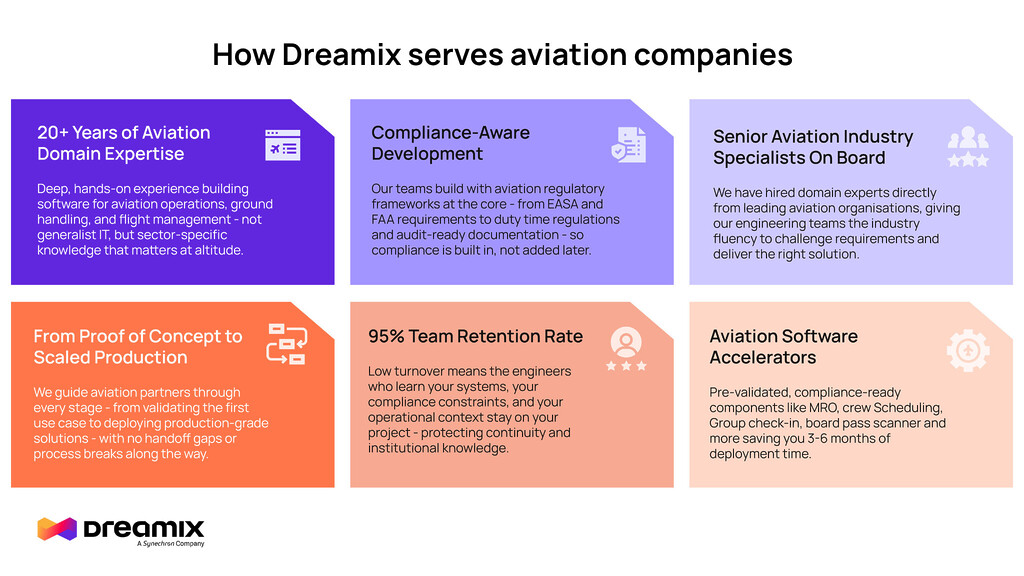
Dreamix has 12+ years of experience in working with leading airline companies and is part of IATA’s Strategic Partnership Program that bridges the gap between aviation solution providers and airlines.
"Our partnership with IATA strengthens our dedication to providing world-class aviation software solutions and puts us at the forefront of industry innovations. It allows us to provide even better service to our partners through advanced technologies and domain knowledge."
Denis Danov, Aviation Expert and CTO at Dreamix
Conclusion
The future of aviation technology depends on digital transformation, but the shift is not straightforward, as legacy systems still support critical operations. Airlines and airports must therefore balance stability with innovation.
Custom software enables gradual modernisation, using technologies like cloud, microservices, APIs, data analytics, and AI to improve efficiency and customer experience without full system replacement.
As the industry evolves, AI and data intelligence will become the main drivers of competitive advantage, shaping long-term growth and innovation.
FAQ about the future of aviation technology
We’d love to hear about your aviation software project and help you meet your business goals as soon as possible.