

Most of the advice written for executives stops at the signature. There’s an abundance of buyer's guides, vendor scorecards, and red-flag checklists for everything up to the moment you pick a partner. Then the guidance goes quiet, right when your money starts moving and you expect real business outcomes.
That quiet period is where projects are won or lost. Research published in Harvard Business Review, covering 1,471 IT projects, found an average cost overrun of 27%, with one project in six running roughly 200% over budget and almost 70% past schedule. Overruns of that size are earned after kickoff, not during procurement.
That’s why the partner you chose matters, and so does what the two of you do together in the weeks that follow. And the best outcomes come from pairing a capable software development agency with a client team that stays engaged after kickoff.
In this blog post, we discuss the topic of what happens after you hire a custom software development agency. As a stakeholder, use it to know what to expect, what to ask for, and how to tell early whether the engagement is on the right track.
Stage 1: Discovery and alignment (weeks 1-4)
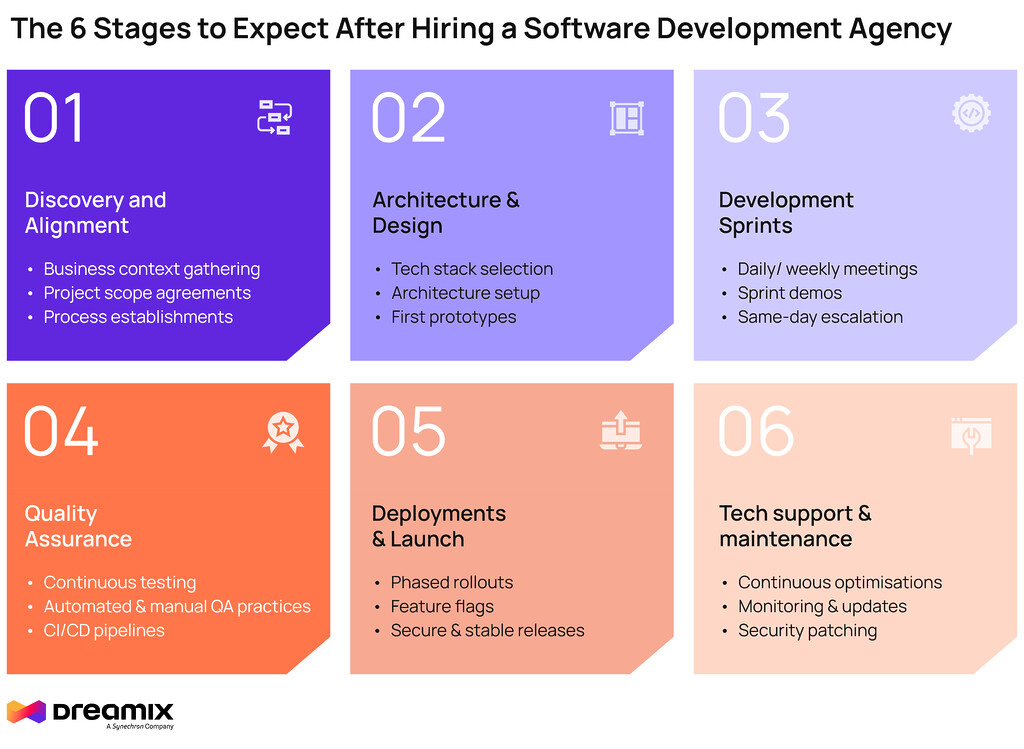
In the first three to four weeks after you hire a software development agency, the team runs discovery: they gather deep context about your business, agree on project scope, and set up how you'll work together. This is the foundation phase, and how well you resource it largely determines whether the rest of the project stays on schedule.
A serious partner arrives hungry for context around your business model, your competitors, your existing systems, and the real reason this project exists.
During this stage, expect to grant access to:
Your data and tools: data analytics, CRM, and the existing codebase the team will work with.
Your people: the key stakeholders who understand how the current process actually works.
Your intent: the business outcome behind the project, not just the feature list.
If you are still weighing partners, our guides on selecting the right custom software development company and how to evaluate and hire software developers cover the decision that sits just before this one.
What’s more, two decisions made during this first phase might shape everything downstream:
- Scope: The team turns your goals into a prioritised backlog and a delivery roadmap. This is the moment to be honest about trade-offs. If your timeline is tight and your scope is wide, a good partner tells you which features belong in phase two rather than quietly overcommitting.
- Point of contact: You should leave discovery knowing exactly who owns the relationship, who you speak to every week, and who makes the call when priorities collide.
At Dreamix, a designated product owner runs this phase, capturing requirements, building the roadmap, and making sure development follows it. The discovery work is also where domain expertise earns its keep. Engineers who understand your industry ask sharper questions and can spot gaps a generalist software development team might miss.
If you want the full picture of how to evaluate that expertise before you get here, our custom software development services buyer's guide by our CTO Denis Danov covers the selection framework in detail.
From our 20-year long experience working with enterprise companies, one of the biggest risks in Stage 1 is your own availability.
Discovery delays everything after it. If key stakeholders cannot make key decisions in real time during these initial weeks, the whole timeline can slip before a single line of production code is written. That’s why we honestly suggest you clear your calendar for this part.
Read next: IT Outsourcing to Bulgaria: 9 Strategic Enterprise Advantages
Stage 2: Architecture and design (weeks 3-8)
Once scope is agreed, the agency defines how the software will be built: senior engineers set the architecture and technology stack, while designers turn requirements into wireframes and prototypes you can review before development starts. These weeks produce few visible features, but the structural decisions made here determine how well your system scales, integrates, and evolves for years.
Senior engineers lead the technical foundation. The choices they make now are hard and expensive to reverse later, which is why this stage deserves your attention even though it produces little you can click on yet. Key decisions include:
- Architecture: How the system is structured, commonly using microservices so parts can scale and change independently rather than as one rigid block.
- Technology stack: The languages, frameworks, and databases the product is built on, chosen to fit your needs today and your talent market tomorrow.
- API-first design: Building clean interfaces from the start so your software can integrate to other systems and absorb new capabilities without a rebuild.
- Cloud infrastructure: A cloud-native, provider-flexible foundation that decides how easily you can grow, deploy, and add additional capabilities like AI later.
In parallel, design and user experience work begins. Wireframes and prototypes turn abstract requirements into something you can see, react to, and correct while changes are still easier and relatively cheaper. Treat these reviews as decision points, not demos:
- Wireframes map the structure and flow before any visual polish, so you catch logic gaps early. For example, a wireframe of a checkout flow might reveal that a customer has no way to edit their cart from the payment screen, forcing them to start over. Spotting that in a grey-box layout takes a five-minute fix; discovering it after the screen is designed and coded means reworking the flow, the visuals, and the backend logic behind it.
- Interactive prototypes let stakeholders click through the product and surface misunderstandings before they reach the codebase.
- Design sign-off locks the direction, because every change after the actual development stage starts costs more time and resources.
Stage 3: Development sprints (weeks 8 onward)
This is the build stage, where the agency writes and ships your software in short Agile iterations, each producing working functionality you can see and test roughly every two weeks. It's the stage most people picture when they imagine hiring a software development agency, and it's where the operating rhythm of the partnership becomes visible. You don't wait months to learn whether the team understood you. You find out every sprint.
Under Agile methodology, work moves in short cycles instead of one long push toward a distant deadline. Here is what a healthy development stage looks like in practice:
- Weekly check-ins happen without exception, so you always know the status and nothing festers between meetings.
- Sprint demos, usually every two weeks, show working software rather than progress slides you can't verify.
- Continuous testing runs alongside development instead of being saved for the end, which keeps the product stable and shortens time to market.
- Same-day escalation means that when something goes wrong, you hear about it that day, with a recommendation attached rather than just a problem.
That last point separates a partner from a supplier. Anyone can report good news. A team that proactively surfaces problems, explains the trade-offs, and challenges your assumptions to understand the goal underneath the request is contributing business value, not just typing code. We built our delivery model around this because we care more about the outcome than the invoice, and our Agile software development approach is designed to keep you in the loop at every step. A good outsourced team, worth saying plainly, should not need constant supervision to do excellent work.
The clearest signal to watch in Stage 3 is your own engagement. The projects that go best are the ones where the client shows up to demos, answers questions quickly, and treats the agency team as an extension of their own:
- Show up to demos so feedback lands while changes are still cheap.
- Answer questions quickly so the team is never blocked waiting on a decision.
- Treat the team as your own so knowledge and context flow both ways.
Read next: Our product-minded development team extension guide by our Senior Product Owner Angel Kurtev breaks down the first four weeks of that integration week by week.
Read next: Forward Deployed Engineers: Enterprise AI’s Missing Link
Stage 4: QA and testing (continuous, intensifying before release)
Quality assurance is a continuous discipline, not a gate at the end of the project. In a mature engagement, automated and manual testing run through every sprint. As you approach release, that testing intensifies into a deliberate hardening phase where the team hunts for edge cases, load problems, and security gaps before your users find them.
For executives, the thing to verify is that outsourced QA is structural rather than improvised. Four questions surface the answer quickly:
- How does the team test, and at what stages of the sprint?
- What is automated, and what stays manual?
- How are security and compliance handled for your specific industry?
In regulated sectors like fintech, aviation, and healthcare, this is where certifications and disciplined processes stop being paperwork and start being protection. Dreamix holds ISO 9001 and ISO 27001 certifications and undergoes annual audits, which is our way of proving that quality and information security are built into how we work rather than promised in a sales deck.
Continuous integration and delivery pipelines matter here too. With CI/CD pipelines in place, tested code moves to release smoothly and predictably, which is the difference between a launch that feels controlled and one that feels like a gamble. It also shortens the feedback loop, so defects surface while they are still cheap to fix.
Stage 5: Deployment and launch
Deployment is where the software meets the real world. Done well, it is anticlimactic, and that is the goal. A confident partner does not flip a switch and hope. They roll out in a way that keeps risk contained and gives you a clean path back if something goes wrong.
Three techniques do most of that work:
- Phased rollouts put the product in front of users gradually, so problems surface at small scale
- Feature flags let the team switch functionality on or off without a new release
- Canary releases expose a small user segment first, giving early warning before a full launch
This stage also includes the practical handover: documentation, knowledge transfer, and making sure your team understands what was built and how it runs. If your custom software development agency treats deployment as the finish line and disappears right after, you have learned something important about the relationship. Instead, if they treat it as a transition into a longer partnership, suggest further improvements with real business value and ROI, you have chosen well.
Check out next: Changing Your Software Development Vendor in 2026? Here’s your Go-to Guide by our Engineering Manager Mihail Milkov
Stage 6: Technical support, maintenance, and evolution
Launch is the beginning of the software's working life, not the end of the project. Real systems need ongoing attention:
- Monitoring to catch performance and availability issues before users report them
- Updates that keep dependencies, integrations, and infrastructure current
- Security patching on a predictable cycle rather than in response to incidents
- Steady improvement as your processes, market, and priorities shift
This is also where the compounding value of custom software shows up. Because the platform was built around your processes, it can keep evolving with them, absorbing new features and new intelligence instead of hitting the ceiling that off-the-shelf products impose.
The best partnerships settle into this stage for years. Some of our client relationships have run for more than a decade, which happens because we treat the software as a living asset and the relationship as an ongoing one rather than a transaction that closes at launch.
The measure of a good agency is not how it behaves during the sales process. It is whether, two years after launch, your software is still an asset that pushes your business ahead. That is the standard worth holding your partner to, and the one worth holding yourself to as well.
The pattern beneath the six stages
Across all six stages, one variable predicts success more than any other: the quality of the partnership itself. A capable and experienced custom software development agency running a disciplined process still needs an engaged client who shows up, decides quickly, and treats the relationship as shared ownership. When both sides bring that, the six stages turn a signed contract into working software that earns its keep for years.
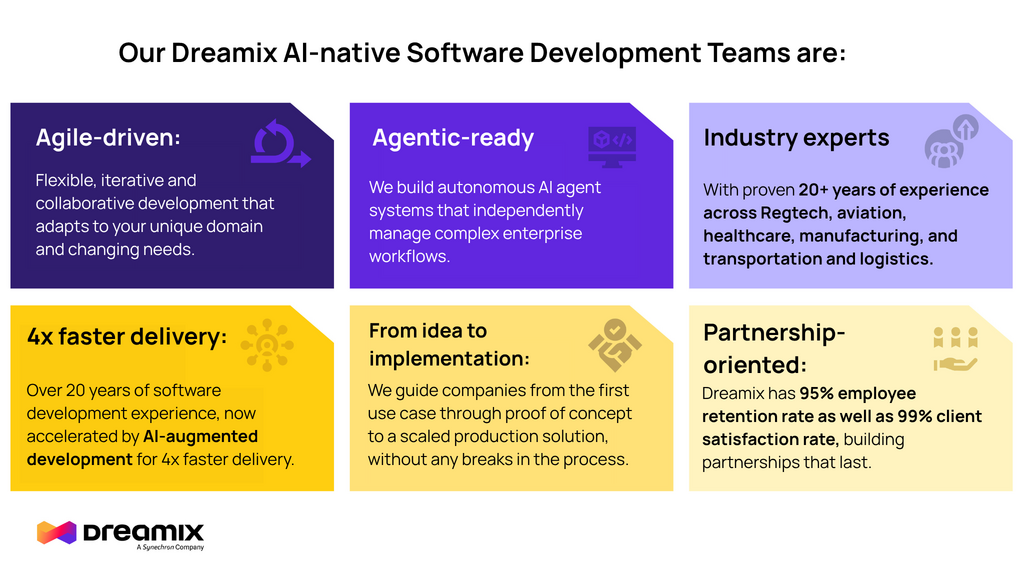
Our Dreamix software engineering teams:
- Use AI native development for 4x faster delivery backed by 20+ years of enterprise software development experience across domains like aviation, regtech, fintech, healthcare, T&L.
- Are driven by agile software development methodology to accommodate the fast-paced market dynamics
- Integrate seamless, reliable CI/CD pipelines to ensure delivery excellence
- Adapt their full-stack expertise to achieve highest software system quality and business ROI
- Can integrate in your in-house team within 2 weeks and start deliver real business value
- Cover the full cycle of software development and support you from the first use case definition through PoC to scaling
- Build lasting relationships guaranteeing stable team compositions
FAQ: working with a custom software development agency
We’d love to hear about your software project and help you meet your business goals as soon as possible.