Migrating legacy applications to the cloud has become a strategic imperative for organisations and the reasons are clear: improved agility, scalability, and resilience. Despite the clear benefits, however, many enterprises still grapple with the complexities of transitioning from outdated systems to modern cloud infrastructures. This hesitation comes at a substantial cost. It’s estimated that outdated workplace technology costs U.S. businesses up to $1.8 trillion annually (data by Samanage). Employees reportedly spend an average of 520 hours per year on repetitive tasks that could be automated, resulting in significant productivity losses.
These staggering productivity losses highlight precisely why cloud migration isn't merely a technical upgrade - it's a critical business transformation that can reclaim thousands of wasted hours and unlock significant operational savings. Plus, a Foundry's survey has found that 29% of IT budgets is allocated to cloud products and services. Investing in modernising legacy applications through cloud migration helps organisations automate manual processes, redirect employee talent toward innovation, and convert technological debt into competitive advantage. In this article we’ll explore exactly how by discussing the 7 key migration success strategies.
What are legacy applications?
Legacy applications are software systems developed with outdated technologies or methodologies that continue to perform critical business functions despite their age. These systems typically run on older hardware, use obsolete programming languages, or rely on unsupported frameworks that make them increasingly difficult to maintain, update, and integrate with modern technologies.
Common examples of legacy applications we at Dreamix have encountered include:
- COBOL-based banking and financial systems developed in the 1970s and 1980s
- Custom-built ERP solutions running on outdated mainframes
- Flight operations systems running on AS/400 platforms from the 1980s
- Aircraft maintenance tracking software using obsolete database technologies
- Patient record systems built on MUMPS or similar older programming languages
- Scheduling systems that lack modern API integration capabilities
Why migrate legacy applications to the cloud?
Dealing with legacy applications can often be a cumbersome, costly and critical issue for enterprises. They often become hard to scale which could cause a bottleneck for any company's development and scale. With the help of cloud providers, one can easily deploy any legacy application with up-to-date technological and security standards. Utilising the cloud infrastructure allows for the gradual migration and deprecation of legacy systems by utilising strategies that allow the extraction and modernisation of critical operations. The sheer amount of tools available mitigate a lot of the issues and provide an opportunity for any company to scale its legacy systems and operations.
Mihail Milkov, Software Engineer @Dreamix
Key drives for migrating legacy applications to the cloud
Let’s also go over the most crucial drivers for companies to invest in legacy app migration:
- Innovation - Cloud environments provide access to technologies such as AI, ML, and advanced analytics that can breathe new life into legacy applications and allow for implementation of new features
- Agility - Cloud technology is famous for allowing businesses to increase agility by allowing them to respond rapidly to changing market conditions and scale services on demand
- Cost-efficiency - When migrating apps to the cloud businesses can optimise costs through pay-as-you-go models that align expenses with actual usage patterns, while also reducing the substantial overhead of maintaining physical data centers. Still, according to Accenture, 58% of companies are experiencing a cloud value gap. This gap is often attributed to the challenges of modernising legacy applications, with 40% of organisations identifying it as a top barrier to achieving desired cloud outcomes.
- Enhanced performance - As a direct result from migrating legacy applications to the cloud, business performance is enhanced through optimised computing resources, load balancing, and content delivery networks
- Disaster recovery - Most cloud platforms come with built-in robust disaster recovery providing automated backups, and rapid failover mechanisms that would be immensely expensive to implement on-premises
- Improved compliance - Cloud migration when done strategically offers tools for security monitoring, access control, audit logging, and more. Besides, major cloud providers (Google Cloud, Azure, AWS) maintain numerous compliance certifications like HIPAA, PCI DSS or SOC 2 helping organisations meet evolving regulatory requirements with less internal overhead.
Related: Build or Buy: When Do Cloud Application Development Services Make Business Sense?
Business risks of maintaining legacy applications
Legacy systems age, and as they do so, they introduce significant business risks that make cloud migration increasingly necessary. Let’s briefly discuss the top reasons why legacy apps pose severe business risks:
- Security vulnerabilities
Legacy applications’s security status is perhaps the most pressing concern businesses need to address. Outdated systems often lack modern security protocols and may no longer receive critical security patches, leaving them exposed to emerging cyber threats. You might still remember the 2017 Equifax breach, which exposed sensitive information of approximately 150 million individuals, was largely attributed to the company's failure to patch a known vulnerability in its legacy systems.
- Performance limitations and scalability constraints
Legacy applications frequently struggle to handle growing data volumes or increased user loads, creating bottlenecks that frustrate customers and inevitably, hamper business growth. One of our partners, a leading transportation company, had a problem related to legacy code piled up by external vendors. Combined with a big people turnover, this resulted in developers missing business context and struggling with productivity issues. Our expert Dreamix team managed to improve the performance of their core by 150 times by drastically reducing message transaction time from 10 minutes to just 8 seconds.
Read next: Overcoming Transportation Legacy System Challenges with a Tailored Approach. Lessons Learnt
- The financial burden of maintaining legacy apps
The software aspect of legacy applications can sometimes create even more significant financial strain than maintaining legacy hardware. Businesses face mounting licensing fees for outdated software that vendors no longer actively develop but continue to charge premium prices to support. Plus, the maintenance contracts often increase yearly while providing diminishing value. And when critical bugs emerge in these aging systems, the cost of emergency fixes can be astronomical, often requiring expensive consultants who specialise in legacy technologies like COBOL, Fortran, or Visual Basic 6.
Cloud migration models for legacy applications
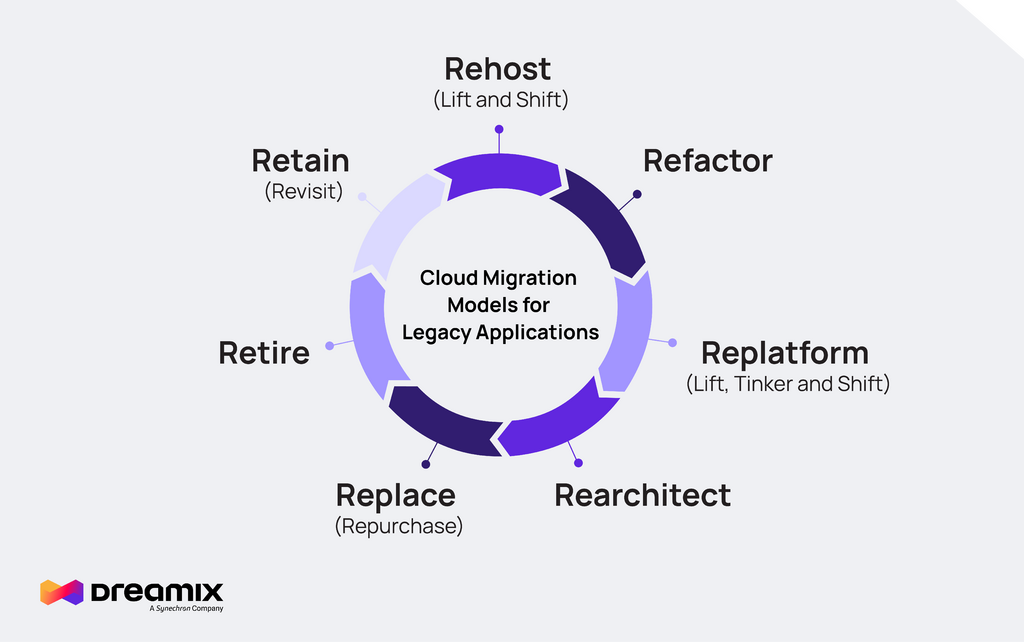
Rehost (Lift and Shift) for fast cloud migration
Rehost (Lift and Shift) is a cloud migration strategy that involves moving applications from on-premises infrastructure to the cloud with minimal or no changes to the underlying code or architecture. As the fastest and least resource-intensive approach, this is an ideal method for organisations seeking to quickly exit data centers, reduce infrastructure costs, or meet short-term capacity needs. Rehosting is especially useful for legacy systems that are stable but resource-heavy, and when there's limited time or budget for a full redesign - such as during a data center lease expiration or expected M&A. For example, Netflix initially used a lift-and-shift approach to accelerate its migration to AWS before refactoring its systems for more scalability and resilience.
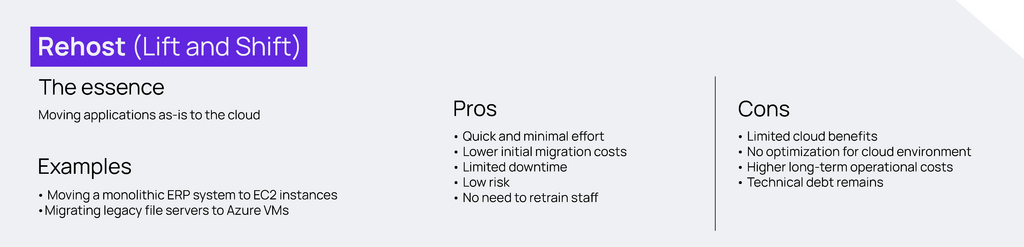
However, rehosting is not suitable for applications that require cloud-native features like auto-scaling, serverless functions, or microservices architectures. Without re-architecting, organisations may miss out on long-term cost optimisation, improved performance, or enhanced security that the cloud has to offer long-term. In some cases, the lack of optimisation can even lead to higher cloud bills due to inefficient resource usage. Therefore, while lift-and-shift can be a pragmatic first step, it’s best viewed as a transitional strategy rather than a permanent solution.
Refactoring
Refactoring another is a cloud migration strategy that involves some level of redesign but not a complete overhaul. As part of migrating legacy applications to the cloud, refactoring helps businesses take full advantage of cloud-native services such as auto-scaling, microservices architecture, containerisation, and serverless functions.
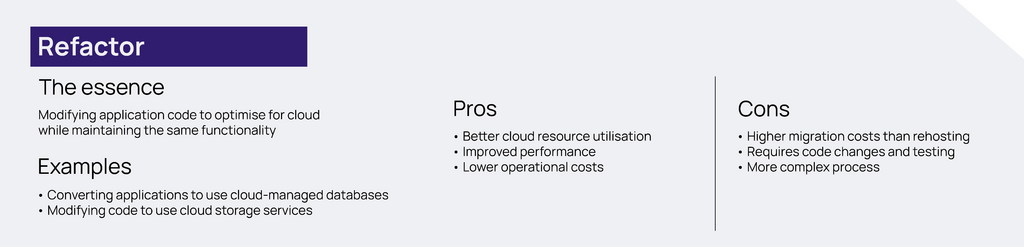
This approach is ideal for businesses that want to modernise legacy systems while unlocking long-term value. With refactoring, they can aim at improved performance, faster deployment cycles, and lower operational costs. Although it requires more development effort than rehosting or replatforming, the refactoring strategy prepares legacy apps to fully benefit from the flexibility and scalability of cloud infrastructure.
Replatform - Lift, tinker and shift
Replatforming is often described as a middle ground between rehosting (lift-and-shift) and refactoring. Often referred to as the "lift, tinker, and shift" or also “lift & reshape”, replatforming involves making targeted optimisations to legacy applications while moving them to the cloud, without changing their core architecture.
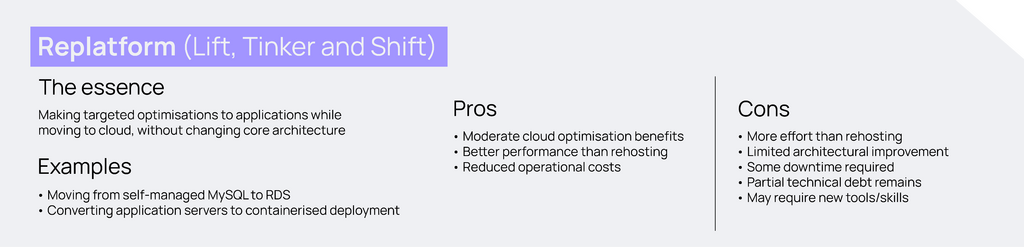
When migrating legacy applications to the cloud, replatforming allows businesses to modernise critical components like database upgrades, switching to managed services, or introducing containerisation but without rewriting the entire codebase. This approach reduces operational costs, improves performance, and enables better scalability, all while keeping disruption and risk relatively low. What’s more, the replatforming strategy allows your legacy application to continue operating while enhancing its security and compliance posture (AWS).
Rearchitect for cloud-native transformation
Rearchitecting requires redesigning the core architecture of a legacy application to fully leverage cloud-native capabilities. This strategy is typically chosen when the existing system can no longer meet business demands for scalability, performance, or agility. As part of migrating legacy applications to the cloud, rearchitecting allows organisations to break free from outdated monolithic structures and rebuild using modern architectures such as microservices, serverless computing, or event-driven models.
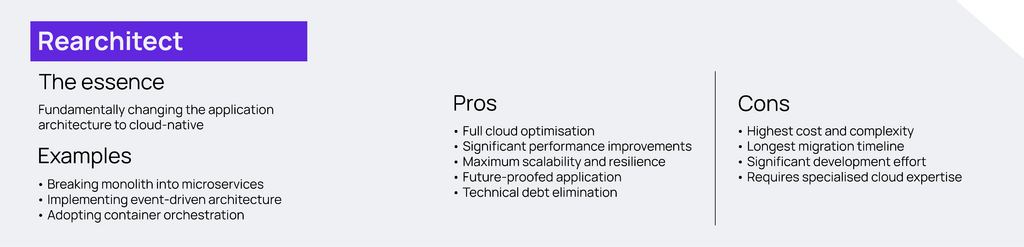
While rearchitecting requires significant investment in time and often an investment in cloud development services, it delivers substantial long-term benefits. These include greater scalability, faster time-to-market, and seamless integration with modern tools and services. For businesses aiming to future-proof their mission-critical applications, rearchitecting is a strategic move that unlocks the full potential of cloud innovation.
Related: How to Create a Future-Oriented Software Architecture
Replace (or Repurchase)
The replace migration strategy involves completely replacing legacy applications with cloud-native solutions rather than migrating or rearchitecting the existing systems. This approach is often chosen when the legacy applications are outdated, inefficient, or unable to meet the performance and scalability demands of modern businesses. By completely replacing legacy systems with cloud-native alternatives, organisations can take full advantage of the flexibility, scalability, and advanced capabilities offered by the cloud, such as serverless computing, AI/ML integration, and real-time analytics.
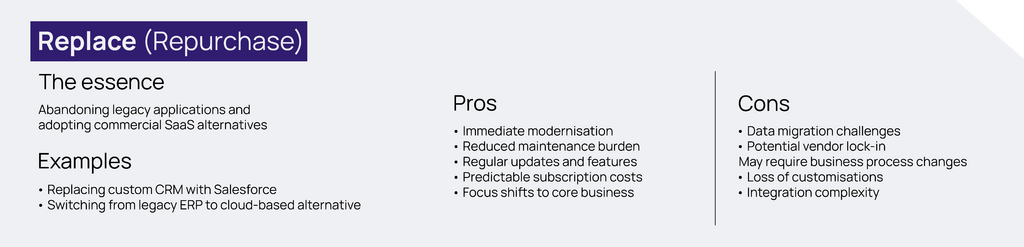
While replacing legacy applications may require significant upfront investment in new technology, it can provide substantial long-term benefits, such as improved performance, reduced maintenance costs, and the ability to innovate faster. This strategy is particularly useful when legacy applications no longer align with business goals or when the cost of maintaining and upgrading the old systems exceeds the benefits of replacement.
Retiring legacy applications
The retire strategy involves exactly what it says - identifying legacy applications that are no longer used or offer minimal business value and then decommissioning them instead of migrating them to the cloud. While doing a cloud migration, it's quite common for software to uncover systems that are so outdated and redundant that are simply only fit for retiring. Retiring these legacy applications helps organisations reduce complexity, cut unnecessary costs, and streamline their IT environments.
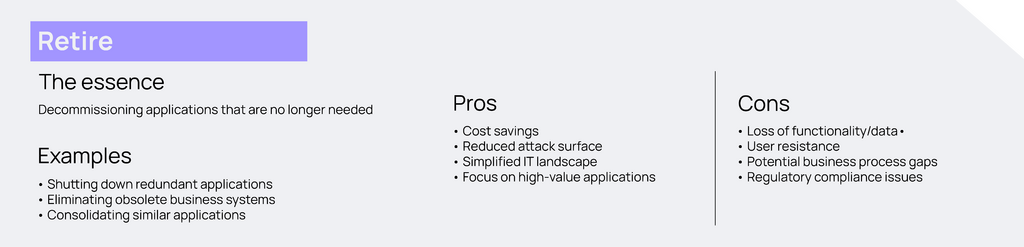
This strategy is especially valuable during the discovery and assessment phase of migration,where analysing application usage and business relevance can lead to smarter business decisions. By retiring what’s no longer needed, companies can focus resources on migrating and modernising only the applications with true business value. If done, this particular cloud migration strategy helps improve the overall migration efficiency and accelerates time-to-value in the cloud.
Retain
The retain strategy is also known as “revisit” or “do nothing for now” involves keeping certain legacy applications on-premises when they are not suitable or ready yet for cloud migration. This approach is often used for systems that are deeply embedded in day-to-day operations, have complex dependencies, or are tightly bound to regulatory or compliance requirements that make cloud migration too risky or impractical.
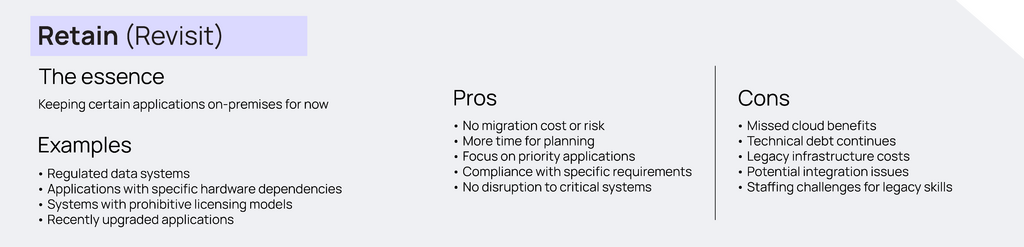
Retaining these applications doesn't mean ignoring their potential for modernisation. Instead, this strategy means maintaining such legacy applications while developing a longer-term modernisation plan they can some day fit into. In the meantime, retaining allows businesses to focus migration efforts on high-impact systems first, while preserving stability in areas where the cloud may not yet deliver clear benefits. Retaining select applications can be a strategic part of a phased migration approach, enabling organisations to balance risk, cost, and resource allocation effectively.
Pro Tip:
When migrating legacy applications, consider adopting cloud agnostic principles in your strategy. Designing applications that can run on multiple cloud platforms without significant modifications will help you avoid vendor lock-in and maintain strategic flexibility. While it may require more initial planning, cloud agnostic development provides long-term benefits including better negotiating leverage, freedom to select best-of-breed services, and easier adaptation to changing business requirements or emerging technologies.
Avoiding pitfalls while migrating legacy to the cloud
Avoiding these common pitfalls during legacy application migration to the cloud can ensure a smooth, cost-effective, and future-ready transformation:
- Evaluate cloud readiness early: Use tools like Azure Migrate, Google Cloud Migrate or AWS Migration Evaluator to assess workloads, identify modernisation opportunities, and align business goals with technical strategies.
- Avoid a pure Lift-and-Shift: Where appropriate, leverage Anthos (or similar tools) to refactor applications into containers and adopt hybrid or multi-cloud architectures, unlocking better scalability and modernisation potential.
- Ensure network reliability: Implement AWS Cloud WAN, Azure Virtual WAN or Google Cloud WAN offering secure, high-performance, and consistent connectivity across cloud regions and hybrid environments.
- Plan for integration and testing: Use Cloud Build, Cloud Deploy, Apigee (Google) for continuous integration and deployment (CI/CD) as well as for managing APIs and ensuring reliable system integrations. Azure and AWS also offer similar product tools.
- Build for operational continuity: Set up observability using Google Cloud Operations Suite, Amazon CloudWatch or Azure Monitor enabling proactive monitoring, logging, and alerting to keep systems running smoothly post-migration.
Related: Migrating Applications to the Cloud in 2025: Best Practices
How to choose the right cloud migration partner
Selecting the right cloud migration partner can make or break the success of your legacy application modernization. The complexity, risk, and scale of cloud migration demand more than just technical know-how—it requires a strategic partner who understands your business goals and can align cloud capabilities with long-term value creation.
In an ideal scenario, your cloud migration partner should bring expertise in modernising legacy applications, cloud-native development, and multi-cloud or hybrid cloud strategies. Look for a proven track record in handling migrations similar to yours, with case studies or client references to back it up. Beyond technical skills, they should also offer strong project management, clear communication, and the ability to co-create a roadmap that balances speed, security, and cost-efficiency.
Why choose Dreamix as a partner for cloud migration services?
- Commitment to excellence: With 16+ years of experience, Dreamix has consistently delivered high-quality software solutions to a diverse range of industries, including healthcare, finance, aviation, and transportation. With our 100+ certified cloud solution architects for AWS, Azure, and Google Cloud, your cloud adoption journey is ensured.
- Security best practices: We rely on industry best practices and comply with stringent security standards including ISO 27001 and GDPR.
- Trusted and growing company: On Clutch Dreamix has an excellent 5-star rating from 26 verified client reviews. We’ve also been recognised as one of the top cloud migration companies in Europe. Dreamix has also been acknowledged by the FT1000 ranking as one of the fastest-expanding businesses in Europe for 2025, securing position #492 with a compound annual growth rate of 63.4%.
We don’t just execute - we act as co-innovation partners, co-developing your digital transformation roadmap with enterprise leaders. By partnering with Dreamix, your company can effectively navigate the complexities of cloud migration, ensuring that legacy applications are transformed into agile, scalable, and secure cloud-based solutions.
Final thoughts
As we’ve discussed in the article, migrating legacy applications to the cloud should be seen as more than just a technical upgrade. Rather, it's a strategic business transformation that can fundamentally reshape organisational capabilities and competitive market positioning. By modernising aging systems through thoughtful cloud migration, businesses unlock unprecedented agility, cost efficiencies, and innovation opportunities that legacy infrastructure simply cannot deliver.
As a strategic first step, companies might begin with a comprehensive app portfolio assessment to identify potentially suitable migration candidates. If such application candidates pop up, it’s time to determine the most appropriate strategies for each by developing a detailed migration roadmap that aligns with business priorities and will ensure that the most critical applications remain intact. As this is a comprehensive process,many companies struggle to manage the entire migration in-house. This is where we at Dreamix can help other companies providing cloud migration services: from consultations early in the planning process to the entire migration execution.
We’d love to hear about legacy app migration needs and help you meet your business goals as soon as possible.