Redefining what's possible in business operations, customer engagement, and strategic decision-making with AI seems more real than ever. The business technology landscape of 2025 is being fundamentally reshaped by a powerful innovation: AI agents. As organisations seek practical AI agents use cases, we're witnessing a shift from theoretical applications to real-world implementation across industries. These intelligent agent solutions are now driving measurable value across enterprises, redefining what's possible in business operations, customer engagement, and strategic decision-making.
This implementation of AI agent technology couldn't be timelier. Organisations face unprecedented challenges: talent shortages across key functions, increasing data complexity, accelerating market changes, and relentless pressure for operational efficiency.
Whether your organisation is just beginning to explore custom AI solutions development, understanding these real-world AI agent use cases and the business outcomes can delivering - provides a valuable roadmap for capturing the full potential of this technology for your business.
AI adoption in businesses: An overlook
As organisations are currently transforming their operations and invest in IT innovations to maximise their value from gen AI, AI agents and AI-anything. Many expert prognosis are that 2025 will be a year of more widespread AI adoption in larger companies, as they're usually at the forefront of global innovations. If we take a closer look at how companies are generating value from AI, we can observe that, without a surprise, the main two drivers are cost reduction and revenue growth. The infographic below is from BCG's 2024 research among 1,000 CXOs worldwide about their AI maturity.
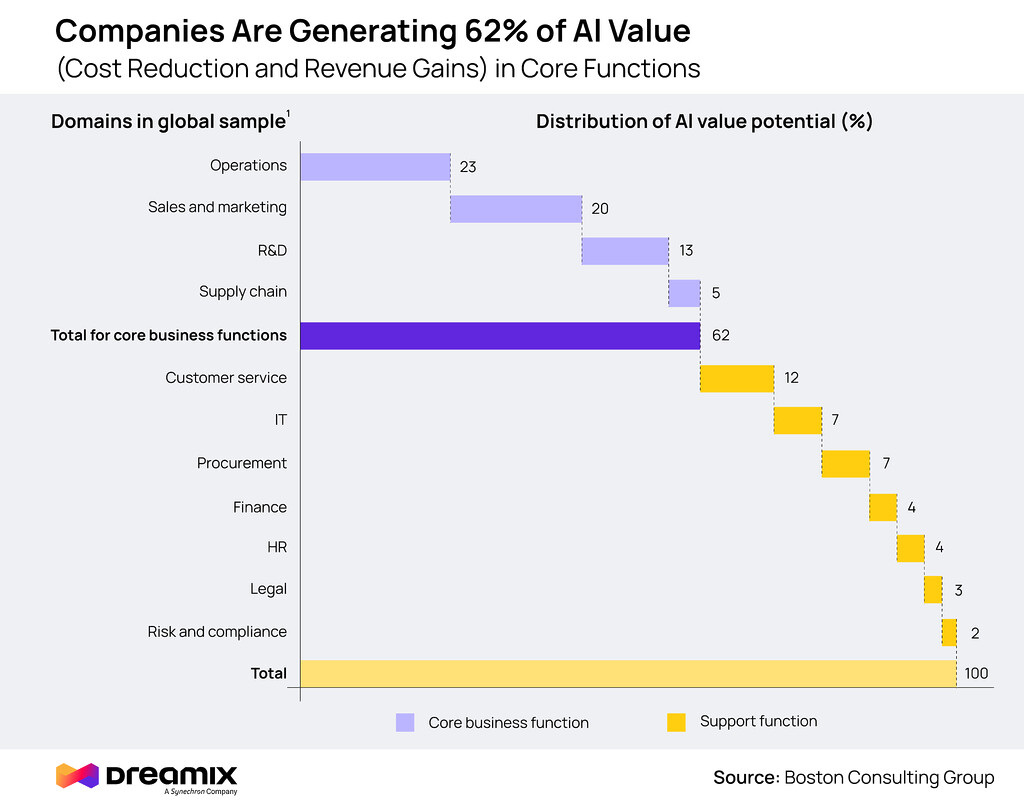
The infographic reveals that companies are generating 62% of AI value (through cost reduction and revenue gains) in core business functions, with operations (23%), sales and marketing (20%), and R&D (13%) delivering the greatest returns. Support functions like customer service (12%), IT (7%), and procurement (7%) contribute smaller but still significant portions of AI's value potential. The data from Boston Consulting Group highlights that organisations looking to maximise AI ROI should prioritise implementations in operational and revenue-generating departments while still allocating appropriate resources to support functions.
But the emergence of another subfield of the AI - agentic AI not only makes most business and tech headlines recently but is another highly promising AI use case that represents one of the most significant technological mega trends of 2025. We'll now take a closer look at what AI agents are, how they operate before diving deeper into some of the most important AI agent use cases that can reduce business costs.
If we look at another report we can observe that there's been a dramatic shift in business leaders' perceptions about AI in just one year. The most striking change is the jump from only 2% believing AI would have a significant impact a year ago to 45% holding that view today – that's a 22-fold increase.
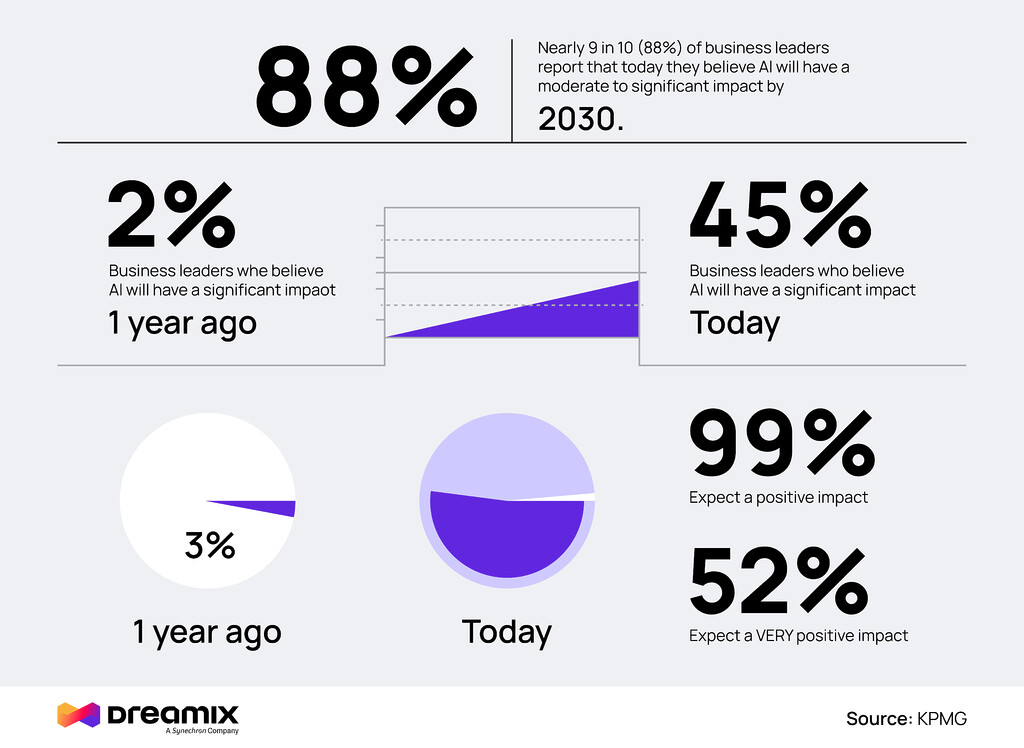
Nearly all executives (99%) now expect AI to have a positive impact, with more than half (52%) anticipating a "very positive" impact. This rapid change in sentiment reflects real-world results as AI implementations move beyond experimentation to delivering measurable business value.
For you as a business leader, this represents both an opportunity and a risk. The opportunity is clear – AI agents are now delivering substantial ROI across operations, sales, and R&D as we saw in the previous infographic. The risk is falling behind competitors who are aggressively investing in this technology. With 88% of your peers believing AI will have a moderate to significant impact by 2030, the question isn't whether to implement AI anymore, but rather which business functions should be prioritised for maximum competitive advantage in your specific industry. But beware, as with any trendy innovation, AI should also be seen from a critical perspective:
Many companies are jumping on the AI bandwagon simply to keep up with competition, without considering how AI integrates strategically into their products. I've encountered potential clients eager to claim they have AI capabilities without a clear understanding of its business fit. This approach is misguided. That's why identifying real use cases and establishing metrics for AI's impact is crucial to avoid wasting resources on irrelevant algorithms.
Kalina Cherneva, Head of Data Practice @Dreamix
What are AI agents?
AI agents are autonomous or semi-autonomous systems designed to perform tasks, make decisions, and interact with their environment using AI technologies. But unlike traditional AI applications, which are typically designed for specific, narrow tasks, AI agents are more flexible, adaptive, and capable of operating independently to achieve goals. AI agents are software systems designed to perceive their environment, make decisions, and take actions to achieve specific goals - all with minimal human intervention. Unlike traditional automation tools that follow rigid rules, AI agents can:
- Learn from data and experiences
- Adapt to changing conditions
- Work autonomously within defined parameters
- Interact naturally with humans through conversation
- Make complex decisions by evaluating multiple factors
Modern enterprise AI agents typically combine large language models (LLMs), computer vision, and specialised algorithms with access to business systems, databases, and tools to perform valuable work automatically.
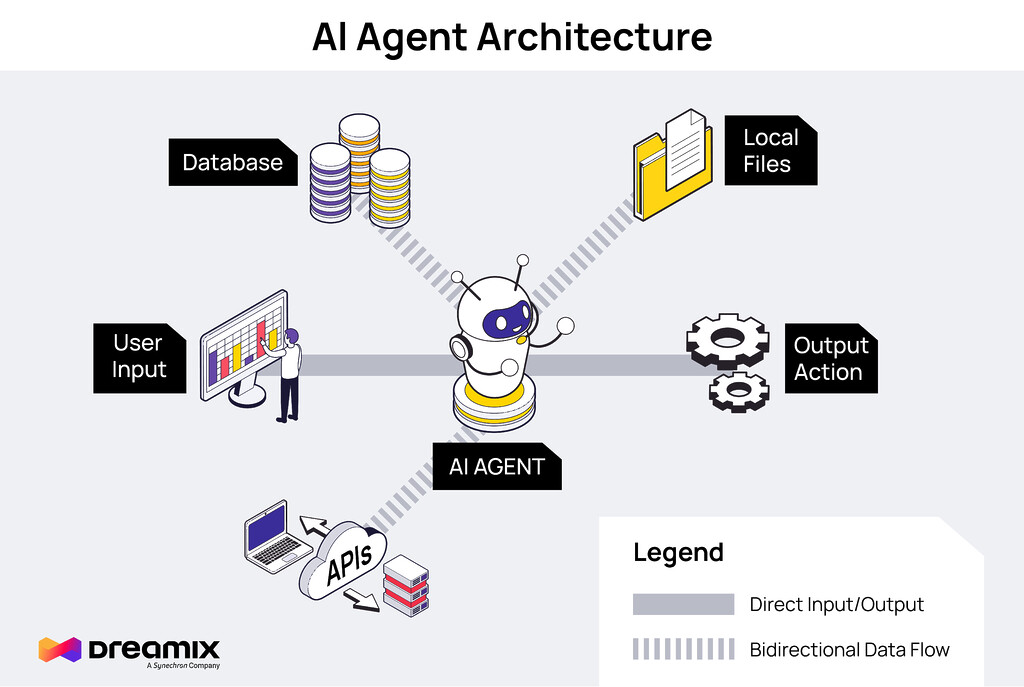
This diagram shows you how modern AI agents work in a business setting. Think of the AI agent (the robot in the center) as your digital employee who can make decisions without constant supervision. It pulls information from your company databases, reads documents from your file systems, and connects to other software through APIs - just like a human employee would gather information before making a decision.
The difference is in scale and speed - your AI agent can process thousands of data points simultaneously. When a user (like your staff or customers) interacts with the system, the AI processes their request alongside all this background information, then takes appropriate actions through your existing business systems.
Types of AI agents
AI agents can be broadly categorised into distinct types based on their roles and capabilities: autonomous, assistive, orchestration, specialised, and customer-facing AI agents. Let us look at each of them and name some AI agent use cases:
Autonomous AI agents
The autonomous AI agent type can operate independently, making decisions and completing tasks with minimal human oversight. That’s what makes its ideal use case is in routine processes like data monitoring or automated reporting. Some real-life example use cases of this AI agent type are Robotic Process Automation (RPA) systems or algorithmic trading agents.
Assistive AI agents
Next are assistive AI agents. This type of AI agent can augment human capabilities by providing real-time information, suggestions, and support while humans maintain control over final decisions, commonly seen in sales enablement or clinical decision support. GitHub Copilot is a notable example that suggests code completions and solutions while developers maintain control over what to accept, modify, or reject.
Related: AI in Software Development: 7 Invaluable Tools for Daily Work
Orchestration AI agents
AI agents for orchestration are capable of coordinating complex workflows across multiple systems and business departments, managing handoffs between human and automated processes to ensure smooth operations. For instance, a customer onboarding orchestration agent can assist businesses by handling the multi-step process of bringing new customers into the business - coordinating document collection and verification, provisioning accounts across multiple systems or scheduling necessary training or setup meetings.
Specialised AI agents
The specialised AI agent types come with the capability to fully leverage deep domain expertise in fields like legal research, scientific discovery, or financial analysis to handle highly technical tasks. For example, regulatory compliance agents within the logistics industry would monitor and manage the complex regulatory requirements faced by transportation and supply chain operations.
Customer-facing AI agents
Last but not least, customer-facing AI agents are designed to engage directly with external users, providing personalised service through conversational interfaces while maintaining brand consistency and service quality. Chatbots are perhaps the most notable real-life business use case of customer-facing AI agents. Combining them with the human-in-the-loop approach (HITL) many businesses implement "graceful handoff" where human customer service representatives take over conversations when the AI reaches its limitations.
Related: What is Human-in-the-Loop (HITL) in AI development?
Without further ado, let's see the top 5 AI agent use cases transforming industries, and why not yours, in 2025:
1. Compliance monitoring AI agents
Compliance monitoring AI agents are specialised systems that continuously analyse business operations, transactions, and documentation to ensure adherence to regulatory requirements, industry standards, and internal policies. As an experienced RegTech software development company, Dreamix fully understands the dynamics and the complexity of the sector. Compliance monitoring AI agent use cases can offer continuous analysis of financial transactions, customer interactions, and business operations to ensure adherence to complex regulatory frameworks like AML, KYC, ESG requirements, and conflict of interest regulations. These specialised AI agents leverage advanced analytics, pattern recognition, and regulatory knowledge bases to identify potential compliance violations, generate required documentation, and create comprehensive audit trails.
How compliance monitoring AI agents help businesses
Your aviation company manages thousands of operations daily that must comply with strict safety regulations, international transportation rules, and complex documentation requirements. As an expert aviation software development company, Dreamix can assist you in developing These compliance areas vary tremendously in complexity, from aircraft maintenance records to crew certification and hazardous materials handling.
A compliance monitoring AI agent:
- Continuously monitors transactions and communications across trading systems and customer touchpoints
- Analyses activities against current regulatory requirements including AML, KYC, and market abuse provisions
- Flags potential conflicts of interest and insider trading risks in real-time
- Automatically generates compliance documentation and audit trails
- Adapts to evolving regulatory frameworks including emerging ESG standards
The business value of compliance monitoring AI agents
Different compliance violations carry vastly different risk profiles and potential penalties. You’re probably aware that major regulatory breaches might cost 100 or even 500x more than minor documentation errors. Compliance monitoring AI agents can ensure you identify high-risk issues quickly while efficiently managing routine compliance checks, significantly reducing the risk of regulatory penalties.
Instead of requiring your compliance specialists to review every transaction or document, these agents distribute workload appropriately - like ensuring senior compliance officers focus on complex regulatory interpretations rather than routine documentation verification that automated systems can handle effectively. This resource optimisation allows you to maintain compliance across more business activities without proportionally increasing your compliance team.
Real life business example: Aviation
Staying within the aviation domain, consider a regional airline handling diverse compliance requirements:
- Aircraft maintenance tracking across multiple aircraft types
- Pilot and crew certification and flight hour monitoring
- Dangerous goods documentation and handling procedures
- Security protocols and passenger screening compliance
- Cross-border regulatory requirements for international routes
Without a compliance monitoring agent, they might:
- Manually track maintenance records with occasional gaps (creating safety risks)
- Struggle to consistently monitor crew duty time limits (risking fatigue-related incidents)
- Dedicate significant staff hours to paperwork verification (high operational costs)
With a compliance monitoring agent, they automatically:
- Track every maintenance requirement and alert before deadlines (reducing aircraft on ground incidents)
- Monitor crew certifications and flight/duty time limitations (ensuring 100% compliance with rest requirements)
- Verify dangerous goods documentation meets destination country requirements (preventing costly customs delays)
- Generate pre-filled compliance reports for aviation authorities
2. Customer support AI agents
Customer support assistance agents are AI systems designed to handle customer inquiries and support requests alongside human agents. These intelligent assistants use natural language processing to understand customer questions, provide relevant answers, and guide customers through common processes. Unlike chatbots with limited responses, these agents can understand context, access company knowledge bases, interpret customer sentiment, and handle complex interactions within defined parameters.
How customer support AI agents help businesses
Your company likely deals with hundreds or thousands of customer support interactions daily, ranging from simple account questions to complex technical issues. These interactions vary tremendously in complexity, urgency, and the expertise required to resolve them.
Customer support assistance agent:
- Receives incoming customer inquiries across multiple channels (via chat, email or even social media)
- Analyses the content, intent, and sentiment of each request
- Immediately handles routine inquiries with accurate, helpful responses
- Collects relevant information for complex issues before routing to human agents
- Learns from successful resolutions to improve future interactions
The business value of AI custom support agents
Different support inquiries have vastly different handling costs. For example, complex technical issues requiring senior agents might cost 5-8x more to resolve than basic informational requests. Customer support agents ensure you only involve human agents when necessary, potentially reducing support operational costs by 20-35%.
Instead of overwhelming your skilled support representatives with simple tasks, these agents distribute workload appropriately - like ensuring senior technical specialists aren't handling basic account questions that entry-level employees or automated systems could manage effectively. This resource optimisation allows you to serve more customers with the same team size.
Real-Life business example: Healthcare
Consider a regional healthcare provider handling diverse patient inquiries:
- Basic administrative questions ("When is my appointment?")
- General health information requests ("What are symptoms of strep throat?")
- Complex medical concerns ("I'm experiencing chest pain and shortness of breath")
Without a support assistance agent, they might:
- Have nurses handling routine scheduling questions (unnecessarily high costs)
- Use untrained staff for all inquiries (poor quality for medical questions)
- Experience long wait times during peak periods (patient dissatisfaction)
With a support assistance AI agent, they automatically:
- Handle routine appointment scheduling and insurance questions without staff involvement (saving on administrative costs)
- Provide consistent answers to common health questions from approved medical sources (improving information accuracy)
3. LLM router agents
Among the top AI agent use cases is surely an LLM router agent. Such an agent represents an intelligent system designed to orchestrate and optimise the use of multiple Large Language Models (LLMs). Think of an LLM router agent as an intelligent traffic controller for your AI systems. At its core, this technology makes smart decisions about which AI model should handle specific tasks or questions coming into your business. It acts as a "traffic controller" for AI tasks, dynamically routing each request to the most suitable LLM based on factors like task complexity, cost, speed, and domain expertise.
How LLM router agents help businesses
Your company likely deals with thousands of different requests - from customer questions and internal queries to data analysis needs. These requests vary tremendously in complexity, urgency, and required expertise.
An LLM router agent:
- Receives incoming requests
- Analyses what each request needs
- Directs it to the most appropriate AI model
- Tracks performance to continuously improve routing decisions
The business value of LLM router agent
Different AI models have different costs. Premium models like GPT-4 might cost 10-20x more than simpler models. Router agents ensure you only use expensive models when necessary, potentially reducing AI operational costs by 30-60%. Also, by matching tasks to the models best equipped to handle them, router agents improve accuracy and response quality, boosting performance. This means better answers for customers and better insights for your team.
An LLM router agent can also save you a tremendous amount of costs. Instead of overwhelming your most powerful AI systems with simple tasks, router agents distribute workload appropriately - like ensuring executives aren't handling tasks that entry-level employees could manage effectively.
Real-life business example: Financial services
Consider a financial services company handling diverse inquiries:
- Basic account questions ("What's my balance?")
- Product information requests ("Tell me about your mortgage rates")
- Complex advisory needs ("How should I restructure my portfolio given current market conditions?")
Without a router agent, they might:
- Use expensive models for everything (unnecessarily high costs)
- Use basic models for everything (poor quality for complex queries)
With a router agent, they automatically direct:
- Simple queries to cost-effective models (saving money)
- Complex queries to sophisticated models (maintaining quality)
- Domain-specific questions to specialised models (improving expertise)
Personalisation AI agents
Personalisation AI agents are intelligent systems that analyse customer data to deliver tailored experiences to each individual. Think of them as digital concierges that get to know your customers and automatically adapt your business interactions to match their specific preferences, behaviors, and needs.
Unlike traditional marketing segmentation that might divide customers into broad groups, these agents create truly individualised experiences by processing vast amounts of data about each customer - their purchase history, browsing behavior, demographic information, and even contextual factors like time of day or device used.
The business value of personalisation AI agents
The most obvious immediate business value of personalisation AI agents for businesses is seen in marketing and business development. In these areas, personalisation directly impacts revenue-generating activities and provides clearly measurable returns. Marketing departments can demonstrate how personalised campaigns outperform generic ones through higher open rates, CTRs, conversion rates, and ultimately, sales.
Business development teams can show how personalised engagement strategies with prospects lead to higher qualification rates, shortened sales cycles, and increased deal sizes. This immediate impact makes marketing and business development the natural first implementation areas for personalisation AI agents.
How personalisation AI agents help businesses
Your business likely interacts with numerous customers daily, each with different preferences, needs, and value potential. These interactions vary tremendously in effectiveness based on how relevant they are to each individual customer.
A Personalisation AI Agent:
- Analyses customer data across touchpoints (website visits, purchases, support interactions)
- Identifies individual preferences and behavioral patterns
- Delivers tailored experiences automatically in real-time
- Continuously learns from results to improve future personalisation
- Scales personalised interactions across your entire customer base
Real-life business example: Aviation
In 2025, personalisation is among the top aviation technology trends. As digital travelers’ crave personalised journeys continue to rise, airlines need to re-adapt their strategies to respond the demand. To illustrate an AI agent use cases revolving around personalisation, let’s consider a commercial airline operating across both domestic and international routes:
- Generic travel offers sent to all loyalty program members
- Standard in-flight experiences regardless of passenger preferences
- One-size-fits-all communication about flight changes or disruptions
- Uniform pricing strategies across all booking channels
Without a personalisation AI agent, they might:
- Send irrelevant destination offers (promoting beach vacations to business travelers)
- Miss ancillary revenue opportunities (not identifying which passengers value premium seating)
- Provide standardised disruption handling regardless of passenger status or needs
With a personalisation AI agent, they automatically:
- Customise travel recommendations based on past booking patterns and preferences (increasing booking conversion)
- Tailor in-flight service options to individual passenger history (boosting ancillary revenue)
- Adapt communication channels and timing based on traveler profiles (improving satisfaction during disruptions
- Personalise loyalty program offers based on individual travel patterns (increasing client engagement)

5. R&D AI Agents
As seen in the graphic above, 13% of generated value from AI is reserved for R&D purposes. That’s why we can’t miss discussing AI agent use cases in R&D. These types of AI agents are autonomous systems designed to accelerate innovation and discovery across scientific and technical domains. R&D AI agents combine LLMs with specialised tools and algorithms to conduct research, generate hypotheses, design experiments, analyse results, and iterate toward solutions with minimal human intervention.
Unlike traditional R&D processes that depend heavily on human expertise and intuition, R&D AI agents can process vast scientific literature or business reports, run simulations and propose novel ideas. Such an AI agent can truly empower the research process by handling repetitive tasks and ultimately reduce operational costs.
How R&D AI agents help businesses
Your business likely engages in complex research challenges requiring extensive knowledge, experimentation, and analysis. Traditional R&D processes are often constrained by human cognitive limitations, information overload, and the inherent time requirements of the scientific method.
An R&D AI Agent:
- Analyses scientific literature across domains (research papers, patents, experimental data)
- Identifies potential innovation opportunities and knowledge gaps
- Designs and prioritises experiments automatically in real-time
- Continuously learns from experimental results to refine hypotheses
- Scales research activities beyond what human teams could accomplish alone
The business value of R&D AI agents
The most immediate business value of R&D AI agents comes from dramatically accelerating the innovation lifecycle while reducing costs. In industries where R&D represents a significant investment like pharma, materials science or manufacturing, R&D AI agents can transform the economics of innovation.
However, rather than replacing skilled researchers, R&D AI agents serve as powerful collaborators, handling tasks that would otherwise create bottlenecks in the innovation process such as literature reviews, data analysis, and experimental design iterations.
Real-life business example: Pharmaceutical Development
To illustrate AI agent use cases in R&D, let's consider a pharmaceutical company developing new therapeutics:
Without an R&D AI agent, the company might:
- Spend months in reviewing scientific literature manually to identify potential drug targets
- Test compounds sequentially based on limited hypotheses
- Miss potential cross-disciplinary insights
- Struggle to efficiently analyse complex experimental results across multiple studies
With an R&D AI agent, the same company can automatically:
- Monitor and synthesise findings from thousands of scientific papers daily, identifying emerging therapeutic targets
- Generate and prioritise novel drug candidates based on predicted efficacy and safety profiles
- Design optimal experiments to test multiple hypotheses in parallel, maximising information gain
- Analyse experimental results in real-time to suggest refinements to molecular structures
- Identify unexpected relationships between disease mechanisms that human researchers might overlook
- Reduce drug development timelines by 30-50% while increasing success rates of candidates entering clinical trials
Conclusion: AI agent use cases transforming operational cost reduction
As we've explored throughout this article, AI agents are rapidly transforming how businesses operate, delivering significant cost reductions while simultaneously enhancing capabilities across critical functions. The five use cases we've examined—Compliance AI agents, personalisation Agents, R&D AI agents, customer support AI agents, and LLM Router Agents—represent the leading edge of this revolution, with each addressing specific operational challenges that traditionally required substantial human resources.
Looking ahead, the integration of these specialized AI agents into cohesive systems represents the next frontier. As these agents become more sophisticated in their capabilities and coordination, businesses will increasingly shift from asking "Which processes should we automate?" or "Which AI agent use cases are best for my business"to "Which processes should remain manual?". This perspective shift signals the true transformative potential of AI agents in business operations.
Ready to embrace AI and transform your operational costs with AI agents?