
Aviation is one of the most heavily regulated industries on the planet. Title 14 of the Code of Federal Regulations – the FAA's primary regulatory document – spans thousands of requirements covering everything from aircraft maintenance to air traffic management and crew certification. Layer EASA, ICAO, EUROCONTROL, IATA’s regulations GDPR, and PCI DSS on top of that, and the compliance landscape facing a modern aviation organisation becomes genuinely complex.
It keeps growing. Flight Information Regions are transitioning to FF-ICE. ICAO's AIS-to-AIM shift is underway. Sustainability reporting mandates are tightening. For any organisation still managing these obligations manually - through spreadsheets, email trails, and siloed systems - the exposure is significant.
So, how to ensure aviation compliance with software? The most effective approach is to build systems with compliance embedded into their architecture.
At Dreamix, we have spent 20+ years providing custom aviation software development services for operators including airlines – Aer Lingus, Icelandair, and VistaJet, ANSPs and ATM software development companies.
This guide draws on that practical experience. The goal is straightforward: help aviation executives understand how the right software approach turns compliance from a constant liability into a reliable operational capability.
What is aviation compliance?
Aviation compliance is the structured set of regulations, standards, and obligations that aviation organisations must meet to operate legally, safely, and efficiently. These obligations come from multiple regulatory bodies – the FAA in the United States, EASA across Europe, ICAO globally, and a range of sector-specific authorities governing everything from air traffic management to passenger data processing.
Compliance covers both what an organisation must do and how it must document that it has done it. The documentation requirement is where many organisations struggle – not because they lack the intent to comply, but because the record-keeping at scale is extraordinarily difficult to do well without purpose-built tools.
What does aviation software compliance cover?
Aviation software compliance spans several interconnected domains, and it is worth being precise about where the boundaries lie. It covers the following areas:
- Operational safety sits at the foundation – adherence to FAA, EASA, and ICAO standards governing flight operations, procedures, and safety management systems.
- Aircraft maintenance and airworthiness covers inspection schedules, work order management, parts tracking, and MRO in aviation standards that ensure aircraft remain operationally certified.
- Data and messaging standards include IATA boarding pass formats, AMHS/AFTN messaging protocols, and TIMATIC – the travel intelligence system used for passenger document verification at check-in.
- Air traffic management involves EUROCONTROL compliance, the ongoing ICAO AIS-to-AIM migration, FF-ICE/TBO trajectory-based operations, and SWIM - the System Wide Information Management standard.
- Passenger data and privacy encompasses GDPR obligations for EU operators, data residency requirements, and the processing of personally identifiable information throughout the passenger journey.
- Payment security requires compliance with PCI DSS across any system that handles card data.
- Interoperability means achieving and maintaining certification against standards like SITA CUTE/CUPPS/CUSS for shared airport infrastructure, and aligning with the EUROCONTROL NM B2B Reference Manual for network manager data exchange.
One important distinction: Dreamix operates in the operational and informational software layer – departure control systems, AIM platforms, MRO applications, air traffic management tools, and passenger processing systems. We do not build avionics or flight control software. That line matters when you are assessing a software partner's scope and accountabilities.
Read next: Future of Aviation: From Legacy Systems to Innovation
How to ensure aviation compliance with software
To ensure aviation compliance with software, follow these steps:
1. Map your compliance obligations before selecting any tooling
Before evaluating software platforms, map which regulatory frameworks apply to your specific operations. An airline operating transatlantic routes will face a different compliance matrix than a regional MRO provider or an air navigation service provider. FAA, EASA, ICAO, EUROCONTROL, IATA’s regulations, GDPR, and PCI DSS each carry distinct requirements - and the overlap between them requires careful orchestration, not assumption.
2. Audit your current systems for compliance gaps
Identify where manual processes, legacy integrations, or data silos are creating regulatory risk. According to Deloitte's insights, airlines frequently report that over 50% of their IT budget goes toward maintaining legacy systems rather than innovation.And those legacy systems are often the source of the compliance gaps that audits eventually surface.
3. Choose software built around aviation-specific standards
Ensure the software you select natively supports formats like AIXM, FIXM, and IWXXM, and messaging protocols like AMHS/AFTN – rather than attempting to bolt these on later. A general-purpose platform adapted to aviation requirements will always carry more integration risk than one designed around those standards from the outset.
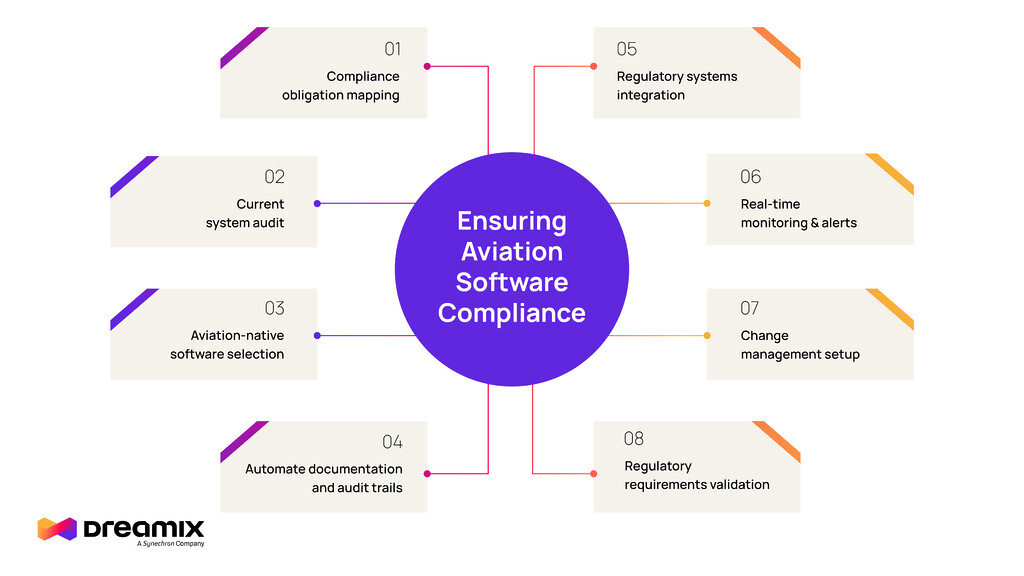
4. Automate documentation and audit trails
Replace manual record-keeping with automated workflows that generate time – stamped, auditable compliance records by default. Every approval, every data exchange, every system action should produce a traceable log. This is a basic expectation of regulators during audits, and it is the kind of capability that only becomes harder to retrofit into a system that was not designed for it.
5. Integrate directly with regulatory systems
Connect to EUROCONTROL Network Manager, SITA CUTE/CUPPS environments, or national AIM platforms rather than relying on manual data transfers. Direct integration removes human error from the chain and ensures that the data regulators receive is current and structurally compliant.
6. Set up real-time monitoring and alerts
Configure dashboards and automated notifications for expiring certificates, overdue maintenance items, and regulatory deadline milestones. Proactive alerting is the difference between managing compliance and reacting to compliance failures. And in aviation, reactive compliance management is expensive. The FAA can impose civil penalties of up to $37,377 per violation per day. For fleet operators, those figures compound fast.
7. Build in change management from the start
CP1 and CP2 are EU regulations (under the SESAR Deployment Programme / Commission Implementing Regulations), developed in response to the ICAO Aviation System Block Upgrades (ASBU) framework. ICAO sets the global framework and methodology while the EU implements it through binding legislation. EASA updates the corresponding Part regulations (e.g., Part-ATM/ANS, Part-FCL amendments) to align technical and operational requirements. Your aviation software development partner should have a structured process for incorporating regulatory updates without requiring a full redevelopment cycle each time. Ask about this explicitly during procurement.
8. Validate and test against regulatory requirements
Compliance is not assumed at go-live. Structured testing against regulatory acceptance criteria, including NM B2B validation and FAT and SAT testing for air traffic management systems, should be embedded in every release cycle. Regulatory testing is not a phase you complete; it is an ongoing practice.
Why compliance is getting harder to manage manually
In 2026, manual compliance management in aviation no longer scales. The sheer volume and complexity of obligations have outpaced what spreadsheets and siloed teams can reliably handle.
Several forces are driving this. Regulatory updates arrive faster than most organisations can absorb them. Compliance data is spread across departments – maintenance, operations, legal, finance – with limited cross-visibility and no single source of truth. Legacy systems, many of which were built when regulatory requirements were simpler, create structural bottlenecks: outdated DCS integrations, non-standardised NOTAM formats, and AFTN messaging infrastructure that was never designed for the interoperability that modern compliance demands.
The cost of falling short is not abstract. Beyond FAA fines, non-compliance creates reputational exposure that erodes partner trust, disrupts operations, and in the most serious cases, triggers suspension of operating licences. Research across industries consistently shows that regulatory violations produce lasting revenue impact – with some organisations seeing 15-25% revenue losses as business partners move to more reliable operators.
Meanwhile, regulatory deadlines are accelerating. FF-ICE implementation milestones are active. ICAO's AIS-to-AIM transition is already reshaping how aeronautical information is published and consumed. These are not theoretical future pressures; they are immediate operational realities.
How software helps aviation companies stay compliant
Purpose-built aviation compliance software addresses the problem at its structural root – by making compliance a function of the system's design rather than a manual layer applied on top.
Automated documentation and audit trails
Well-built aviation software automates compliance documentation, approval workflows, and communication records. It maintains full auditability across structured data pipelines – AIXM 5.1.1, FIXM, IWXXM – and applies role-based access controls with comprehensive audit logging. The result is an audit trail that is always current and always complete, without depending on individuals to maintain it.
Regulatory-ready integrations
This is where deep domain expertise matters most. Building FF-ICE-ready integrations with EUROCONTROL and Network Manager ecosystems requires a team that understands FIXM-aligned data models and message exchange interfaces at a detailed level. The same is true for dual-publish pipelines that generate both cNOTAM and dNOTAM from a single structured source, or for achieving SITA CUTE/CUPPS certification for shared airport infrastructure. These capabilities are not available off-the-shelf; they need to be engineered by people who understand both the regulatory requirements and the technical implementation.
Real-time data visibility
Consolidated MET and AIM platforms can ingest multi-source data – METAR, TAF, SIGMET, NOTAM – with sub-10-second latency, providing operational teams with a live view of compliance-relevant conditions. 4D trajectory visualisation tools support FF-ICE flow management. Live dashboards surface expiring documents, overdue maintenance items, and operational risk in real time, giving leadership the visibility they need to act before a gap becomes a violation.
Passenger data and GDPR compliance
For EU-based operators, TIMATIC integration for travel document verification and GDPR-compliant passenger data processing are non-negotiable. Data residency architecture, which determines where passenger data is stored and processed, must align with both airline-specific requirements and country-level regulations. Getting this wrong carries significant regulatory and commercial risk.
Read next: Why Compliance Should Be Built In, Not Bolted On – A Conversation with Carly Waddleton
Maintenance and airworthiness tracking
Automated scheduling of inspections and maintenance tasks, digital records management across work orders, parts tracking, and airworthiness certificates – these capabilities remove the manual overhead that creates compliance risk in MRO operations. Proactive alerts on expiring documentation give compliance teams enough lead time to act before a gap occurs.
The right partner brings aviation knowledge alongside software capability because you cannot build a compliant system for an industry you do not understand.Concretely, that means deep familiarity with DCS integration, NOTAM data structures, AIXM, AMHS messaging, and airline operations. It means knowing the NM B2B Reference Manual well enough to build against it, not just reference it. It means understanding EUROCONTROL, IATA, FAA, and EASA requirements not as a checklist, but as operational context. What to look for in a compliance-ready aviation software partner
On the commercial side, a CAPEX model with no vendor lock - in matters and you own the system outright. Our software development pricing models are flexible and adapt to your project setup. Pre-validated accelerators that reduce build time without cutting corners on compliance are a genuine differentiator as they mean faster time to compliance without compromising quality.
Why Dreamix is a trusted aviation software development partner
- 20+ years of aviation domain expertise spanning operations, ground handling and flight management, built through direct experience rather than generalist IT knowledge
- Compliance-aware development with EASA, FAA and duty time regulations embedded into the engineering process from the start, producing audit-ready documentation as a standard output
- Senior aviation specialists on the team, hired directly from leading aviation organisations, giving engineers the industry fluency to challenge requirements and build solutions fit for operational reality
- 95% team retention rate, meaning the engineers who learn a client's systems, compliance constraints and operational context remain on the project long-term, preserving continuity and institutional knowledge
- End-to-end delivery model covering proof of concept, development and fully scaled production
- Pre-validated aviation software accelerators for MRO, crew scheduling, group check-in and boarding pass scanning, reducing deployment timelines by three to six months
- IATA Strategic Partner status, providing direct access to industry standards, networks and aviation-specific regulatory insight that informs every solution built

Aviation compliance is a sustained operational commitment, not a project with a completion date. Regulatory requirements grow more complex each year, compliance deadlines are unrelenting, and manual processes are increasingly unable to keep pace with what modern aviation standards require.How to ensure aviation compliance with software comes down to building aviation-specific systems that embed regulatory requirements directly into their design, rather than treating compliance as an add-on.Software built with aviation-specific depth turns compliance from a persistent liability into a structural capability – one that generates the audit trails, integrations, and real-time visibility that regulators expect and that your operations depend on.Conclusion
The critical differentiator in selecting a software engineering partner is not just technical competence. It is the combination of technical competence with a genuine understanding of how aviation works. That combination is rare, and it is the foundation of everything Dreamix brings to aviation compliance engagements.If you are navigating a compliance challenge, whether that is FF-ICE readiness, MRO system modernisation, GDPR architecture, or SITA CUTE/CUPPS certification, get in touch with the Dreamix aviation team. We are ready to discuss your specific situation.
FAQ regarding how to ensure aviation compliance:
We’d love to hear about your aviation software project and help you meet your business goals as soon as possible.