
Key takeaways:
- IROPS is now a structural profit risk: With disruption costs exceeding $60B annually, airlines face growing exposure from compensation (EU261/US DOT), operational inefficiencies and brand erosion.
- Legacy recovery models are fundamentally flawed: Siloed aircraft, crew and passenger recovery leads to slower decisions, higher costs and suboptimal outcomes during disruptions.
- AI enables real-time, end-to-end recovery: From proactive disruption detection to automated passenger re-accommodation and claims processing, airlines can reduce recovery time, lower compensation costs and protect customer loyalty.
- Operational resilience requires infrastructure rethink: Mobile, decoupled passenger processing ensures continuity even when central systems fail.
- The competitive gap is widening: Airlines investing in intelligent IROPS management are recovering faster, spending less and delivering significantly better passenger experiences.
IROPS in aviation: The new normal?
Irregular operations (IROPS) have evolved from an operational inconvenience into one of the largest uncontrolled cost drivers in aviation. These refer to delayed or canceled flights, unplanned diversions, staff shortages, industry strikes, infrastructure or supply chain issues, security breaches, etc.
While irregular operations have always existed in the world of aviation, what was once an occasional headache has become a persistent, compounding business risk in 2026. A combination of macroeconomic forces, environmental shifts and structural industry constraints is pushing IROPS frequency and severity to levels that most airlines' legacy systems were never designed to handle.
Here’s some of the most crucial events causing IROPS in aviation as of April 2026:
- Geopolitical tension: The Russia-Ukraine conflict continues to force European and Asian carriers onto longer, more fuel-intensive routes. Similarly, escalations in Iran have triggered flight reroutings and airspace closures affecting carriers across multiple continents. These diversions directly cause longer flight routes and more fuel burn, tighten crew duty-time windows and create schedule fragility that amplifies the downstream impact of any further disruption.
- Spiked jet fuel prices: One of the most immediate pressure points on airline operations right now are fuel prices. The Iran conflict and the closure of the Strait of Hormuz have sent jet fuel prices into a sharp upward spiral and are up 100%, according to Yahoo Finance, more than double late-February levels.
- Labour shortages: From pilots and cabin crew to air traffic controllers and ground handlers, the aviation workforce has still not fully recovered to pre-pandemic capacity. IATA projected labour costs will reach $253 billion in 2025, up 7.6% year-on-year, as wage pressure intensifies. In fact, labour is now the largest single cost component at 28% of total operating costs, overtaking fuel in non-crisis years. Fewer staff means less operational buffer when disruptions hit, and slower recovery when they do. ATC shortages in the US and parts of Europe are a particular bottleneck, directly contributing to ground delays and flow restrictions that trigger network-wide IROPS events.
What this means for the P&L
For airline CFOs, these forces create a compounding exposure. Each factor independently increases the probability and cost of IROPS events. Together, they create a disruption environment where the margin for error has narrowed considerably, but most airlines' recovery tools have not kept pace.
Currently, the aviation industry's average net profit margin sits at roughly €7.80 per passenger. A single major disruption can erase weeks of operating profit at an affected hub. In this environment, IROPS is no longer just an operational issue but a balance sheet risk.
Where technology can bridge the gap
For 12+ years in the domain, Dreamix has helped aviation leaders across the world embrace digital transformation and optimise business operations, shaping the technological foundations of the future of aviation. The good news is that the same AI and data capabilities driving progress in other areas of airline operations are now mature enough to tackle many of the IROPS problems directly. But most airlines still solve disruptions the same way they did a decade ago: separately, reactively and manually. Aircraft recovery sits in one silo. Crew rescheduling sits in another. Passenger re-accommodation is handled last, often by overwhelmed gate agents working with outdated tools.
Airlines that have already invested in AI - across crew scheduling, dynamic pricing systems, aircraft MRO software - are already seeing measurable ROI. In fact, a recent McKinsey study found that AI-driven predictive maintenance alone could decrease aircraft downtime by 30% while reducing maintenance costs by up to 15% industry-wide.
These are measurable, proven returns in revenue management and maintenance. The same underlying AI capabilities, processing large volumes of operational data in real time and generating optimised decisions faster than any human team, apply directly to IROPS recovery. Airlines that invest in intelligent disruption management stand to recover faster, spend less on compensation and rebooking and protect the brand equity that took years to build. The remainder of this article lays out what that investment looks like in practice, starting with the regulatory landscape that makes it urgent.
Shifting IROPS from ‘reactive’ to ‘strategic’ with technology
The biggest problem with manual processes in aviation is that they’re operating with fragmented data, leading to limited augmentation and reactive operations. Solving IROPS at scale requires more than a single technology. It requires a combination of AI, intelligent automation, and purpose-built aviation software working across the full recovery chain, from crew and ground staff scheduling through passenger re-accommodation to regulatory compliance.
AI and machine learning are particularly well suited to the IROPS problem because of its data-heaviness and operational and regulatory complexity. Agentic workflows in AI, when applied to aviation context, can process thousands of variables simultaneously, evaluate recovery scenarios in real time, and deliver optimised recommendations faster than any human team.
McKinsey research on agentic AI in travel shows that AI agents can automate critical airline processes like rebooking during travel disruptions, handling refunds and issuing vouchers, freeing frontline staff to focus on the high-touch passenger interactions that actually build loyalty.
For aviation leaders evaluating their disruption readiness, six capabilities deserve priority.
Mobile passenger processing for operational flexibility
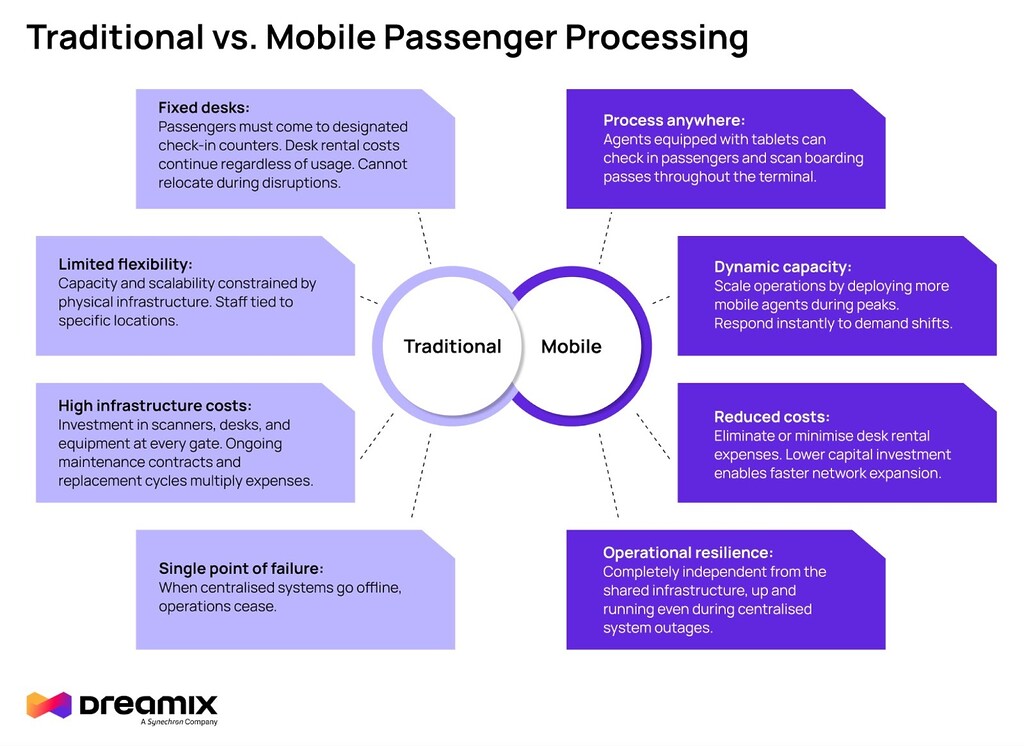
During IROPS, fixed check-in desks create bottlenecks. Queues build at service counters. Staff trained on legacy DCS systems cannot easily redeploy to where they are needed most. The entire passenger-facing operation becomes rigid at the exact moment it needs to be flexible.
Mobile passenger processing solves this by decoupling check-in and boarding from fixed airport infrastructure. Dreamix built a mobile airport check-in solution for a leading European airline that replaced traditional desk-bound check-in with a mobile solution, allowing agents to process passengers from anywhere in the terminal and allowing for disruption teams to be deployed in quick succession.
The system uses an adaptive interface designed to be intuitive for younger ground staff who are often reluctant to engage with legacy aviation systems. The result:
- lower costs for common use airport equipment
- faster processing during peak periods and disruptions
- scalability when IROPS events spike passenger volumes at specific gates or terminals
- Complete oversight of the network without reliance on 3rd party systems
For airlines operating across multiple airports, this kind of operational flexibility directly reduces the time it takes to clear a backlog of displaced passengers after a disruption.
The September 2025 cyberattack: A case study in infrastructure dependence
The September 2025 ransomware attack on check-in systems at major European airports, including Heathrow, Brussels, Berlin, and Dublin, exposed this vulnerability. When centralised passenger processing systems went offline, most airlines were forced to revert to paper-based manual processes or cancel flights entirely. The cascade of rebooking, compensation, and reputational fallout was immediate.
One airline, however, continued normal operations. A mobile boarding and check-in solution built by Dreamix for the carrier, operating independently of the compromised shared infrastructure, processed over 21,000 passenger boardings per day during the crisis. Ground agents using mobile devices scanned boarding passes, accessed real-time passenger lists and managed passenger flow throughout terminals, maintaining processing speeds up to 1.5x faster than traditional methods.
Read next: 2 Passenger Processing Solutions Elevate Airport Operations
"The power of this mobile solution became crystal clear during the system outage. While airports were scrambling with backup laptops and hand-written boarding passes, our client's agents were already equipped with a more flexible, more reliable system."
Gary Kenny, Head of Aviation Solutions at Dreamix
Agentic re-accommodation of disrupted passengers at scale
The biggest gap in most airlines' IROPS toolkit is passenger re-accommodation. Passenger service systems were built to manage fares, tickets, seats and delivery of service, not to match thousands of displaced travellers with available flights, hotels and ground transport in real time. When disruptions hit, desk agents are forced into labour-intensive manual processes at the exact moment when tensions are highest.
AI-powered re-accommodation systems can ingest passenger name record (PNR) data as well as One-order records, evaluate available inventory across the airline's network (and partner networks) and push personalised rebooking options directly to passengers' mobile devices within minutes of a disruption event. This reduces call centre volume during peak events, improves acceptance rates for rebooking offers and cuts the per-passenger cost of recovery significantly.
Automation of the claims process
When compensation is unavoidable, the speed and efficiency of the claims process matters. Airlines that process claims slowly or inconsistently drive passengers toward third-party claims management companies, which typically take 25% or more of the payout as commission and add legal and administrative costs for the airline.
Automated claims engines can calculate entitlements under EU261, US DOT rules and other regulatory frameworks instantly, issue compensation proactively and close the loop with passengers before frustration drives them to external services. The result is lower total cost per claim, faster resolution and a measurably better passenger experience during a stressful moment. This shifts compensation from reactive cost to controlled process.
Optimised rescheduling of disrupted crews and ground staff
Crew recovery is consistently the most complex element of IROPS management. When a hub-wide disruption mispositions hundreds of crew members from their next scheduled assignments, the crew scheduling team must simultaneously solve thousands of assignment problems under strict duty-time regulations. The same challenge applies to ground handling operations, where staff must be redeployed across shifts, terminals and qualification types under tight regulatory and labour constraints.

For ground operations, the gains from intelligent scheduling are equally significant. Dreamix developed an intelligent crew scheduling solution with AI-powered crew roster optimisations.
Our crew rostering accelerator has already helped a client achieve real business results:

Turning IROPS readiness into a strategic roadmap
For the C-Suite evaluating disruption readiness, the path forward requires focus across three dimensions:
- Audit your data foundations: AI-powered IROPS management depends on clean, connected, real-time data across operations, crew scheduling and passenger service systems. In our most recent blog post, our Head of Data Practice Kalina Cherneva discusses the importance of data readiness for AI companies need to fill in to benefit from AI capabilities.
- Close the passenger recovery gap: The passenger re-accommodation layer is where most airlines have the largest delta between current capability and available technology. It is also where the ROI is most immediate: reduced call centre volume, lower compensation costs and stronger post-disruption NPS scores. This is the natural starting point for most carriers.
- Build infrastructure resilience into your technology roadmap: Mobile passenger processing, decoupled from shared airport systems, should be a standard component of every airline's IROPS contingency plan. The cost of deployment is modest compared to the cost of a single major disruption handled with paper vouchers and manual processes. Dreamix's aviation software accelerators, built with 12+ years of domain expertise and validated in live airline environments, reduce development time by 30-40% compared to building from scratch. As part of IATA's Strategic Partnership Program, Dreamix works alongside airlines to deliver solutions purpose-built for unique industry compliance and operational requirements.
Read next: The Future of Air Traffic Controllers (ATCOs): AI, Automation & ATM
FAQs about IROPS:
We’d love to hear about your aviation software project and help you meet your business goals as soon as possible.