The global aviation sector is navigating its most significant change since the invention of radar. As air traffic demand surges and airspace complexity intensifies, the traditional model of Air Traffic Management (ATM) is being rewritten, moving from manual, voice-dependent control toward a highly automated, AI-augmented ecosystem.
I’m Tsvetana Yaneva, and I write about how technology reshapes safety-critical industries. At Dreamix, our team works with carriers, airports, and air traffic management service providers to build custom aviation software that solves real operational problems, from legacy modernisation to the decision-support and simulation systems that AI-augmented ATM depends on.
For the past decades, the capacity of the world's airspace has been constrained by the cognitive limits of human controllers. And despite advancements in digital surveillance, the core task - separating aircraft in real-time - has remained a high-stress, labor-intensive process. As of 2026, the industry faces a dual challenge: a global shortage of qualified ATCOs and an unprecedented volume of complex traffic, including traditional commercial flights, drones, and future Advanced Air Mobility (AAM) vehicles.
This article explores the trajectory of that shift, the rise of “Human-Autonomy Teams,” and what the future holds for the Air Traffic Controller (ATCO).
The bottleneck: Why traditional ATM needs to evolve
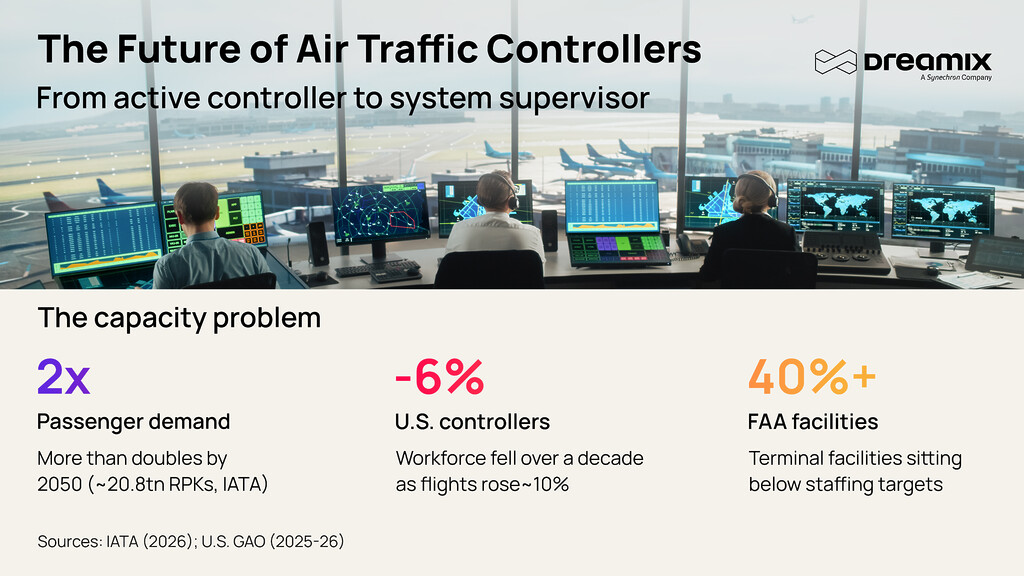
For decades, airspace capacity has been capped by one thing: the number of qualified controllers and the cognitive load each can safely carry. That constraint is now colliding with demand. IATA projects global air travel demand will more than double by 2050, reaching about 20.8 trillion revenue passenger kilometers under its mid-range scenario.
At the same time, the workforce is moving the other way. In the U.S., the number of controllers fell roughly 6% over the past decade according to GAO while flights rose about 10%, and more than 40% of FAA terminal facilities now sit below their staffing targets. Europe has reported a shortage of 700 to 1,000 ATCOs, with a large retirement wave still ahead. Training a controller can take up to three years, so hiring alone can’t close the gap.
For airlines and air navigation service providers (ANSPs), the business cost poses a significant economic challenge. In fact, ATC capacity and staffing shortfalls drove the majority of Europe’s delay costs in recent years, creating a multi-billion-euro problem, as per IATA report. Adding capacity through software, rather than headcount alone, is now a board-level priority.
The current phase: AI as a "Decision-Support" Co-pilot
The immediate future of ATM is defined by Intelligent Decision Support Tools (DSTs). For now, AI can’t entirely replace the human air traffic controllers but it is augmenting their situational awareness significantly. Here are some of the most prominent examples:
Predictive conflict detection: Modern AI models now process 4D trajectories (latitude, longitude, altitude, and time) to predict separation infringements far earlier than traditional systems. These tools offer "Explainable AI" (XAI) resolutions, providing controllers with the reasoning behind a suggested flight path change, the same approach we describe in our work on AI agents that reason and reroute autonomously, where explainability frameworks are built to meet aviation safety standards.
Workload Management: AI agents are taking over routine administrative tasks, such as flight data verification and initial coordination between sectors, allowing ATCOs to focus entirely on tactical traffic separation. This is the same principle behind offloading routine work to AI agents to reduce operational costs: let automation handle the routine so senior experts concentrate on complex judgment calls.
Weather and flow optimisation: By analysing vast datasets, AI optimises arrival and departure sequences, significantly reducing fuel burn and environmental impact by minimising holding patterns, one of the efficiency levers we explore in AI optimising fuel consumption and air traffic management.
The Paradigm Shift: From "Active Controller" to "System Supervisor"
As we move toward 2030, the role of the ATCO is shifting from active tactical operator to system supervisor. The controller stops flying every interaction by hand and starts overseeing a system that handles the routine, stepping in where judgment is needed. That change in posture is the same one playing out across every safety-critical industry adopting AI, and it reframes the job around exception management rather than constant manual control.
The Human-Autonomy Team (HAT)
The most successful operational models, such as those being tested within the SESAR Joint Undertaking, suggest a "Human-Autonomy Team" structure. In this framework:
Low-complexity flights: Routine, point-to-point flights in predictable airspace may become fully automated, managed by a system-level AI that handles communication and conflict resolution. This is the practical face of agentic AI that decides and acts within set guardrails, rather than a tool that only flags options for a human to action.
High-complexity scenarios: ATCOs retain authority over complex situations, emergency responses, and non-standard flight paths where human judgment, intuition, and context-awareness remain irreplaceable.
As IATA's CIO Kim Macaulay put it in our recent interview with her: “No matter what we do with AI in aviation, there has to be a human in the loop” - a principle that anchors every credible HAT model.
Challenges of higher automation
While efficiency gains are clear, the transition brings even more significant human factors to address. Getting the technology right is only half the work; the other half is keeping people sharp, engaged, and ready to take over.
Skill erosion: If an AI manages the majority of traffic, the controller needs a deliberate way to keep manual-intervention skills current for the moment a system fails or hands back control. This is one reason a structured AI adoption strategy treats workforce readiness as a design requirement, not an afterthought.
"Out-of-the-Loop" syndrome: Maintaining constant situational awareness while monitoring an automated system requires new training methodologies, often using "digital twins" of the airspace for continuous, simulation-based readiness. Building these high-fidelity simulation environments is itself a custom aviation software challenge, demanding real-time data integration and the same reliability standards as the live system they mirror.
Related: Ensuring Excellence: The Role of FAT and SAT Testing in Air Traffic Management Towers
The path to full automation: Technical and regulatory hurdles
Full autonomy - a system where machines manage entire sectors without human intervention - is the ultimate goal for hyper-dense, high-tech environments like urban air mobility. However, the path is obstructed by three critical requirements:
Certification and Certification Trust: Agencies like EASA and the FAA are establishing rigorous frameworks for AI assessment. Any AI managing air traffic must demonstrate deterministic behavior, not just probabilistic success.
Cyber Resilience: As we integrate AI into the core of ATM, the "attack surface" increases. Resilience strategies - such as decentralized data processing and edge computing - are now mandatory to ensure that a cyber-breach at one hub does not paralyze regional airspace.
Standardization (IATA ONE Record): Seamless data exchange across borders is the prerequisite for global AI integration. The industry is moving toward unified data standards to ensure that AI models in different countries can "speak" the same operational language.
Read next: IROPS Without the Chaos: Resilient Airline Operations
How Dreamix can help ATM providers within aviation
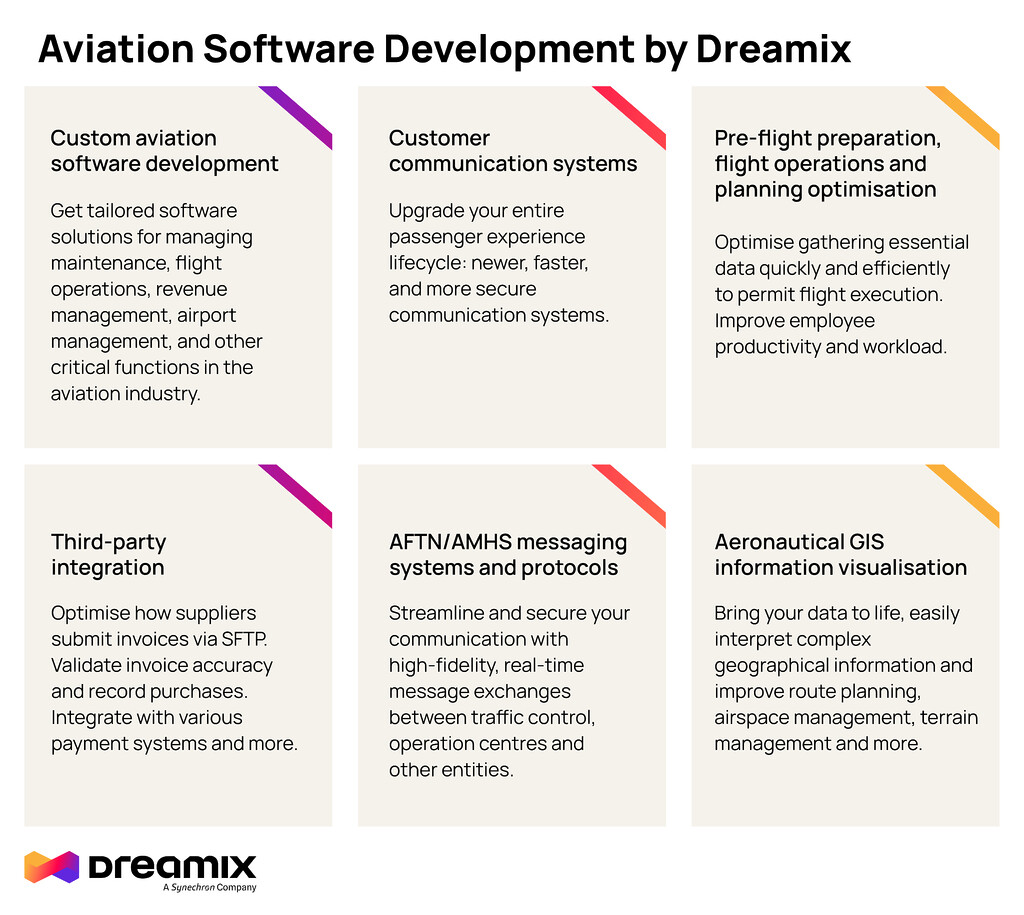
- Custom aviation software development
Get tailored software solutions for managing maintenance, flight operations, revenue management, airport management, and other critical functions in the aviation industry.
- Customer communication systems
Upgrade your entire passenger experience lifecycle: newer, faster, and more secure communication systems.
- Pre-flight preparation, flight operations and planning optimisation
Optimise gathering essential data - including NOTAMs (Notices to Air Missions) - quickly and efficiently to permit flight execution. Improve employee productivity and workload.
- Third-party integration
Optimise how suppliers submit invoices via SFTP. Validate invoice accuracy and record purchases. Integrate with various payment systems and more.
- AFTN/AMHS messaging systems and protocols
Streamline and secure your communication with high-fidelity, real-time message exchanges, including NOTAM distribution, between traffic control, operation centres and other entities.
- Aeronautical GIS information visualisation
Bring your data to life, easily interpret complex geographical information, active NOTAMs, and improve route planning, airspace management, terrain management and more.
Conclusion
The future of the Air Traffic Controller is not one of obsolescence, but of professional evolution. By offloading repetitive, low-value monitoring tasks to AI, the industry is creating a safer, more efficient, and more sustainable airspace. The "controller of the future" will be an expert supervisor, a master of complex human-machine interaction, and the ultimate safety gatekeeper in a highly automated, AI-driven sky.
How is your organization currently addressing the transition toward AI-augmented Air Traffic Management - are you focusing more on the integration of decision-support tools or on the long-term workforce retraining required for these new roles?
FAQs about ATCOs & air traffic management:
We’d love to hear about your custom aviation software project and help you meet your business goals as soon as possible.