Aviation is a sector under significant pressure to do more with less. Passengers expect seamless air travel from booking to boarding, while airlines manage rising costs, complex regulations and ageing infrastructure.
I’m Gary Kenny, and I have 20+ years of experience working with airlines, airports and aviation service providers. I joined Dreamix to lead our aviation solutions practice, bringing that domain expertise directly into how we design and build software for the industry.
Dreamix is an IATA Strategic Partner in Data and Technology, and that partnership reflects a long-standing commitment to aviation. Our team works with carriers and aviation service providers to build custom aviation software solutions that address real operational problems, from legacy DCS modernisation to crew scheduling, MRO data infrastructure and the industry’s shift toward Offer and Order management.
We’ve seen where the bottlenecks appear across this industry and also how the right software solves them. The strongest results come from practical, structured change, targeting the highest-cost inefficiencies first.
This guide explains where inefficiencies sit and how to improve airline operations.
Key takeaways
- Legacy systems are the single biggest barrier to airline operational efficiency.
- Automation can save airlines up to 150+ man-days annually on invoice processing alone.
- AI-driven crew rostering reduces fatigue, errors and compliance risk.
- Real-time data infrastructure is the foundation of smarter decision-making.
- Custom aviation software consistently outperforms off-the-shelf tools in heavily regulated, safety-critical environments.
- Predictive MRO (Maintenance, Repair and Overhaul) programmes reduce maintenance costs by 18%–25% and cut unplanned downtime by up to 50%.
- Technology modernisation in aviation could generate close to $45 billion in industry-wide EBITDA impact by 2030, according to McKinsey.
What are the biggest operational challenges airlines face?
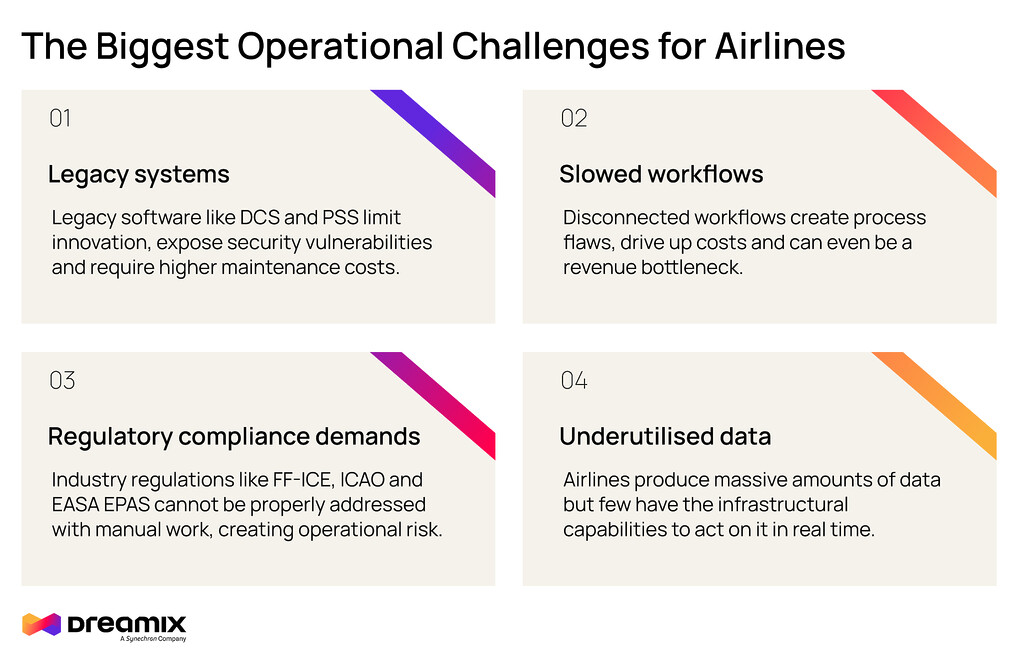
The biggest operational challenges facing the aviation industry today fall into four major categories:
- Legacy system constraints
- Siloed workflows
- Regulatory complexity
- Underutilised data
Let me explain all of these airline operation challenges in detail:
1. Legacy DCS and Passenger Services Systems block modernisation
The DCS controls the entire departure process: check-in, boarding, weight and balance, load control and real-time communication with ground handling. Many carriers are still operating DCS platforms built on architectures that predate modern API standards.
The same applies to the broader PSS, which manages reservations, inventory, fares and ticketing. Many airlines still rely on payment platforms, communication protocols and flight operations tools built decades ago.
These systems may still function, but they create significant risks, such as:
- Security vulnerabilities that grow with every year they go unpatched.
- Workflow bottlenecks caused by systems that can’t integrate with modern third-party solutions.
- NDC (New Distribution Capability) incompatibility and ONE Order standards that are now redefining how airline products are distributed and serviced.
- Higher IT maintenance costs due to the burden of supporting ageing infrastructure.
- Inability to support new passenger-facing services like tap-and-go payments or digital credentials.
The instinct is often to rip and replace, but that approach is not realistic in aviation. Replacing a core operational system mid-operation is like changing an engine in flight.
In aviation, that approach carries significant operational risk. Incremental modernisation, extending existing infrastructure layer by layer using cloud-first architecture and API connectivity, delivers change without disrupting live operations.
Related: Future of Aviation: From Legacy Systems to Innovation
2. Siloed workflows drive up costs
Manual, disconnected workflows are widespread across the airline industry. Systems like airport check-in, invoice processing and payment reconciliation, maintenance planning, staff scheduling and even operational systems like lounge management, ancillary sales collection, and baggage tracing systems don’t communicate with each other.
And this is the operational impact of disconnected workflows:
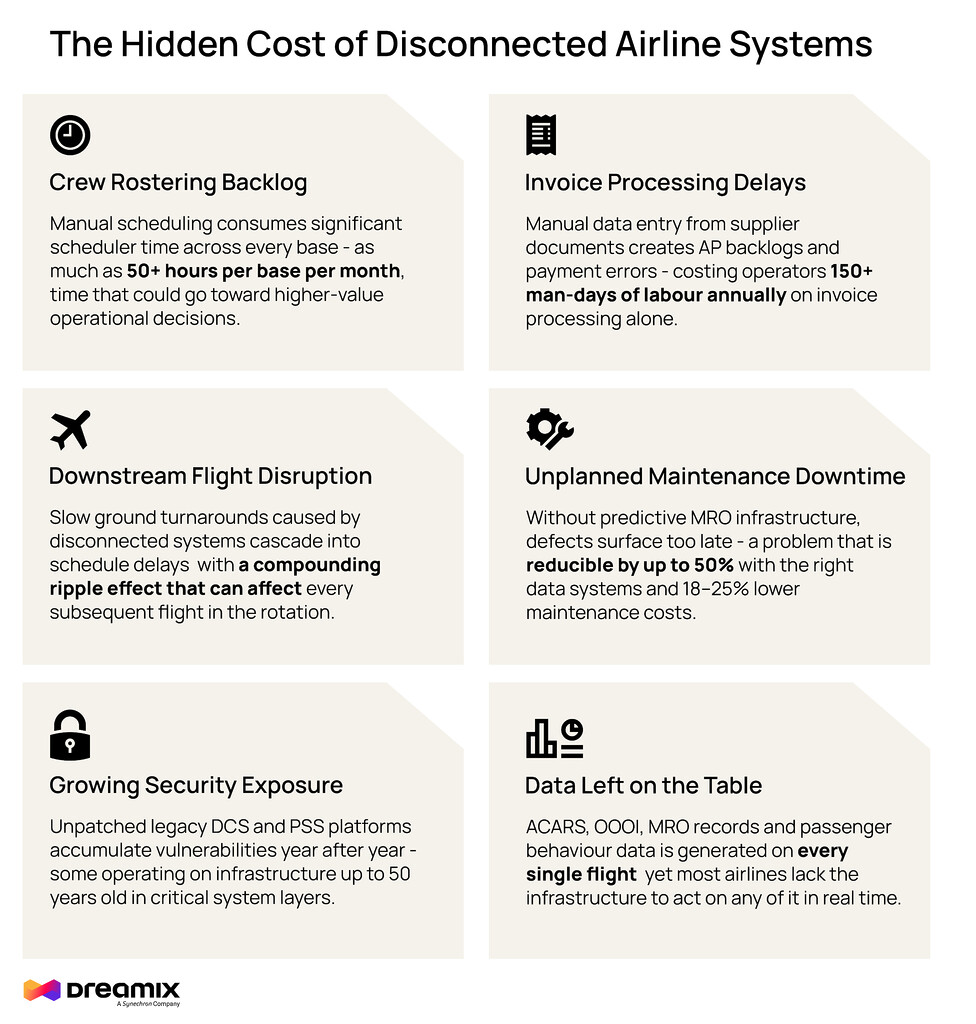
- Slow turnaround times on the ground affect flight schedules downstream.
- Poor resource utilisation across crew, gates and ground equipment.
- Flight disruptions caused by scheduling errors that better-integrated systems would catch in advance.
- Invoice processing backlogs in accounts payable, driven by manual data entry from supplier documents.
- Crew rostering inefficiencies that take schedulers 50+ hours per month per base to manage manually.
These issues rarely stay contained. One delay affects another team. Then it affects another process. And that’s how small inefficiencies become system-wide problems.
A success story from Dreamix:
We worked on automated invoicing in luxury aviation for a global US-based jet charter provider. The Dreamix team built a custom Accounts Payable system. Within three months, the solution saved more than 150 man-days of labour and fully automated 40% of all uploaded invoices. This example shows how targeted automation can reduce errors, accelerate processing and free teams for higher-value operational work.
3. Regulatory compliance and interoperability demands
The aviation industry faces a growing list of regulatory obligations. Compliance is now a major operational design issue, not just a reporting issue.
Some of the most demanding requirements include:
- FF-ICE (Flight and Flow Information for a Collaborative Environment) reshapes how air traffic data is shared across borders within the ATM environment, requiring integration with Eurocontrol and other ANSPs (Air Navigation Service Providers).
- ICAO sustainability mandates are placing new, structured reporting obligations on airlines’ operational data infrastructure.
- EASA EPAS (European Plan for Aviation Safety) is accelerating the pace of safety and compliance evolution across European airspace
I’ve seen teams struggle when compliance is treated as an afterthought. That usually creates more manual work and more operational risk.
To stay compliant, airlines need systems built on strong data standards, capable of integrating with Eurocontrol and other ATM environments and flexible enough to adapt as requirements evolve.
Aviation mechanics and operational engineers often bear the burden of compliance work, while much of it can be automated.
Read next: How to Ensure Aviation Compliance With Software: 2026 Guide
4. Underutilised data
Every flight produces a vast stream of data - from OOOI times and ACARS transmissions to passenger patterns, MRO records, load factors, and ground operations performance.
Most lack the infrastructure to act on it in real time.
These are only some of the missed opportunities for utilising gathered data I can think of:
- Personalised passenger communication and dynamic service offers.
- Predictive aircraft maintenance that reduces deferred maintenance and unplanned downtime.
- GDPR-compliant data sharing with partners without disrupting operational SOPs.
- Real-time data feeds that enable faster responses to flight disruptions and last-minute schedule changes.
- Dynamic pricing and offer construction powered by a Customer 360 view built on NDC-compatible data flows.
How to improve airline operations
Improving airline operations requires a structured, technology-led approach that targets these areas:
- Legacy systems
- Automates manual processes
- Strengthens compliance infrastructure
- Unlocks the value of operational data
Here are my recommendations on how airlines can improve their operations:
1. Modernise legacy systems incrementally
The most sustainable path to aviation digital transformation is incremental modernisation, not wholesale replacement. By using a cloud-first approach, airlines can improve existing systems instead of replacing them. That approach is more practical and less risky.
In practice, this means the following:
- Rebuilding customer engagement platforms layer by layer, replacing outdated interfaces while keeping core data structures intact.
- Integrating third-party solutions such as self-bag drop, autocheck and tap-and-go payment systems via APIs, without requiring a full infrastructure overhaul.
- Migrating to cloud infrastructure progressively, maintaining 95% test coverage and robust security assessments throughout.
This method works well because it protects business continuity.
2. Automate manual workflows
The fastest wins come from targeting the processes that consume the most manual effort.
Key areas for automation include:
- Flight planning and regulatory documentation: Smart automation tools handle routine compliance workflows, freeing aviation mechanics and operations staff for higher-complexity tasks.
- Invoice processing: OCR-based automation can eliminate manual data entry entirely, with documented savings of up to 150+ man-days annually.
- Airport check-in and ground coordination: Mobile apps built for airport environments streamline passenger processing and staff planning, thus reducing errors and improving flight turnaround speed.
Automation works best when it removes friction, not human oversight. The goal here is not to automate everything but to remove slow, repetitive work that drains valuable time.
This is where airlines often see strong cost savings. It is also where they can improve efficiency without waiting years for impact.
Below, you an see the hidden costs of disconnected and siloed airline systems:
3. Invest in crew management and rostering software
Crew management is one of the most operationally complex and cost-sensitive areas in any airline.
Manual rostering is slow and error-prone. Keeping compliant with evolving regulatory frameworks around duty hours, rest periods and certification requirements represents a huge operational challenge for airlines.
But AI-driven roster optimisation has the potential to change the equation. AI-powered tools improve scheduling efficiency. They consider regulations, crew preferences, qualifications and operational demands at the same time. This reduces fatigue, lowers compliance risk and improves crew satisfaction.
Dreamix’s Airline Crew Scheduling Software Accelerator is built specifically for this challenge. It integrates with your existing scheduling, payroll and regulatory frameworks without causing disruptions.
4. Build for regulatory compliance from day one
In aviation, compliance can’t be an afterthought. It needs to be architected into systems from the start.
Best practices for compliance-first airline software development include:
- FF-ICE-ready integrations with Eurocontrol systems that support the shift to collaborative air traffic management.
- Real-time aviation data visualisation tools that support both regulatory reporting and commercial decision making.
- Automated compliance documentation and audit trails that reduce the manual effort involved in demonstrating adherence to ICAO, EASA and IATA standards.
I’ve seen compliance become a serious drag on operations when it is poorly designed. I’ve also seen the opposite. When built properly, compliance becomes an enabler. It supports faster adaptation and better control.
In our latest interview with Carly Waddleton, a Co-Founder and Chief Customer Officer at OneReg, a New Zealand-based aviation compliance platform on why aviation compliance should be built in, not bolted on.
5. Unlock the value of operational data
Airlines that want to improve efficiency must treat data as a strategic asset. However, turning this in action requires a data foundation supporting three core capabilities:
- Customer 360 platforms that consolidate passenger data into a single view, enabling personalised communication that will improve customer experience.
- Integrated data access across operations, finance and customer service, so teams can respond to real-time data signals rather than working from yesterday’s reports.
- GDPR-compliant data frameworks that support airline partnerships and third-party data sharing without creating compliance risk.
For airlines managing flight disruptions, strong data infrastructure changes the game. It’s the difference between reactive damage control and proactive passenger management.
The role of a strategic aviation technology partner
Off-the-shelf software solutions are built for the broadest possible market.
Aviation is not a broad market. It’s a highly specialised, safety-critical and heavily regulated environment where generic tools consistently fall short.
Custom airline operations management software by a partner with deep domain expertise delivers something that catalogue products cannot – a system designed around your workflows, regulatory obligations and integration requirements.
When evaluating a technology partner for aviation, I advise looking at the following qualifiers:
- Domain expertise: Does the team understand DCS architecture, NOTAM data structures, FF-ICE and airport infrastructure standards at an engineering level?
- Stable, experienced teams: High team turnover on long-running aviation programmes introduces risk.
- Regulatory knowledge: Can the partner navigate ICAO, EASA, EUROCONTROL and IATA requirements without slowing development down?
- IATA alignment: Partnership status with IATA signals commitment to industry standards.
Dreamix is an IATA Strategic Partner in Data and Technology. We work directly with aviation stakeholders to challenge norms, develop proof-of-concept solutions and shape the future of the industry.

Real-world example: Modernising aviation data infrastructure
A strong illustration of what this looks like in practice is Dreamix’s partnership with Icelandair to modernise their aviation data infrastructure.
Icelandair came to us with the following challenges:
- fragmented data
- inconsistent reporting
- limited self-service access across teams
We built a modern, scalable data platform that gives teams access to a single, trusted source of truth for faster and more informed decision-making. Business users can now independently access and analyse data, reducing reliance on technical teams and speeding up data analysis.
Conclusion
Knowing how to improve airline operations is one thing; acting on it is another.
I can tell you from experience that the airlines that move forward aren’t those that invest in a single large-scale IT project and call it done.
The real winners are those treating software as an ongoing strategic asset. They continuously modernise their infrastructure, automate costly manual workflows and build the data capabilities needed to operate intelligently in real time.
FAQs about improving airline operations:
Ready to explore how to improve airline operations at your company? Let's discuss how to improve your business processes with the right technology.