

The aviation industry isn’t one to stand still. Quite the contrary: if we compare how much all industries spend on research and development (R&D), aviation is near the top of the list.
Aviation continues to experience robust demand. With that in mind, airlines face new operational challenges around profitability and efficiency while managing increased capacity demands.
How are airlines going to handle this sustained growth and the market expectations that come with it and the market expectations it comes with? In this article, the Dreamix team leans on 20+ years of experience building custom aviation software to talk about aviation trends 2026 is going to present us with. Let’s take a look:
Aviation Software Market Trends: Key Takeaways
- Legacy system integration complexity remains aviation’s primary barrier to AI adoption and operational advancement.
- AI has moved from isolated applications towards coordinated systems embedded in core airline operations.
- Real-time data processing is becoming essential for responsive aviation operations.
- Cybersecurity is now aviation’s top IT priority due to operational dependencies on connected systems.
- Sustainability tracking is shifting from compliance reporting to integrated operational decision-making.
- Airport automation is transforming from premium features to standard passenger processing infrastructure.
Legacy systems are out, clouds are in
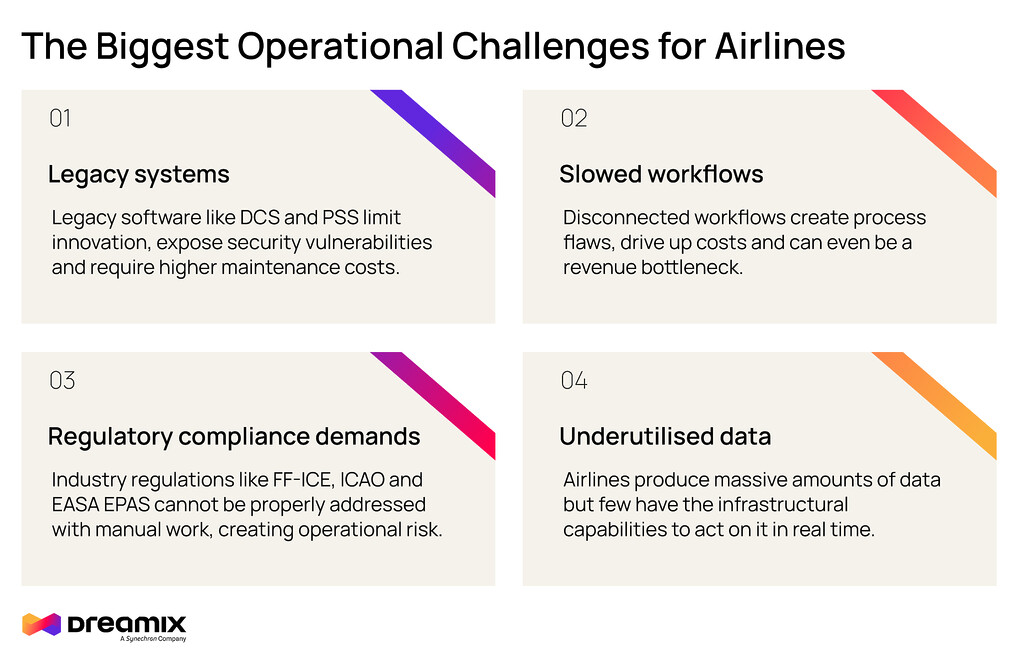
Legacy infrastructure remains one of the biggest barriers to innovation in aviation.
Given that I just talked about aviation as an innovation-rich sector, you’d be surprised by how prevalent legacy systems are. Leading airlines have spent years investing in third-party integrations and proprietary extensions designed to support ageing mainframe infrastructure.
Over time, this has created highly interconnected operational environments that are difficult to modernise without disrupting critical systems.
As a result, many airline operations control ecosystems have effectively become a Gordian Knot of dependencies, leading organisations to adopt an “if it’s not broken, don’t fix it” approach to infrastructure modernisation.
Why is this becoming a larger problem?
The limitations of legacy architecture are becoming obvious as airlines attempt to scale AI-driven and data-centric operations. According to SITA’s IT Insights report, 49% of airlines identify data integration and consistency as the main barriers to scaling AI.
On top of that, maintenance software trends show persistent reliance on decades-old MRO (Maintenance, Repair and Overhaul) databases that contain critical maintenance and compliance records. Fragmented systems reduce interoperability across operational workflows.
How airlines are responding
Rather than replacing entire systems outright, airlines are pursuing gradual modernisation strategies, including:
- Cloud migration
- API-first integration
- Modular architectures
- Middleware layers connecting legacy and modern systems
This approach allows aviation companies to improve resilience and operational flexibility while avoiding the risks associated with full system replacement.
At Dreamix, we specialise in custom aviation software development that bridges legacy systems with modern capabilities, helping airlines modernise operations without disruption.
AI trends in aviation: shift from isolated to coordinated systems
AI in aviation is moving from standalone applications to connected systems. Early deployments focused on predictive alerts, simulation, and in-flight optimisation, where tools operated independently across specific operational functions.
Today, AI is used to connect decisions across systems rather than optimise single processes in isolation. This shift is shaping the future of aviation technology.
Airport AI software trends
According to SITA, airports are applying AI where earlier decisions improve passenger traffic and operational flow. The main uses of AI in airports are listed below:
- 64% use AI for cybersecurity
- 60% use AI for passenger flow management
- 57% use AI for customer service
- 53% use AI for aircraft turnaround
In passenger flow management, AI helps predict crowded areas at important points like check-in, security, boarding, and baggage claim. Instead of reacting to problems, it allows earlier interventions, like staffing adjustments, lane openings or passenger re-routing.
In turnaround operations, AI identifies delays in refuelling, catering and baggage handling. This way, teams can intervene earlier and protect departure schedules.
Despite active adoption, scaling is constrained by fragmented systems and limited data sharing. Many decisions still rely on manual coordination, slowing response times during disruption. As a result, 73% of airports plan to increase AI investment, with 56% prioritising IT and connectivity infrastructure.
Airline AI software trends
Early deployments focused on predictive alerts, flight simulation and in-flight improvements. These applications improved individual functions but operated largely independently across the airline system.
Today, airlines shift toward more coordinated and system-wide use of AI across core operational areas.
Here are some of the airline software trends:
- 63% use AI in operations control: supporting disruption management, aircraft assignment, and crew planning
- 75% use AI in customer service: providing real-time passenger updates and handling routine queries
- 17% use AI in turnaround monitoring: identifying delays in refuelling, catering, and baggage handling
- 17% use AI for cross-system operational adjustments: responding to demand shifts, airport slot constraints, and regulatory changes
Despite this expansion, adoption remains uneven in areas that depend on multi-system coordination. AI is most effective where data is structured within a single environment, and more limited where operational visibility depends on integration across multiple systems and partners.
Identity-based personalisation
Identity-based personalisation ensures that passenger preferences and context persist across systems and touchpoints. To support this, airlines are linking operational and customer environments to deliver timely updates across the passenger journey.
This reflects a broader shift toward integrated data use, where passenger interactions are managed across booking, operations, and post-booking services rather than isolated interfaces.
The popular ONE Order initiative is a great example of using data to improve the passenger journey. If you’re not familiar with the concept, ONE order is intended to be the successor of PNR bookings. It’s an XML-based standard that combines multiple records into a single, customer-focused Order. Such a detailed passenger profile lets airlines tailor their marketing messaging, or even offer personalised and relevant in-flight services.
As integration deepens, passengers can receive real-time updates on delays, gate changes, and connection opportunities with greater consistency and operational alignment.
As a result, airline customer experience is becoming a systems coordination challenge, where service quality depends less on individual interface improvements and more on how effectively backend systems are connected across the travel ecosystem.
Aviation business technology trends: shift to real-time operations
Aviation is shifting from delayed data processing to real-time systems as part of the ongoing digital transformation in aviation.
Aviation business technology trends in 2026 focus on event-driven architecture and unified operational data layers, with 48% of airports planning cross-silo data streaming or synchronisation by 2028.
In practice, this supports real-time operational updates when disruptions occur, including automatic changes to gate assignments, crew schedules, catering, and passenger notifications.
As a result, airport software trends prioritise real-time infrastructure as a core requirement for more predictive and responsive operations.
Cybersecurity evolves into operational resilience
Aviation cybersecurity has moved beyond IT department concerns and has become a core operational priority. It is now crucial for maintaining stable day-to-day operations across interconnected systems.
In SITA’s latest IT Insights report, 71% of airports cite cybersecurity as their top overall IT focus area. The focus has increasingly shifted toward third-party and API ecosystem risks, reflecting the interconnected nature of modern aviation operations.
Problems in the aviation industry stem from cybersecurity vulnerabilities affecting operational systems. As a result, companies are implementing security measures designed to maintain uptime and operational stability while protecting against evolving threats.
Aviation retailing undergoes commercial transformation
Aviation retailing systems are adopting digital commerce models similar to leading e-commerce platforms. This includes dynamic pricing, personalised offer management, and unified retail platforms that replace legacy booking logic.
According to McKinsey research, price represents only 34% of the relative importance in traveller booking decisions. In response, airlines are implementing recommendation engines that suggest relevant services based on passenger behaviour and preferences.
Airport software trends also show growing integration between commercial and operational systems. From parking and lounge access to retail and dining, passengers increasingly receive more relevant and coordinated offers based on their journey context and travel requirements.
Sustainability becomes embedded in data infrastructure
Regulatory pressure is driving widespread adoption of sustainability tracking and reporting systems. Sustainable aviation technology is now primarily a data infrastructure challenge rather than an operational consideration.
Industry reports indicate that 83% of airlines are implementing fleet renewal programs, while 67% are sourcing Sustainable Aviation Fuel (SAF). Emissions tracking and reporting automation systems are being integrated into core operational systems, supporting real-time sustainability monitoring.
Operational efficiency improvements driven by better data analysis generate both cost savings and emissions reductions. Airlines are implementing systems that optimise routes, fuel consumption, and operational procedures based on environmental impact alongside traditional metrics.
Operations control centres embrace automation
Modern operations control centres are becoming semi-autonomous systems with AI-assisted decision-making environments. Predictive disruption detection systems identify potential issues before they affect operations.
How to improve airline operations involves automated coordination suggestions that help human operators manage complex operational scenarios.
McKinsey research shows that each additional minute an aircraft is delayed costs airlines approximately $100, highlighting the financial importance of efficient operations management.
These systems process weather data, air traffic information, crew availability, and passenger loads simultaneously to suggest optimal responses to operational challenges. The human role is shifting from primary decision-maker to supervisor and exception handler.
Airport automation trends reshape ground operations
Infrastructure technology trends are driving comprehensive automation across airport operations. Biometric systems, automated baggage handling, and AI-powered passenger flow management are becoming standard infrastructure rather than premium features.
According to SITA:
- 77% of airports use self-service kiosks
- 63% use automated bag drop systems
- Biometric border control is live at 54% of airports and expected to reach 83% by 2028.
Digital identity systems are evolving rapidly, with 64% of airlines planning to use airline-issued digital identity credentials, representing a shift from reliance on national schemes to airline-controlled passenger identification systems.
Aviation software market challenges in 2026
In addition to the various aviation trends 2026 is presenting us with, several challenges continue to intensify.
Privacy concerns
As we talk about personalisation, we need to remember the flip side of that - namely, an increased risk of privacy concerns. With airlines gathering more information, we look for new and better ways to aggregate, analyse and process it. It’s important to make sure passenger data is handled responsibly and transparently.
Flying green
As I said earlier, air travel is on the rise again. And that’s great, but with people taking to the air again, we need to ask ourselves, “What about the CO2 emissions?”
Global carbon dioxide emissions reached over 930 million metric tons before the pandemic. This was the highest level before the drop in emissions caused by it. As air travel numbers are going back up, so are emissions. By 2050, over 10 billion passengers will be using commercial airlines.
Thankfully, major airlines have committed to carbon-neutral goals. Aer Lingus is working toward achieving net-zero carbon emissions by 2050, and is already introducing more fuel-efficient and quieter aircraft into its fleet.
Furthermore, the sustainable aviation fuel (SAF) market is expected to reach over €30 billion by 2030, and more than €500 billion by 2050. The industry’s unwavering focus on environmental preservation is clear, and it’s something we should keep in mind in our decision-making.
In addition to the obvious moral obligation we share, ESG ratings are a crucial business metric, and penalties for failing to comply can be severe.
Economic pressures on profitability
While nearly half the airlines tracked created positive economic value in recent years, the industry remains fragile and vulnerable to economic uncertainty, geopolitical tensions, and potential imbalances between capacity and demand.
Aircraft shortage impacts operations
McKinsey research indicates that rising passenger demand is meeting with constrained aircraft supply, creating approximately 2,000 global aircraft shortage.
This forces airlines to optimise existing operations through better software rather than expanding fleets.
Data integration complexity
SITA confirms that 62% of airlines cite process and culture transformation as their biggest IT challenge.
The challenge of integrating diverse data sources continues to grow as airlines implement more sophisticated systems.
Final thoughts
The aviation software market trends we’re seeing in 2026 represent a fundamental shift toward operational intelligence. We’ll be faced with the task of meeting increased demand as we work to incorporate groundbreaking technologies, follow existing regulations, and prepare for upcoming compliance standards.
Any challenges we face can be overcome, as long as we approach them strategically and collaboratively. Privacy considerations and sustainability concerns will require careful planning in the near future, and I expect the industry’s commitment to overcoming them will shape its trajectory in the coming years.
FAQs about aviation software market trends
We’d love to hear about your aviation software project and help you meet your business goals as soon as possible.